



Beschrijving
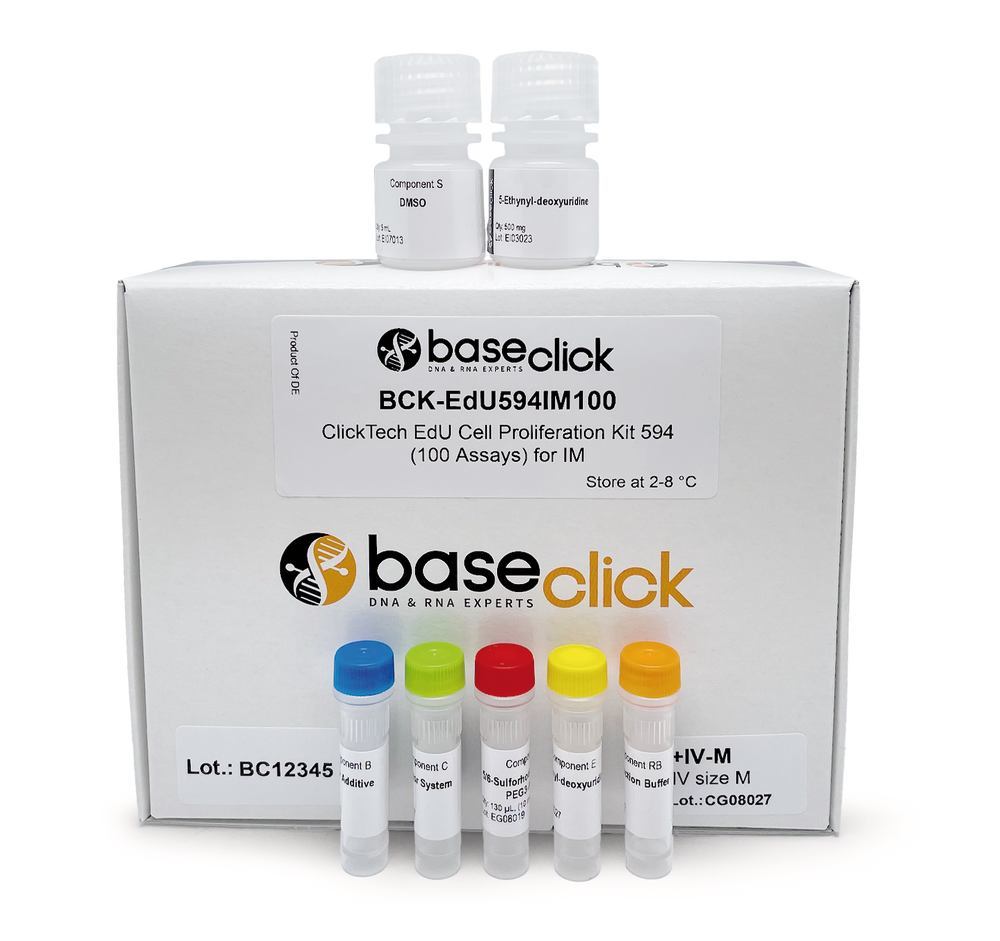
ClickTech EdU Kit 488 is een celproliferatiekit bedoeld voor imaging-toepassingen in vivo. Het behoort tot de ClickTech EdU-familie van reagentia die worden gebruikt in click-chemistry-benaderingen om EdU-incorporatie tijdens DNA-synthese en celproliferatie te detecteren, met een readout gekoppeld aan het 488 fluorescente kanaal. Volgens de productgegevens wordt dit S-formaat geleverd voor in vivo gebruik en bevat het 50 mg extra EdU. De verpakkingsgrootte is 1 kit en het nettogewicht is 0,101 kg. Laboratoria die actief zijn in organische chemicaliën, click-chemistry en celproliferatie-assays kunnen deze kit gebruiken wanneer een op imaging gerichte EdU-workflow in vivo is gespecificeerd. Het product is afkomstig van fabrikant baseclick en is gepositioneerd voor imaging in plaats van high-throughput screening. ClickTech EdU Kit 488 combineert daarom de 488 imaging-aanduiding, de in vivo toepassing en de vermelde extra EdU-hoeveelheid in één eenheid. Deze configuratie past bij experimentele opstellingen die de imaging, in vivo S-variant van de ClickTech EdU 488-kit vereisen, zoals beschreven in de informatie van de fabrikant.
Dit artikel hoort bij Click-chemistry, bioconjugatie & synthesereagentia, in Organische chemicaliën & synthesereagentia.
Belangrijkste kenmerken
- Technisch Informatieblad:

- Veiligheidsinformatieblad:
Compliance & Safety Information

 Waarschuwing
Hazard Statements (H-Phrases)
Precautionary Statements (P-Phrases)
Recent bekeken
Misschien vind je dit ook leuk
Browse related categories
Category
Organic chemicals & synthesis reagents
Sub-category
Click chemistry, bioconjugation & synthesis reagents
Catalogue
Brand
Questions about ClickTech EdU EdU-proliferatiekit voor cellen 488 in vivo, L (1000 mg extra EdU)
What is this article?
ClickTech EdU EdU-proliferatiekit voor cellen 488 in vivo, L (1000 mg extra EdU) is the article on this page. Luminix Health distributes baseclick for laboratory use. It sits in Click chemistry, bioconjugation & synthesis reagents, inside Organic chemicals & synthesis reagents, in Chemicaliën.
Click and bioconjugation reagents join two molecules under mild conditions, often an azide to an alkyne, or an NHS ester to an amine. The linker length and the reactive group are the specification. They are small bottles of a reactive compound, and moisture often ruins them.
An organic chemical is built on carbon. In this category it is a building block or a reagent for making another molecule: a starting material, a coupling agent, a polymer, a PEG. Purity is a specification of which impurities remain. The structure, the CAS number and the grade decide whether two bottles are the same substance. Structures and properties are on PubChem. Nomenclature is IUPAC. Classification follows ECHA and the CLP Regulation.
Which category should I open next?
The category is Organic chemicals & synthesis reagents. The sub-category is Click chemistry, bioconjugation & synthesis reagents. The catalogue is Chemicaliën.
Shelves beside this one are Organic building blocks & synthesis reagents and Polymers, PEGs & silicones.
What should I check before I order?
The technical information on this page is the manufacturer's sheet. Read that, not a rewritten specification.
When this page shows a safety data sheet, use that manufacturer file. Hazard text does not belong in the sales description. For a pack size, a grade or a certificate that is not on the page, send a quote request or contact the team.
How does ordering and shipping work?
Luminix Health distributes this article from the heart of Europe. Articles in stock ship within 2–5 business days. Standard delivery is free from €250 excl. VAT. Cold-chain goods and dangerous goods under ADR are never included in that free delivery. The terms are in the Shipping Policy. The full brand index is on shop by brand. Who we are is on about us.
Which other categories should I open?
The seven catalogues are Labware, Lab chemicals, Lab instruments, Lab consumables, Chromatography equipment, Lab safety equipment and Life Science & Microbiology.