


Beschrijving
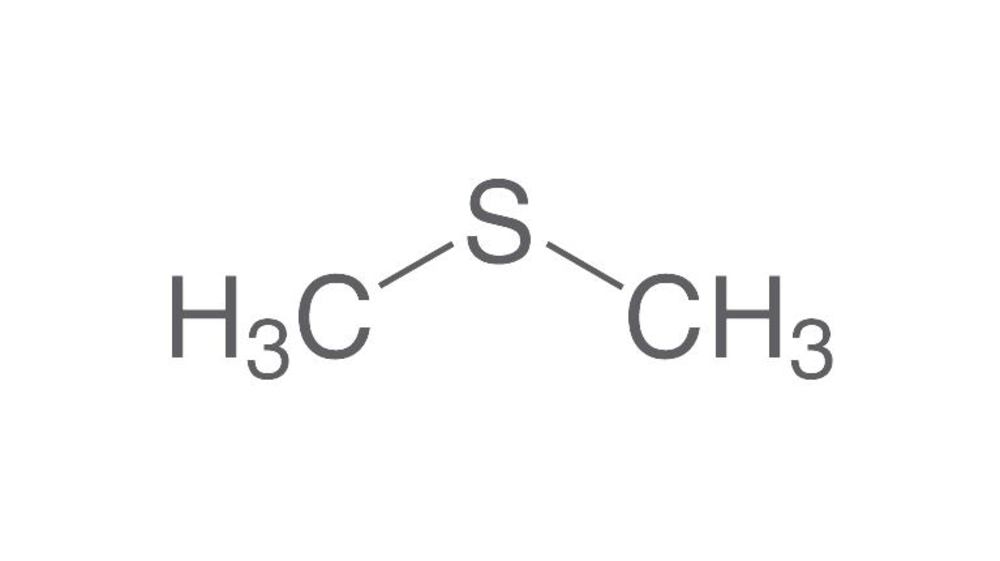
Dimethylsulfide is een organozwaveldervaat dat met een zuiverheid van minimaal 99 % wordt aangeboden voor synthese. Het heeft CAS-nummer 75-18-3 en de brutoformule C₂H₆S, met een molaire massa van 62,14 g/mol en een dichtheid van 0,85 g/cm³. Het kookpunt is 37,3 °C en het vlampunt ligt onder de −30 °C; daarom zijn temperatuurregeling en de juiste laboratoriumpraktijken essentieel tijdens het overbrengen en het opzetten van reacties. Dit vluchtige sulfide wordt in de synthetische chemie gebruikt als zwavelhoudende bouwsteen en procesreagens waar een dimethylsulfidebron met een hoog gehalte is vereist. Gedocumenteerde fysische gegevens ondersteunen dosering, controles op oplosmiddelcompatibiliteit en planning voor veilig gebruik. Dimethylsulfide van fabrikant Carl ROTH (EG-nr. 200-846-2) past in onderzoeks- en syntheseomgevingen die een duidelijk gespecificeerde C₂-thioether van synthesekwaliteit vereisen.
Dit artikel hoort bij Anorganische zouten, in Anorganische chemicaliën.
Belangrijkste kenmerken
- Gehalte: ≥99 %
- CAS-nummer: 75-18-3
- Verpakkingsgrootten: 100 ml, 250 ml, 500 ml
- EG-nr.: 200-846-2
- Zuiverheid: min. 99 %
- Molaire massa: 62,14 g/mol
- Technisch informatieblad:

- Veiligheidsinformatieblad:
Compliance & Safety Information
 Gevaar
Hazard Statements (H-Phrases)
Precautionary Statements (P-Phrases)
Recent bekeken
Misschien vind je dit ook leuk
Browse related categories
Category
Sub-category
Catalogue
Brand
Questions about Dimethylsulfide, min. 99%, voor synthese, 100 ml, glas
What is this article?
Dimethylsulfide, min. 99%, voor synthese, 100 ml, glas is the article on this page. Luminix Health distributes Carl Roth for laboratory use. It sits in Inorganic salts, inside Inorganic chemicals, in Chemicaliën.
An inorganic salt is an ionic solid, a chloride, a sulfate, a nitrate, a phosphate. The degree of hydration changes the mass that contains one mole of the ion. Analytical grade limits the foreign ions. A hydrate and the anhydrous salt are not interchangeable by weight.
An inorganic chemical is a salt, an acid or base in solid form, a metal, an oxide, or an element. The waters of hydration are part of the formula: a hydrate and an anhydrous salt are different masses for the same ion. Trace metals matter when the salt will be used in analysis. Nanomaterials add particle size to the specification. Look the substance up on PubChem. Hazard classes are on ECHA, under the CLP Regulation and REACH. Transport of the dangerous ones is explained by the UNECE.
Which category should I open next?
The category is Inorganic chemicals. The sub-category is Inorganic salts. The catalogue is Chemicaliën.
Shelves beside this one are Metals, elements & oxides and Nanomaterials & quantum dots.
What should I check before I order?
When this page shows a safety data sheet, use that manufacturer file. Hazard text does not belong in the sales description. For a pack size, a grade or a certificate that is not on the page, send a quote request or contact the team.
How does ordering and shipping work?
Luminix Health distributes this article from the heart of Europe. Articles in stock ship within 2–5 business days. Standard delivery is free from €250 excl. VAT. Cold-chain goods and dangerous goods under ADR are never included in that free delivery. The terms are in the Shipping Policy. The full brand index is on shop by brand. Who we are is on about us.
Which other categories should I open?
The seven catalogues are Labware, Lab chemicals, Lab instruments, Lab consumables, Chromatography equipment, Lab safety equipment and Life Science & Microbiology.