
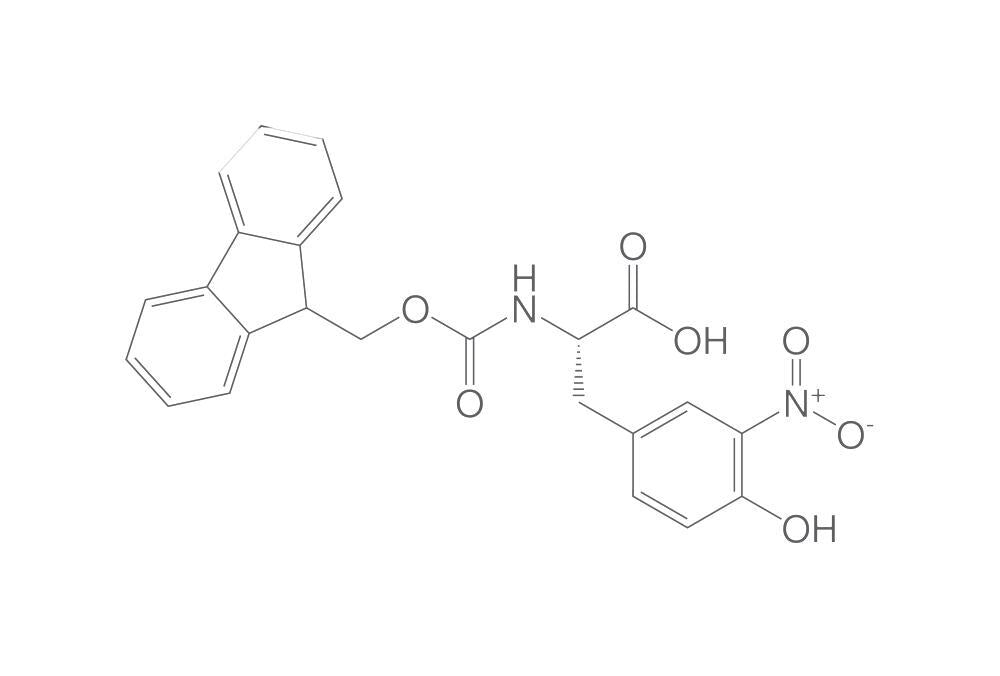


Beschrijving
Fmoc-3-nitro-L-tyrosine is een Fmoc-beschermd aromatisch aminozuurderivaat, geleverd met een minimale zuiverheid van 95 % voor geavanceerde peptide- en biochemische synthese. Met CAS-nummer 136590-09-5, empirische formule C₂₄H₂₀N₂O₇ en molaire massa 448.42 g/mol voert het een 3-nitro-gesubstitueerd tyrosine-residu in in Fmoc-sequenties in de vaste fase of in oplossing. De nitrogroep verruimt de mogelijkheden voor modificatie na assemblage, spectroscopische labeling en structuur-activiteitsonderzoek van tyrosinebevattende peptiden. Fysische gegevens omvatten een vlampunt van 379.8 °C en een kookpunt van 704.4 °C. Onderzoeksgroepen die werken aan modellen van oxidatieve stress, nitratienabootsingen of gefunctionaliseerde peptidescaffolds kunnen dit bouwsteen inbouwen onder standaard Fmoc-koppelingsomstandigheden. Het is bedoeld voor laboratoriumgebruik in werkstromen voor chemicaliën en biochemicaliën die een goed gedefinieerd nitro-tyrosine-Fmoc-reagens met transparante identiteitsgegevens vereisen.
Dit artikel maakt deel uit van Klikchemie, bioconjugatie & synthesereagentia, in Biochemicaliën & reagentia.
Kenmerken
- Gehalte: ≥ 95 %
- Kleur: gerapporteerd
- Vorm: gerapporteerd
- CAS-nummer: 136590-09-5
- Verpakkingsgroottes: 10 g, 25 g, 50 g
- Zuiverheid: min. 95 %
- Brutoformule: C₂₄H₂₀N₂O₇
- Molaire massa: 448.42 g/mol
- Vlampunt: 379.8 °C
- Kookpunt: 704.4 °C
- Technisch datablad:

- Veiligheidsinformatieblad:
Compliance & Safety Information
 Waarschuwing
Hazard Statements (H-Phrases)
Recent bekeken
Misschien vind je dit ook leuk
Browse related categories
Category
Sub-category
Klikchemie, bioconjugatie & synthesereagentia
Catalogue
Brand
Questions about Fmoc-3-nitro-L-tyrosine, min. 95 %, 10 g
What is this article?
Fmoc-3-nitro-L-tyrosine, min. 95 %, 10 g is the article on this page. Luminix Health distributes Carl Roth for laboratory use. It sits in Klikchemie, bioconjugatie & synthesereagentia, inside Biochemicaliën & reagentia, in Microbiologische media.
Click and bioconjugation reagents join two molecules under mild conditions, often an azide to an alkyne, or an NHS ester to an amine. The linker length and the reactive group are the specification. They are small bottles of a reactive compound, and moisture often ruins them.
A biochemical is a molecule of life, sold as a reagent: an amino acid, a sugar, a nucleotide, a lipid, an enzyme, an antibiotic. The difference from a bulk chemical is that the use is a biological one, and the impurities that matter are the ones that change that use. An enzyme is specified by activity, not only by mass. An antibiotic is specified by potency. Papers are on PubMed. Structures are on PubChem. Strains and lines that consume these reagents are at ATCC.
Which category should I open next?
The category is Biochemicaliën & reagentia. The sub-category is Klikchemie, bioconjugatie & synthesereagentia. The catalogue is Microbiologische media.
Shelves beside this one are Aminozuren & peptiden, Koolhydraten & suikers, Co-enzymen, nucleotiden & vitaminen, Biochemicaliën (overig), Enzymen & substraten, Antibiotica & antimycotica, Lipiden, steroïden & vetzuren and Detergenten & oppervlakteactieve stoffen.
What should I check before I order?
When this page shows a safety data sheet, use that manufacturer file. Hazard text does not belong in the sales description. For a pack size, a grade or a certificate that is not on the page, send a quote request or contact the team.
How does ordering and shipping work?
Luminix Health distributes this article from the heart of Europe. Articles in stock ship within 2–5 business days. Standard delivery is free from €250 excl. VAT. Cold-chain goods and dangerous goods under ADR are never included in that free delivery. The terms are in the Shipping Policy. The full brand index is on shop by brand. Who we are is on about us.
Which other categories should I open?
The seven catalogues are Labware, Lab chemicals, Lab instruments, Lab consumables, Chromatography equipment, Lab safety equipment and Life Science & Microbiology.