



Beschrijving
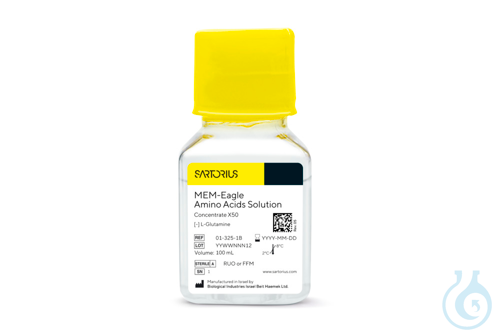
MEM-Eagle Amino Acids Solution X50 is a concentrated cell-culture supplement formulated to support the growth and propagation of a wide spectrum of cell types under controlled laboratory conditions. Supplied as a convenient 100 ml unit, this X50 solution supplies the essential amino acids required for preparing and fortifying MEM-based media. It is intended for research and bioprocessing workflows in which reliable nutrient supplementation is needed to maintain cell viability, promote expansion and improve experimental reproducibility. The preparation integrates readily into standard media-preparation routines and helps reduce variability associated with incomplete formulations. Produced by manufacturer Sartorius, the solution is suitable for both routine maintenance and more specialised culture protocols involving diverse mammalian and other cell lines. With a net weight of 0,010 kg, the compact pack is easy to handle and store within typical laboratory inventories. Laboratories use this amino-acid concentrate to optimise culture performance, support adherent or suspension systems and ensure balanced nutritional conditions throughout extended culture periods without resorting to complex custom blends.
This article is part of Click chemistry, bioconjugation & synthesis reagents, in Biochemicals & reagents.
Key features
- Pack size: 100 ml
- Storage temperature: 2–8 °C
- Product type: MEM-Eagle amino acids solution
- Concentration: X50
Recent bekeken
Misschien vind je dit ook leuk
Browse related categories
Category
Sub-category
Click chemistry, bioconjugation & synthesis reagents
Catalogue
Brand
Questions about MEM Amino Acids Solution 50X 100ML
What is this article?
MEM Amino Acids Solution 50X 100ML is the article on this page. Luminix Health distributes Sartorius for laboratory use. It sits in Click chemistry, bioconjugation & synthesis reagents, inside Biochemicals & reagents, in Microbiologische media.
Click and bioconjugation reagents join two molecules under mild conditions, often an azide to an alkyne, or an NHS ester to an amine. The linker length and the reactive group are the specification. They are small bottles of a reactive compound, and moisture often ruins them.
A biochemical is a molecule of life, sold as a reagent: an amino acid, a sugar, a nucleotide, a lipid, an enzyme, an antibiotic. The difference from a bulk chemical is that the use is a biological one, and the impurities that matter are the ones that change that use. An enzyme is specified by activity, not only by mass. An antibiotic is specified by potency. Papers are on PubMed. Structures are on PubChem. Strains and lines that consume these reagents are at ATCC.
Which category should I open next?
The category is Biochemicals & reagents. The sub-category is Click chemistry, bioconjugation & synthesis reagents. The catalogue is Microbiologische media.
Shelves beside this one are Amino acids & peptides, Carbohydrates & sugars, Coenzymes, nucleotides & vitamins, Biochemicals (other), Enzymes & substrates, Antibiotics & antimycotics, Lipids, steroids & fatty acids and Detergents & surfactants.
What should I check before I order?
When this page shows a safety data sheet, use that manufacturer file. Hazard text does not belong in the sales description. For a pack size, a grade or a certificate that is not on the page, send a quote request or contact the team.
How does ordering and shipping work?
Luminix Health distributes this article from the heart of Europe. Articles in stock ship within 2–5 business days. Standard delivery is free from €250 excl. VAT. Cold-chain goods and dangerous goods under ADR are never included in that free delivery. The terms are in the Shipping Policy. The full brand index is on shop by brand. Who we are is on about us.
Which other categories should I open?
The seven catalogues are Labware, Lab chemicals, Lab instruments, Lab consumables, Chromatography equipment, Lab safety equipment and Life Science & Microbiology.