


Beschrijving
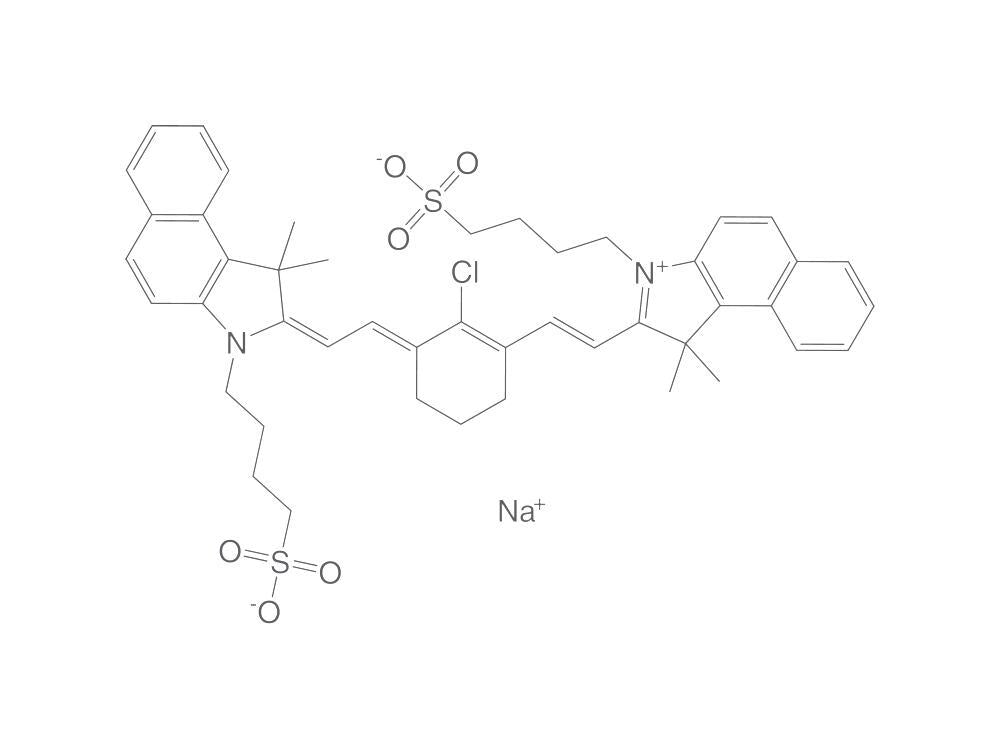
NIR-820 Heptamethine-Cyanine natriumzout is een polymethinekleurstof die als cyanine-natriumzout wordt geleverd voor nabij-infrarood optisch werk. Het heeft CAS-nummer 172616-80-7, de brutoformule C₄₆H₅₀ClN₂NaO₆S₂ en een molaire massa van 849,48 g/mol. In methanol vertoont de kleurstof een absorptiemaximum bij 820 nm, waardoor deze stevig in het NIR-venster valt dat wordt gebruikt voor beeldvorming, detectie en spectroscopische studies. Het materiaal behoort tot de familie van heptamethine-cyanines. Fysieke en spectrale gegevens van fabrikant Carl ROTH ondersteunen het gebruik ervan in de kleurstofchemie, fluorescentiegerelateerd onderzoek en de ontwikkeling van NIR-actieve labels. Onderzoekers die met polymethinekleurstoffen werken, zullen de gedefinieerde absorptiegolflengte en de goed gekarakteriseerde molecuulformule nuttig vinden voor methodeontwikkeling en vergelijkende studies in het bereik van zichtbaar licht tot NIR.
Dit artikel hoort thuis bij Fluorescerende kleurstoffen & labels, in Kleurstoffen, vloeistoffen & indicatoren.
Belangrijkste kenmerken
- CAS-nummer: 172616-80-7
- Verpakkingsgroottes: 1 g, 5 g, 10 g
- EG-nr.: 812-320-5
- Brutoformule: C₄₆H₅₀ClN₂NaO₆S₂
- Molaire massa: 849,48 g/mol
- Technisch informatieblad:

- Veiligheidsinformatieblad:
Compliance & Safety Information
 Waarschuwing
Hazard Statements (H-Phrases)
Recent bekeken
Misschien vind je dit ook leuk
Browse related categories
Category
Kleurstoffen, kleuringen & indicatoren
Sub-category
Fluorescerende kleurstoffen & labels
Catalogue
Brand
Questions about S 0306 - FEW Chemicals, 820 nm in MeOH, 1 g, glas
What is this article?
S 0306 - FEW Chemicals, 820 nm in MeOH, 1 g, glas is the article on this page. Luminix Health distributes Carl Roth for laboratory use. It sits in Fluorescerende kleurstoffen & labels, inside Kleurstoffen, kleuringen & indicatoren, in Chemicaliën.
A fluorescent dye absorbs at one wavelength and emits at a longer one. As a label it is attached to a protein, a nucleic acid or a cell. Excitation and emission maxima, and the reactive group if it must conjugate, are the specification. The colour name does not tell you the wavelengths.
A dye or a stain binds, or changes colour, so that something invisible becomes visible. An indicator changes at a pH or a redox point. A fluorescent dye absorbs one wavelength and emits another, which is how a microscope or a plate reader picks it out. The excitation and emission, or the transition interval, are the specification. The colour name on the label is not. Structures are on PubChem under IUPAC names. Methods are in the PubMed literature.
Which category should I open next?
The category is Kleurstoffen, kleuringen & indicatoren. The sub-category is Fluorescerende kleurstoffen & labels. The catalogue is Chemicaliën.
Shelves beside this one are Microscopiekleurstoffen & kleuroplossingen and Kleurstoffen & pigmenten.
What should I check before I order?
When this page shows a safety data sheet, use that manufacturer file. Hazard text does not belong in the sales description. For a pack size, a grade or a certificate that is not on the page, send a quote request or contact the team.
How does ordering and shipping work?
Luminix Health distributes this article from the heart of Europe. Articles in stock ship within 2–5 business days. Standard delivery is free from €250 excl. VAT. Cold-chain goods and dangerous goods under ADR are never included in that free delivery. The terms are in the Shipping Policy. The full brand index is on shop by brand. Who we are is on about us.
Which other categories should I open?
The seven catalogues are Labware, Lab chemicals, Lab instruments, Lab consumables, Chromatography equipment, Lab safety equipment and Life Science & Microbiology.