


Beschrijving
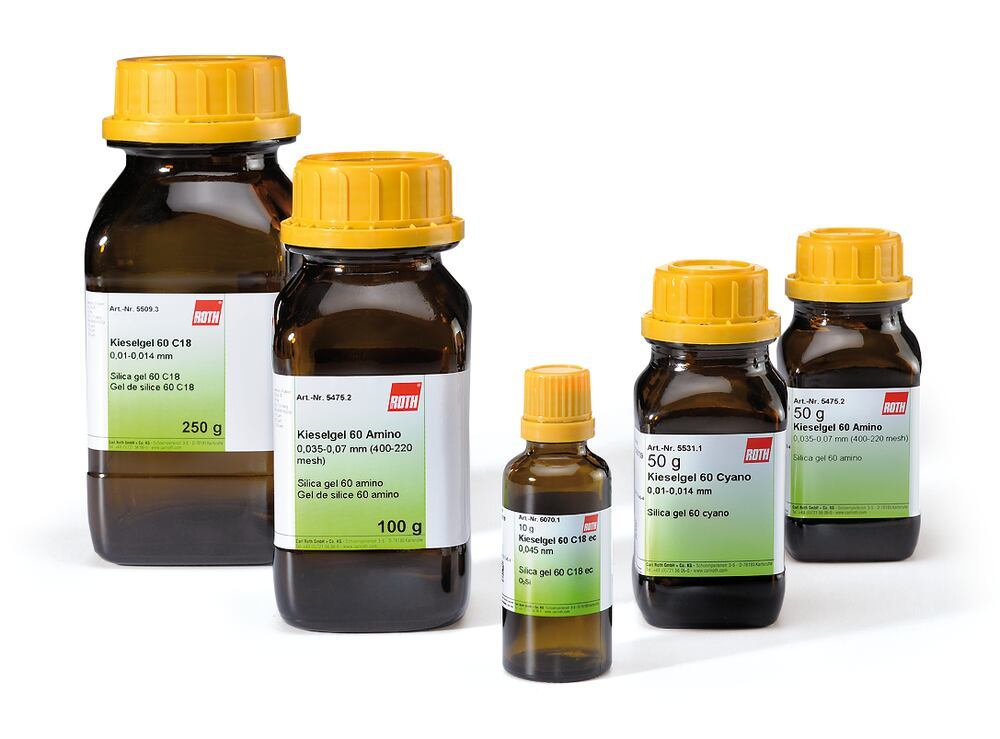
Silicagel 60 C₁₈ is een octadecyl-gefunctionaliseerde chromatografische silicagel met een deeltjesgrootte van 0,035-0,07 mm (400-220 mesh), CAS-nummer 7631-86-9 en de empirische formule SiO₂. Het heeft een molaire massa van 60,09 g/mol en een dichtheid van 2,1 tot 2,2 g/cm³, wat een goed gedefinieerde reversed-phase stationaire fase voor laboratoriumgebruik oplevert. C₁₈-gebonden Silicagel 60 wordt op grote schaal toegepast voor hydrofobe retentie van niet-polaire en matig polaire analyten in reversed-phase scheidingen. Laboratoria gebruiken dit materiaal voor de zuivering van organische verbindingen, natuurproductfracties en farmaceutische tussenproducten waarbij de oppervlaktechemie met lange alkylketens zorgt voor een sterke niet-polaire interactie. Het product van fabrikant Carl ROTH koppelt het beproefde Silicagel 60-dragersysteem aan een C₁₈-modificatie en een nauwe specificatie van 400-220 mesh voor een consistente bedvorming en doorstroming. Het ondersteunt onderzoeks-, preparatieve en kwaliteitscontroleworkflows die reproduceerbare deeltjesgrootte vereisen in combinatie met gedocumenteerde dichtheids- en molaire-massagegevens voor routinematige chromatografische praktijken.
Dit artikel hoort bij Sorbenten, silicagel & ionenwisselaars, in SPE & monster voorbereiding.
Belangrijkste kenmerken
- Uiterlijk: wit poeder
- Poriendiameter: 53-80 Å
- Specifiek oppervlak: 500-600 m²/g
- Koolstofgehalte: 16,0-18,4 %
- d50: 47,0-60,0 µm
- CAS-nummer: 7631-86-9
- Verpakkingsgrootten: 50 g, 100 g, 250 g
- EG-nr.: 231-545-4
- Empirische formule: SiO₂
- Molaire massa: 60,09 g/mol
- Technisch informatieblad:

- Veiligheidsinformatieblad:
Recent bekeken
Misschien vind je dit ook leuk
Browse related categories
Category
Sub-category
Sorbents, silica gel & ion exchangers
Catalogue
Brand
Questions about Silicagel 60 C18, 0,035-0,07 mm (400-220 mesh), 50 g, glas
What is this article?
Silicagel 60 C18, 0,035-0,07 mm (400-220 mesh), 50 g, glas is the article on this page. Luminix Health distributes Carl Roth for laboratory use. It sits in Sorbents, silica gel & ion exchangers, inside SPE & sample preparation, in Chromatografie.
Loose sorbent, silica gel and ion-exchange resin are the phases bought in bulk to pack a column or to stir into a solution. Particle size and activity, or the ion-exchange capacity, are the specification. A TLC silica and a flash silica of different particle sizes are not the same separation.
Solid-phase extraction holds a compound on a sorbent while the rest of the sample is washed away, then releases it in a small volume. The sorbent, the bed mass and the solvents are the method. Silica, ion exchangers and polymer phases do different jobs. A flash column is the same idea scaled toward purification rather than trace cleanup. The molecules are on PubChem, named by IUPAC.
Which category should I open next?
The category is SPE & sample preparation. The sub-category is Sorbents, silica gel & ion exchangers. The catalogue is Chromatografie.
Shelves beside this one are SPE cartridges & columns and Flash, empty & glass chromatography columns.
What should I check before I order?
The technical information on this page is the manufacturer's sheet. Read that, not a rewritten specification.
When this page shows a safety data sheet, use that manufacturer file. Hazard text does not belong in the sales description. For a pack size, a grade or a certificate that is not on the page, send a quote request or contact the team.
How does ordering and shipping work?
Luminix Health distributes this article from the heart of Europe. Articles in stock ship within 2–5 business days. Standard delivery is free from €250 excl. VAT. Cold-chain goods and dangerous goods under ADR are never included in that free delivery. The terms are in the Shipping Policy. The full brand index is on shop by brand. Who we are is on about us.
Which other categories should I open?
The seven catalogues are Labware, Lab chemicals, Lab instruments, Lab consumables, Chromatography equipment, Lab safety equipment and Life Science & Microbiology.