


Beschrijving
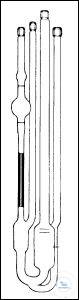
Ubbelohde-viscosimeter 1000-10000 mm²/s is een capillair glazen instrument van het DIN-type voor de bepaling van de kinematische viscositeit in het laboratorium. Het draagt een gedrukte constante overeenkomstig ISO/DIN 3105, DIN 51502 en BS 188 en is aangeduid als maat Nr. IV met capillaire constante K 10. De inwendige diameter is 3.6 mm, passend bij het meetbereik 1000-10000 mm²/s voor monsters met hogere viscositeit. Dit ongekalibreerde, vierbenige ontwerp ondersteunt stabiele onderdompeling tijdens getimede stromingsmetingen onder gecontroleerde badomstandigheden. Geleverd als één stuk met een nettogewicht van 0.081 kg, past de viscosimeter in routinematige werkstromen voor kwaliteitscontrole en onderzoek die de vastgestelde praktijk van capillaire viscosimetrie volgen. Het instrument van fabrikant Witeg is bedoeld voor gebruik met geschikte thermostatische apparatuur en timingmethoden die typisch zijn voor Ubbelohde-procedures. De vierbenige constructie helpt bij de positionering in het bad, terwijl de gedrukte constante de berekening van de kinematische viscositeit uit gemeten uitstroomtijden mogelijk maakt zodra de kalibratiestatus van het laboratorium en de temperatuuromstandigheden zijn gedefinieerd. Laboratoria kunnen deze maat integreren in een bestaande Ubbelohde-reeks wanneer de constante K 10 en de boring van 3.6 mm vereist zijn voor het venster 1000-10000 mm²/s.
Dit artikel maakt deel uit van Viscometers, in Dichtheids- & viscositeitsmeting.
Kenmerken
- Verpakkingsgrootte: 1 stuk
- Type: DIN Ubbelohde-viscosimeter, vierbenig
- Maataanduiding: Nr. IV
- Meetbereik: 1000-10000 mm²/s
- Capillaire constante K: 10
- Binnendiameter: 3.6 mm
Recent bekeken
Misschien vind je dit ook leuk
Vragen over Ubbelohde-viscosimeter 1000-10000mm²/s
Wat is dit artikel?
Ubbelohde-viscosimeter 1000-10000mm²/s is het artikel op deze pagina. Luminix Health verdeelt Witeg voor laboratoriumgebruik. Het hoort bij Viscometers, binnen Dichtheids- & viscositeitsmeting, in Instrumenten.
Een capillaire viscosimeter meet de doorlooptijd van een vloeistof door een buis. Een rotatieviscosimeter draait een spindel in de vloeistof. Beide vragen een opgegeven temperatuur. Kinematische en dynamische viscositeit zijn verschillende getallen. De capillairmaat moet de doorlooptijd binnen het bereik brengen dat de methode toelaat.
Dichtheid is massa gedeeld door volume. Een areometer drijft op een diepte die afhangt van de dichtheid van de vloeistof. Een pyknometer is een recipiënt met gekend volume dat vol gewogen wordt. Viscositeit is de weerstand tegen stromen. Een capillaire viscosimeter meet hoe lang een volume nodig heeft om door een buis te zakken. Beide metingen vragen een opgegeven temperatuur, omdat dichtheid en viscositeit veranderen als een vloeistof opwarmt. De eenheden zijn herleidbaar naar het BIPM en NIST.
Welke categorie bekijk ik hierna?
De categorie is Dichtheids- & viscositeitsmeting. De subcategorie is Viscometers. De catalogus is Instrumenten.
Verwante categorieën zijn Hydrometers en Dichtheidsmeters & pyknometers.
Wat controleer ik voor ik bestel?
Staat er een veiligheidsinformatieblad op deze pagina, gebruik dan dat document van de fabrikant. Gevarenteksten horen niet in de verkoopbeschrijving. Zoek je een verpakking, kwaliteit of certificaat dat hier niet staat? Stuur een offerteaanvraag of contacteer het team.
Hoe werkt bestellen en verzenden?
Luminix Health levert dit artikel vanuit het hart van Europa. Artikelen op voorraad vertrekken binnen 2–5 werkdagen. Standaardlevering is gratis vanaf €250 excl. btw. Koelketen en gevaarlijke goederen onder het ADR vallen nooit onder die gratis levering. De voorwaarden staan in het verzendbeleid. De volledige merkenindex staat bij shop by brand. Wie we zijn, lees je op over ons.
Welke andere catalogi open ik?
De zeven catalogi zijn Labmateriaal, Chemicaliën, Instrumenten, Verbruiksartikelen, Chromatografie, Veiligheid en Microbiologische media. Staat het artikel niet op het schap, vraag een offerte.