
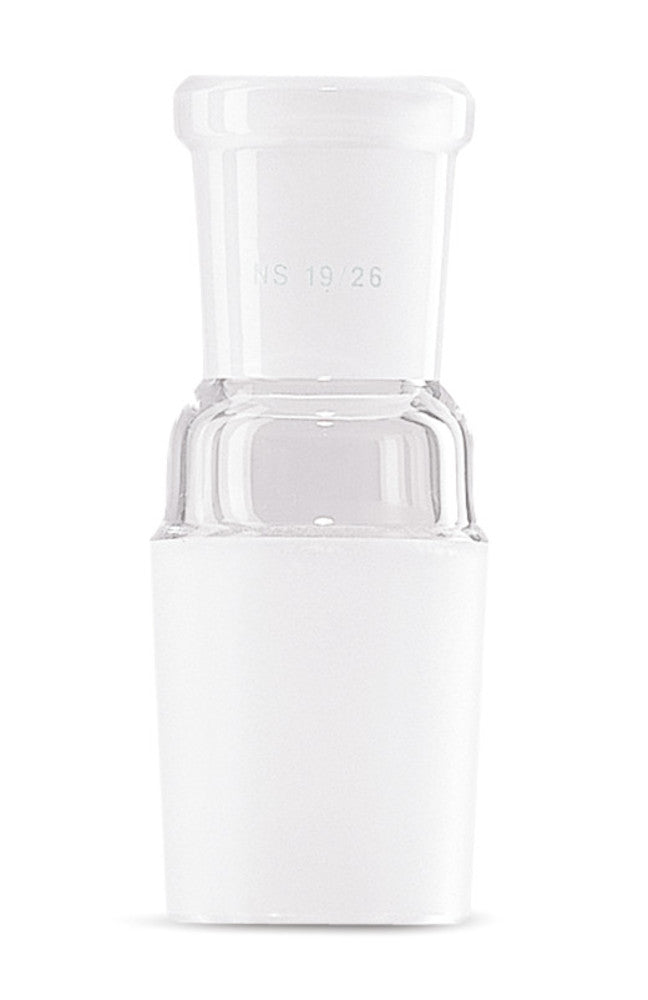



Beschrijving
Reductieadapter met standaard slijpstuk biedt een betrouwbare overgang tussen verschillende maten geslepen glasverbindingen in laboratoriumopstellingen voor destillatie, extractie en reactie. Gemaakt van DURAN®-glas, combineert deze adapter een hulsslijpstuk NS 29/32 met een kernslijpstuk NS 24/29, zodat grotere apparaathalsen veilig aan tussenliggende slijpstukmaten kunnen worden gekoppeld. De geslepen oppervlakken ondersteunen een nauwe mechanische passing voor damp- en vloeistofoverdracht onder typische laboratoriumomstandigheden. Aangeboden als één stuk met een gewicht van 0.05 kg, is het component geschikt voor modulaire glaswerkreeksen in analytische, preparatieve en onderwijslaboratoria. Van fabrikant Lenz past de adapter bij gevestigde DURAN®-slijpstukconventies en helpt hij de systeemintegriteit te behouden zonder extra adapters of stukken op maat. Hij is ingedeeld bij glascomponenten met slijpstukken voor destillatie- en extractiewerk. Nauwkeurige NS-maten ondersteunen een eenvoudige voorraadkoppeling en vervanging in meerdelige slijpstukopstellingen die in de dagelijkse laboratoriumpraktijk worden gebruikt.
Dit artikel maakt deel uit van Slangverbinders, adapters & fittingen, in Slangen, leidingen & koppelingen.
Kenmerken
- Verpakkingsgrootte: 1 stuk
- Producttype: Reduceeradapter met standaard slijpstuk
- Materiaal: DURAN®-glas
- Manchonslijpstuk: NS 29/32
- Kernslijpstuk: NS 24/29
- Gewicht: 0.05 kg
Recent bekeken
Misschien vind je dit ook leuk
Browse related categories
Category
Slangen, leidingen & koppelingen
Sub-category
Slangverbinders, adapters & fittingen
Catalogue
Brand
Questions about Reductieadapter, m. stand. slijpstuk, DURAN®, huls 29/32, kern 24/29
What is this article?
Reductieadapter, m. stand. slijpstuk, DURAN®, huls 29/32, kern 24/29 is the article on this page. Luminix Health distributes Lenz for laboratory use. It sits in Slangverbinders, adapters & fittingen, inside Slangen, leidingen & koppelingen, in Labmateriaal.
A hose connector or adapter joins two lines, or steps one bore down to another. The barb diameter has to match the tube, and the thread has to match the stopcock or the bottle. Most leaks are a mismatch here, not a hole in the tube.
Tubing is how a liquid or a gas moves between two vessels without being poured. Silicone stays flexible and survives repeated autoclaving. PTFE resists almost every solvent and is stiff. PVC is the ordinary flexible line for water and for mild aqueous work. The fitting, not the tube, is what usually leaks: the barb, the thread and the stopcock have to match the tube bore. Glass and plastic apparatus around these lines is indexed under ISO laboratory ware.
Which category should I open next?
The category is Slangen, leidingen & koppelingen. The sub-category is Slangverbinders, adapters & fittingen. The catalogue is Labmateriaal.
Shelves beside this one are PVC-, PTFE- & overige slangen, Kranen & ventielen, Siliconenslang and Slangaccessoires.
What should I check before I order?
The technical information on this page is the manufacturer's sheet. Read that, not a rewritten specification.
When this page shows a safety data sheet, use that manufacturer file. Hazard text does not belong in the sales description. For a pack size, a grade or a certificate that is not on the page, send a quote request or contact the team.
How does ordering and shipping work?
Luminix Health distributes this article from the heart of Europe. Articles in stock ship within 2–5 business days. Standard delivery is free from €250 excl. VAT. Cold-chain goods and dangerous goods under ADR are never included in that free delivery. The terms are in the Shipping Policy. The full brand index is on shop by brand. Who we are is on about us.
Which other categories should I open?
The seven catalogues are Labware, Lab chemicals, Lab instruments, Lab consumables, Chromatography equipment, Lab safety equipment and Life Science & Microbiology.