
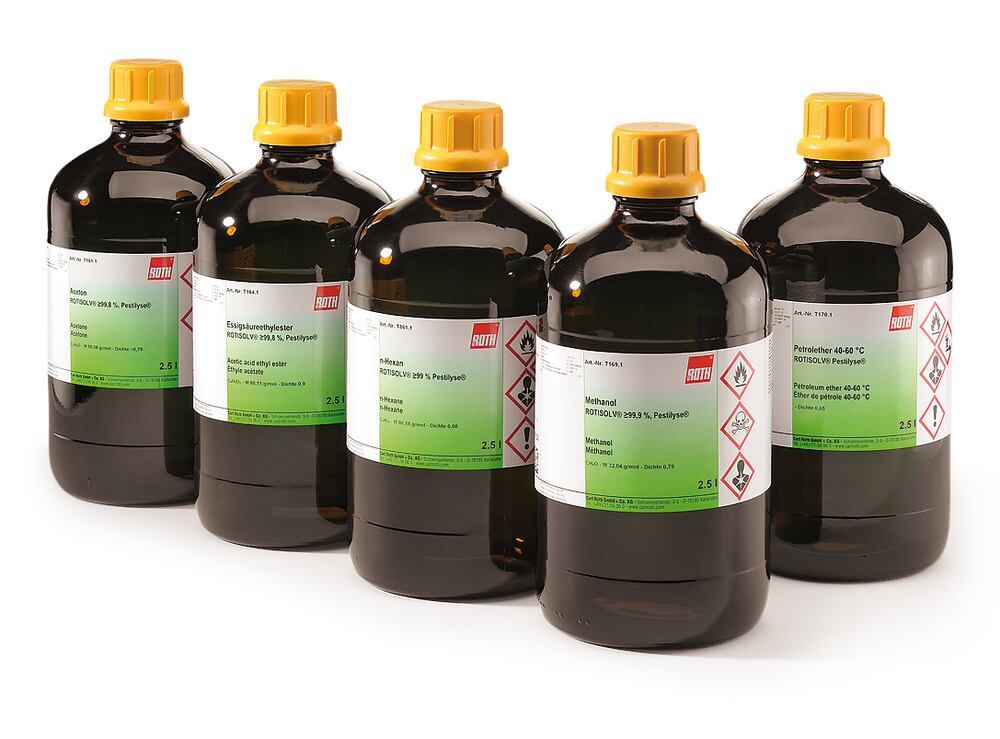


Description
Acetonitrile ROTISOLV® Pestilyse® est un solvant aprotique polaire de haute pureté avec une teneur minimale de 99.9 %, numéro CAS 75-05-8 et formule empirique C₂H₃N. Il offre une masse molaire de 41.05 g/mol, une masse volumique de 0.79 g/cm³, un point d'ébullition de 81.65 °C et un point d'éclair de 2 °C, des paramètres qui favorisent un usage maîtrisé dans le développement de méthodes chromatographiques. La qualité Pestilyse® aide à la préparation, à la dilution et aux étapes d'extraction sensibles aux résidus, courantes dans les laboratoires orientés GC. Le solvant est largement utilisé lorsqu'un milieu nitrile propre est requis pour les flux de travail analytiques et les tâches complémentaires de chimie organique. Issu du fabricant Carl ROTH dans la ligne ROTISOLV®, il fournit une option acetonitrile fiable pour la chromatographie de laboratoire courante et avancée.
Cet article fait partie de Solvants de qualité HPLC & LC-MS, dans Solvants. Voir aussi Solvants de qualité analytique (p.a.).
Caractéristiques
- Dosage (GC): ≥99.9 %
- Eau (KF): ≤0.2 %
- Acidité: ≤0.0005 meq/g
- Résidu d'évaporation: ≤0.0005 %
- GC/ECD (signal individuel en tant que lindane): ≤5 ng/l
- GC/PND (signal individuel en tant que ethylparathion): ≤10 ng/l
- Numéro CAS: 75-05-8
- Conditionnements: 2.5 l, 4 l
- N° CE: 200-835-2
- Pureté: min. 99.9 %
- Formule brute: C₂H₃N
- Masse molaire: 41.05 g/mol
- Fiche technique:

- Fiche de données de sécurité:
Compliance & Safety Information

 Danger
Hazard Statements (H-Phrases)
Precautionary Statements (P-Phrases)
Récemment consulté
Vous aimerez peut-être aussi
Questions about Acetonitrile ROTISOLV®, min. 99.9 %, Pestilyse®, 2.5 l, verre
What is this article?
Acetonitrile ROTISOLV®, min. 99.9 %, Pestilyse®, 2.5 l, verre is the article on this page. Luminix Health distributes Carl Roth for laboratory use. It sits in Solvants de qualité HPLC & LC-MS, inside Solvants, in Produits chimiques.
HPLC grade limits the absorbance and the residue that would appear as peaks or baseline drift. LC-MS grade goes further on metal ions and on particles that would suppress a mass spectrum. A solvent that is only analytical grade is a false economy on an LC-MS system.
A solvent dissolves. The grade says which impurities are low enough for the method. Analytical grade is the ordinary pure solvent. HPLC and LC-MS grades limit the absorbance and the ions that would become peaks or background. A dry solvent has had water removed. A deuterated solvent is for NMR, where the hydrogen signal would otherwise drown the sample. Technical grade is for cleaning and for synthesis that does not need a chromatogram. Identity is on PubChem. Names follow IUPAC. Hazards follow ECHA, the CLP Regulation and REACH.
Which category should I open next?
The category is Solvants. The sub-category is Solvants de qualité HPLC & LC-MS. The catalogue is Produits chimiques.
Shelves beside this one are Solvants de qualité analytique (p.a.), Solvants secs & deutérés (NMR, synthèse), Solvants de qualité technique & synthèse and Solvants verts & alternatifs.
What should I check before I order?
The technical information on this page is the manufacturer's sheet. Read that, not a rewritten specification.
When this page shows a safety data sheet, use that manufacturer file. Hazard text does not belong in the sales description. For a pack size, a grade or a certificate that is not on the page, send a quote request or contact the team.
How does ordering and shipping work?
Luminix Health distributes this article from the heart of Europe. Articles in stock ship within 2–5 business days. Standard delivery is free from €250 excl. VAT. Cold-chain goods and dangerous goods under ADR are never included in that free delivery. The terms are in the Shipping Policy. The full brand index is on shop by brand. Who we are is on about us.
Which other categories should I open?
The seven catalogues are Labware, Lab chemicals, Lab instruments, Lab consumables, Chromatography equipment, Lab safety equipment and Life Science & Microbiology.