


Description
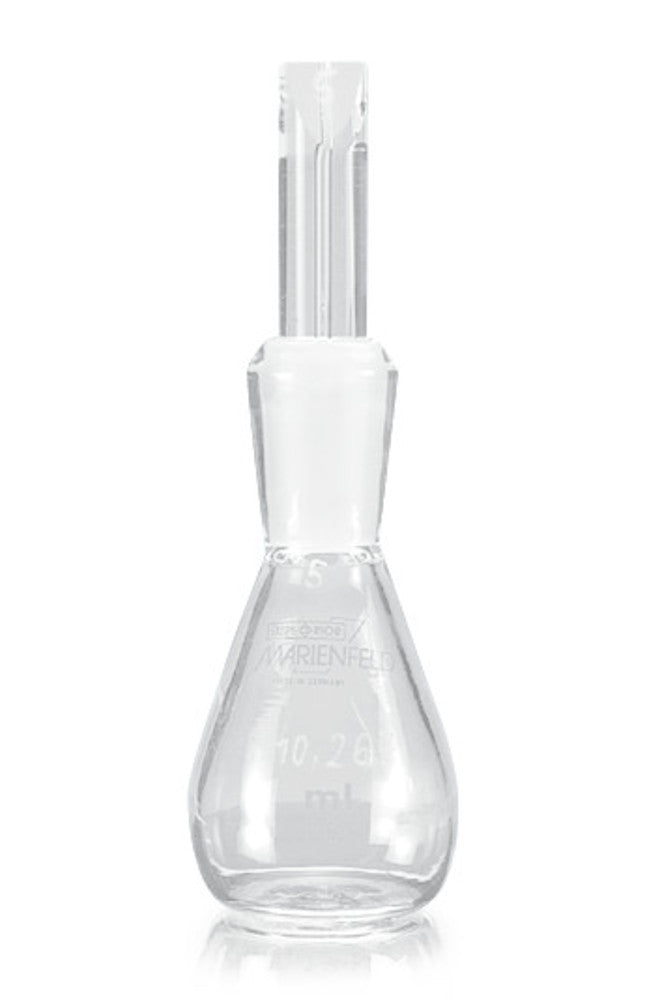
Les pycnomètres Gay-Lussac en verre borosilicaté 3.3 sont des récipients en forme de poire destinés aux déterminations de laboratoire de densité et de densité relative dans le cadre de l'analyse volumétrique. Ce modèle présente une capacité nominale de 25 ml et est livré en une pièce, offrant un volume ample pour les échantillons liquides lorsque des aliquotes plus importantes sont préférées. La géométrie en forme de poire favorise un remplissage contrôlé et un placement stable sur la balance analytique pendant la pesée. Le verre borosilicaté 3.3 offre la résistance chimique et thermique associée à une verrerie de laboratoire durable. Disponible du fabricant Marienfeld, le pycnomètre sert aux mesures de densité, à la caractérisation de liquides et aux applications de contrôle qualité dans les environnements de recherche, d'enseignement et industriels. Son poids unitaire de 0.03 kg maintient le récipient pratique pour l'usage à la balance malgré la capacité plus élevée. La construction transparente permet une observation claire du niveau de remplissage et de l'aspect de l'échantillon tout au long de la procédure. Les laboratoires qui s'appuient sur des pycnomètres de type Gay-Lussac parmi les fioles jaugées et les récipients apprécieront cette unité en forme de poire de 25 ml comme une option robuste pour le travail de densité avec des volumes d'échantillon plus importants.
Cet article fait partie de Ballons à fond rond, dans Béchers & fioles. Voir aussi Fioles à fond plat.
Caractéristiques
- Conditionnement: 1 pièce
- Type de produit: Pycnomètre Gay-Lussac
- Matériau: borosilicate glass 3.3
- Forme: en forme de poire
- Capacité: 25 ml
- Poids: 0.03 kg
Récemment consulté
Vous aimerez peut-être aussi
Browse related categories
Category
Sub-category
Catalogue
Brand
Questions about Pycnomètres Gay-Lussac, verre borosilic. 3.3, en forme de poire, 25 ml, 1 unité
What is this article?
Pycnomètres Gay-Lussac, verre borosilic. 3.3, en forme de poire, 25 ml, 1 unité is the article on this page. Luminix Health distributes Marienfeld for laboratory use. It sits in Ballons à fond rond, inside Béchers & fioles, in Matériel de laboratoire.
A round-bottom flask is the heating flask of a distillation or a reflux. The curved wall takes the heat, and the ground neck connects to a still head or a condenser. The joint size, not only the volume, has to match the rest of the set.
A beaker is an open working vessel: easy to pour, poor as a measure. An Erlenmeyer flask has a flat base and a conical wall so a liquid can be swirled without climbing out. A round-bottom flask is for heating under a condenser, because the heat meets a curved wall and the joint at the neck connects to the rest of the glassware. Borosilicate is the glass that survives the temperature change. These forms are listed under ISO laboratory glassware.
Which category should I open next?
The category is Béchers & fioles. The sub-category is Ballons à fond rond. The catalogue is Matériel de laboratoire.
Shelves beside this one are Béchers, Fioles Erlenmeyer, Récipients de réaction & récipients à double enveloppe, Fioles à fond plat, Fioles (autres) and Accessoires pour béchers & fioles.
What should I check before I order?
The technical information on this page is the manufacturer's sheet. Read that, not a rewritten specification.
When this page shows a safety data sheet, use that manufacturer file. Hazard text does not belong in the sales description. For a pack size, a grade or a certificate that is not on the page, send a quote request or contact the team.
How does ordering and shipping work?
Luminix Health distributes this article from the heart of Europe. Articles in stock ship within 2–5 business days. Standard delivery is free from €250 excl. VAT. Cold-chain goods and dangerous goods under ADR are never included in that free delivery. The terms are in the Shipping Policy. The full brand index is on shop by brand. Who we are is on about us.
Which other categories should I open?
The seven catalogues are Labware, Lab chemicals, Lab instruments, Lab consumables, Chromatography equipment, Lab safety equipment and Life Science & Microbiology.