
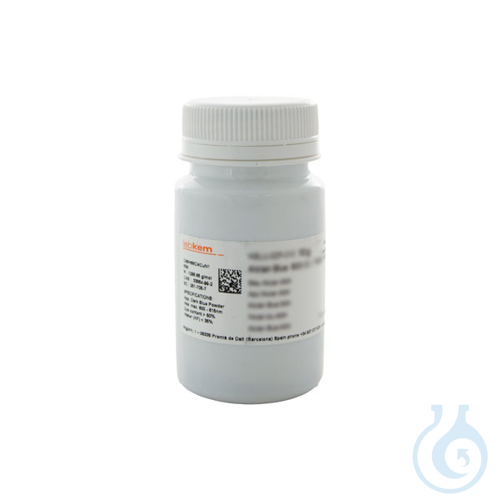



Description
Eosin-Methylene Blue according to May-Grünwald est un réactif de coloration de laboratoire fourni en pack de 25 g pour des applications microbiologiques et histologiques selon la méthode de May-Grünwald. Cette combinaison de colorants est utilisée dans des flux de coloration où les composants eosin et methylene blue favorisent la visualisation différentielle des structures cellulaires au microscope. Proposé par le fabricant Labbox sous la ligne de produits LABKEM, le matériau est présenté comme un pack prêt à l'emploi d'un poids net de 0.025 kg, adapté à la préparation routinière en laboratoire de solutions de coloration. Il est classé parmi les réactifs de microbiologie et prend en charge les protocoles de coloration May-Grünwald standard dans les laboratoires cliniques, de recherche et d'enseignement. La quantité unitaire compacte de 25 g permet un usage contrôlé et une gestion simple des stocks. Les laboratoires ayant besoin de eosin-methylene blue stain according to May-Grünwald peuvent intégrer ce pack dans des séquences de coloration établies pour les frottis sanguins et les préparations associées, en s'appuyant sur l'identité de formulation définie et la taille du pack pour une gestion cohérente des réactifs.
Cet article fait partie de Réactifs & consommables d'histologie, dans Microscopie et histologie.
Caractéristiques
- Conditionnement: 25 g
- Type de produit: Réactif de coloration LABKEM
- Colorant: Eosin-Methylene Blue
- Méthode: selon May-Grünwald
- EAN: 8434868020443
- Fiche technique:

Récemment consulté
Vous aimerez peut-être aussi
Questions about Colorant de May-Grünwald pour microscopie, 25 g
What is this article?
Colorant de May-Grünwald pour microscopie, 25 g is the article on this page. Luminix Health distributes Labbox for laboratory use. It sits in Réactifs & consommables d'histologie, inside Microscopie et histologie, in Instruments de laboratoire.
Histology reagents are the fixatives, the solvents, the paraffins and the stains that turn a tissue into a readable section. The stain and the tissue, not the bottle size alone, choose the reagent. Many of these liquids are flammable or toxic and travel under dangerous-goods rules.
A light microscope forms an image with glass lenses and transmitted or reflected light. A stereo microscope is the lower-magnification instrument for dissecting and for looking at a surface. Fluorescence needs a light source and filters matched to the dye. Histology is the preparation that makes a tissue readable: fixation, a cassette, a section, a stain. The objective's magnification and numerical aperture decide the resolution. The slide and the cover glass decide whether the section sits in the focal plane. Stains and dyes as substances are identified on PubChem. Papers on the methods are on PubMed.
Which category should I open next?
The category is Microscopie et histologie. The sub-category is Réactifs & consommables d'histologie. The catalogue is Instruments de laboratoire.
Shelves beside this one are Lames de microscope & lamelles couvre-objet, Objectifs, oculaires & optiques de microscope, Cassettes & moules d'histologie, Chambres de comptage & hémocytomètres, Stéréomicroscopes, Microscopes optiques & à fluorescence, Accessoires de microscopie, Sources de lumière froide & éclairage and Microscopes numériques & USB.
What should I check before I order?
When this page shows a safety data sheet, use that manufacturer file. Hazard text does not belong in the sales description. For a pack size, a grade or a certificate that is not on the page, send a quote request or contact the team.
How does ordering and shipping work?
Luminix Health distributes this article from the heart of Europe. Articles in stock ship within 2–5 business days. Standard delivery is free from €250 excl. VAT. Cold-chain goods and dangerous goods under ADR are never included in that free delivery. The terms are in the Shipping Policy. The full brand index is on shop by brand. Who we are is on about us.
Which other categories should I open?
The seven catalogues are Labware, Lab chemicals, Lab instruments, Lab consumables, Chromatography equipment, Lab safety equipment and Life Science & Microbiology.