


Description
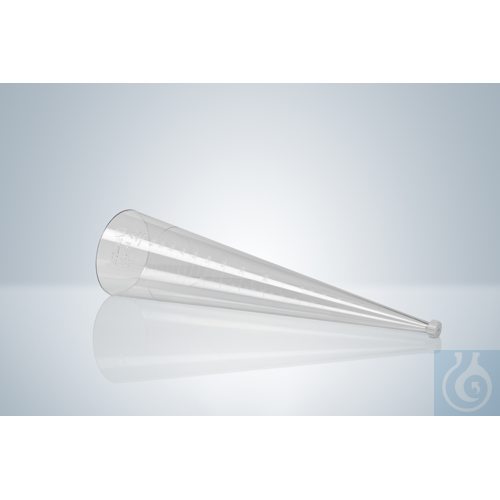
Récipient de sédimentation 1000 ml selon Imhoff est un récipient de laboratoire pour la détermination des matières décantables selon la méthode classique d'Imhoff. Fabriqué en SAN, il est parfaitement transparent et incassable, combinant transparence optique et propriétés de manipulation robustes pour l'analyse courante de l'eau et des eaux usées. Une échelle en relief favorise une lecture claire du volume pendant la sédimentation, tandis que la fermeture à vis permet une vidange simple et contrôlée après l'essai. La capacité de 1000 ml correspond aux procédures standard de cône d'Imhoff utilisées dans les laboratoires environnementaux et de procédé. La construction en SAN offre une résistance aux chocs par rapport au verre tout en conservant la clarté nécessaire pour observer la couche de sédiment. Fourni en lots de 3 pièces du fabricant Hirschmann, le récipient est destiné au travail quotidien de sédimentation d'Imhoff où la durabilité, une graduation lisible et une vidange facile comptent. Le poids net est de 0.711 kg, ce qui en fait un article de laboratoire solide mais pratique pour des mesures de décantation répétées sans ajouter de risque de manipulation inutile.
Cet article fait partie de Accessoires pour béchers & fioles, dans Béchers & fioles.
Caractéristiques
- Conditionnement: 3 pièces
- Température de stockage: +5 - +40 °C
- Matériau: SAN
- Capacité: 1000 ml
- Exécution: selon Imhoff
- EAN: 4049338018093
Récemment consulté
Vous aimerez peut-être aussi
Questions about CÔNE DE SÉDIMENTATION 1000 ML, SELON IMHOFF
What is this article?
CÔNE DE SÉDIMENTATION 1000 ML, SELON IMHOFF is the article on this page. Luminix Health distributes Hirschmann for laboratory use. It sits in Accessoires pour béchers & fioles, inside Béchers & fioles, in Matériel de laboratoire.
Accessories for beakers and flasks are the cork rings, the covers, the joint clips and the holders that keep a flask upright or closed. A clip is what stops a ground joint from falling apart when it is inverted.
A beaker is an open working vessel: easy to pour, poor as a measure. An Erlenmeyer flask has a flat base and a conical wall so a liquid can be swirled without climbing out. A round-bottom flask is for heating under a condenser, because the heat meets a curved wall and the joint at the neck connects to the rest of the glassware. Borosilicate is the glass that survives the temperature change. These forms are listed under ISO laboratory glassware.
Which category should I open next?
The category is Béchers & fioles. The sub-category is Accessoires pour béchers & fioles. The catalogue is Matériel de laboratoire.
Shelves beside this one are Ballons à fond rond, Béchers, Fioles Erlenmeyer, Récipients de réaction & récipients à double enveloppe, Fioles à fond plat and Fioles (autres).
What should I check before I order?
When this page shows a safety data sheet, use that manufacturer file. Hazard text does not belong in the sales description. For a pack size, a grade or a certificate that is not on the page, send a quote request or contact the team.
How does ordering and shipping work?
Luminix Health distributes this article from the heart of Europe. Articles in stock ship within 2–5 business days. Standard delivery is free from €250 excl. VAT. Cold-chain goods and dangerous goods under ADR are never included in that free delivery. The terms are in the Shipping Policy. The full brand index is on shop by brand. Who we are is on about us.
Which other categories should I open?
The seven catalogues are Labware, Lab chemicals, Lab instruments, Lab consumables, Chromatography equipment, Lab safety equipment and Life Science & Microbiology.