
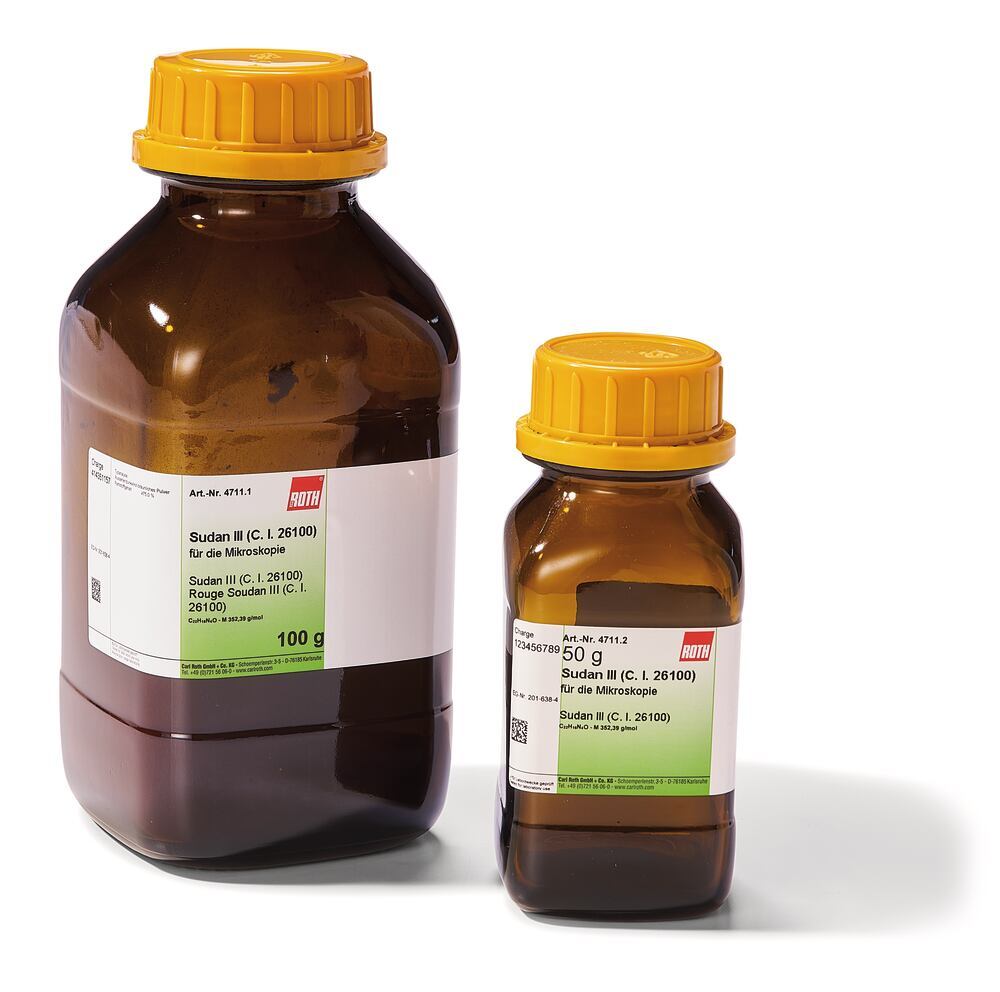


Description
Sudan III (C.I. 26100) est un colorant azoïque lipophile, fourni pour la microscopie, avec le numéro CAS 85-86-9, la formule empirique C₂₂H₁₆N₄O et une masse molaire de 352.39 g/mol. Ce colorant classique des graisses est largement utilisé pour visualiser les lipides neutres, les triglycérides et les structures hydrophobes associées dans les préparations histologiques et cytologiques. Le colorant appartient à la série Sudan et est apprécié dans les flux de coloration biologique où un contraste net des domaines riches en lipides est requis. Fabriqué par Carl ROTH, il porte le numéro EG 201-638-4 et s'inscrit dans les protocoles établis pour les colorants et pigments de microscopie. Les laboratoires travaillant en histologie, en soutien à la pathologie et en imagerie biologique générale peuvent intégrer ce réactif dans des séquences de coloration standard. Son identité chimique définie et sa spécification orientée microscopie soutiennent une préparation reproductible des solutions de coloration lorsque vous les manipulez selon les bonnes pratiques de laboratoire.
Cet article fait partie de Colorants & solutions de coloration pour microscopie, dans Colorants, colorations & indicateurs.
Caractéristiques
- Aspect: poudre rouge foncé, brunâtre
- Teneur en colorant: ≥75 %
- Numéro CAS: 85-86-9
- Conditionnements: 100 g, 50 g
- N° CE: 201-638-4
- Formule brute: C₂₂H₁₆N₄O
- Masse molaire: 352.39 g/mol
- Fiche technique:

- Fiche de données de sécurité:
Récemment consulté
Vous aimerez peut-être aussi
Browse related categories
Category
Colorants, colorations & indicateurs
Sub-category
Colorants & solutions de coloration pour microscopie
Catalogue
Brand
Questions about Sudan III (C.I. 26100), pour microscopie, 100 g, verre
What is this article?
Sudan III (C.I. 26100), pour microscopie, 100 g, verre is the article on this page. Luminix Health distributes Carl Roth for laboratory use. It sits in Colorants & solutions de coloration pour microscopie, inside Colorants, colorations & indicateurs, in Produits chimiques.
A microscopy stain binds a structure so it can be seen: haematoxylin on nuclei, eosin on cytoplasm, Gram reagents on a bacterial wall. A ready solution and a dry dye to be dissolved are different articles. The method names the stain. A substitute dye is a different method.
A dye or a stain binds, or changes colour, so that something invisible becomes visible. An indicator changes at a pH or a redox point. A fluorescent dye absorbs one wavelength and emits another, which is how a microscope or a plate reader picks it out. The excitation and emission, or the transition interval, are the specification. The colour name on the label is not. Structures are on PubChem under IUPAC names. Methods are in the PubMed literature.
Which category should I open next?
The category is Colorants, colorations & indicateurs. The sub-category is Colorants & solutions de coloration pour microscopie. The catalogue is Produits chimiques.
Shelves beside this one are Colorants fluorescents & marqueurs and Colorants & pigments.
What should I check before I order?
The technical information on this page is the manufacturer's sheet. Read that, not a rewritten specification.
When this page shows a safety data sheet, use that manufacturer file. Hazard text does not belong in the sales description. For a pack size, a grade or a certificate that is not on the page, send a quote request or contact the team.
How does ordering and shipping work?
Luminix Health distributes this article from the heart of Europe. Articles in stock ship within 2–5 business days. Standard delivery is free from €250 excl. VAT. Cold-chain goods and dangerous goods under ADR are never included in that free delivery. The terms are in the Shipping Policy. The full brand index is on shop by brand. Who we are is on about us.
Which other categories should I open?
The seven catalogues are Labware, Lab chemicals, Lab instruments, Lab consumables, Chromatography equipment, Lab safety equipment and Life Science & Microbiology.