
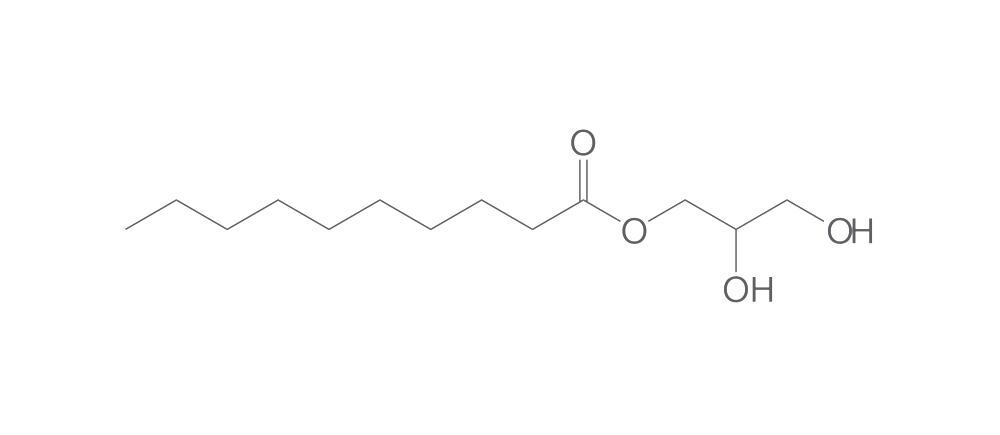


Description
1-Decanoyl-rac-glycerol is a monoacylglycerol biochemical offered at min. 95 % purity, with CAS number 2277-23-8 and the empirical formula C₁₃H₂₆O₄. The molar mass is 246,34 g/mol, enabling precise mass-to-mole conversions, stock calculations and clear entries in laboratory records. It is As a defined rac-glycerol ester, the compound provides a discrete molecular identity for chemical and biochemical studies that rely on well-characterised lipid-related building blocks. CAS registry data and the empirical formula support alignment with published procedures and internal documentation standards. The product is available from manufacturer Carl ROTH within the biochemicals selection and suits research settings that require transparent substance parameters at small scale. quantity is practical for screening, reference weighing and repeated low-consumption trials without excess material. Stated purity of min. 95 % together with the molar mass assists preparation of accurate working solutions and transfer of methods between users or instruments. Overall, the combination of identity data, purity statement and compact pack presentation offers a focused specification set for careful laboratory handling and scientific reporting.
This article is part of Polymers, PEGs & silicones, in Organic chemicals & synthesis reagents.
Key features
- CAS number: 2277-23-8
- Pack sizes: 25 mg, 50 mg, 100 mg, 250 mg, 500 mg
- Purity: min. 95 %
- Empirical formula: C₁₃H₂₆O₄
- Molar mass: 246,34 g/mol
- Weight: 0,001 kg
Recently viewed
You may also like
Browse related categories
Category
Organic chemicals & synthesis reagents
Sub-category
Catalogue
Brand
Questions about 1-Decanoyl-rac-glycerol, min. 95 %, 25 mg
What is this article?
1-Decanoyl-rac-glycerol, min. 95 %, 25 mg is the article on this page. Luminix Health distributes Carl Roth for laboratory use. It sits in Polymers, PEGs & silicones, inside Organic chemicals & synthesis reagents, in Lab chemicals.
A polymer, a PEG or a silicone is sold by molecular weight, or by viscosity, as much as by name. PEG 400 and PEG 4000 are different liquids and solids. A silicone oil's viscosity grades are the product range. The average molecular weight is the specification.
An organic chemical is built on carbon. In this category it is a building block or a reagent for making another molecule: a starting material, a coupling agent, a polymer, a PEG. Purity is a specification of which impurities remain. The structure, the CAS number and the grade decide whether two bottles are the same substance. Structures and properties are on PubChem. Nomenclature is IUPAC. Classification follows ECHA and the CLP Regulation.
Which category should I open next?
The category is Organic chemicals & synthesis reagents. The sub-category is Polymers, PEGs & silicones. The catalogue is Lab chemicals.
Shelves beside this one are Organic building blocks & synthesis reagents and Click chemistry, bioconjugation & synthesis reagents.
What should I check before I order?
When this page shows a safety data sheet, use that manufacturer file. Hazard text does not belong in the sales description. For a pack size, a grade or a certificate that is not on the page, send a quote request or contact the team.
How does ordering and shipping work?
Luminix Health distributes this article from the heart of Europe. Articles in stock ship within 2–5 business days. Standard delivery is free from €250 excl. VAT. Cold-chain goods and dangerous goods under ADR are never included in that free delivery. The terms are in the Shipping Policy. The full brand index is on shop by brand. Who we are is on about us.
Which other categories should I open?
The seven catalogues are Labware, Lab chemicals, Lab instruments, Lab consumables, Chromatography equipment, Lab safety equipment and Life Science & Microbiology.