
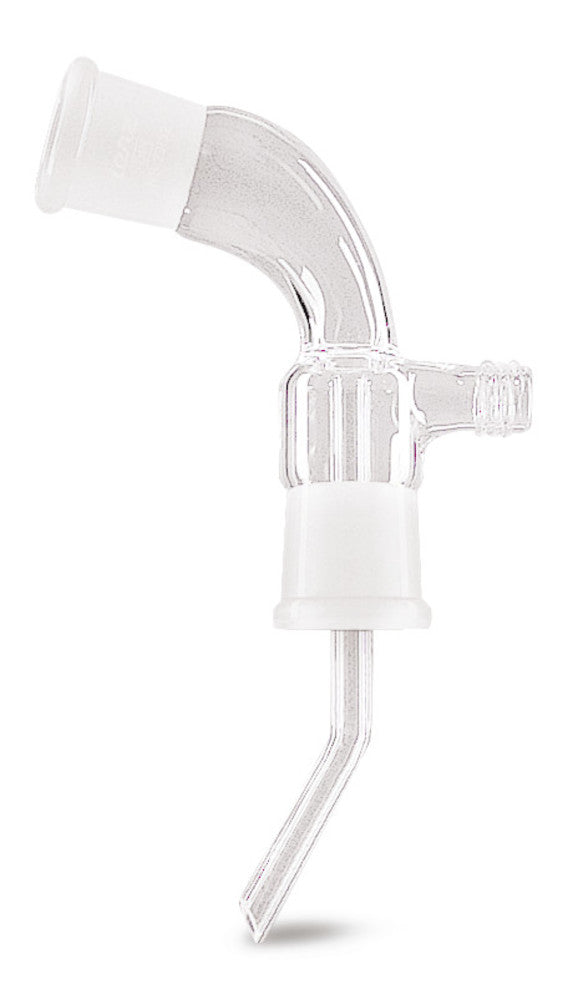



Description
Adapters for distillation receiver DURAN® according to Bredt, bent 105° with sleeve NS 29/32, connect the delivery side of a distillation train to the receiving vessel. The Bredt-related design combined with a 105° bend guides condensate into the receiver while the NS 29/32 sleeve mates with matching ground-joint glassware. Constructed from DURAN® laboratory glass, these adapters sit in the range of glass components for distillation and extraction that use standard European joints. Each unit is supplied as 1 pc(s) and weighs 0,100 kg, supporting single-piece replacement in multi-joint assemblies. Offered by manufacturer Lenz, the adapter is intended for laboratory setups where an angled receiver connection improves drainage and reduces hold-up at the joint. The sleeve geometry ensures a secure fit to NS 29/32 cores on flasks, cow-type receivers or related pieces. Suitable for organic synthesis work-ups, solvent recovery and other distillation workflows that rely on DURAN® ground-glass components with a defined bend toward the receiver.
This article is part of Hose connectors, adapters & fittings, in Tubing, hoses & fittings.
Key features
- Pack size: 1 pc(s)
- Product type: Adapter for distillation receiver
- Design: According to Bredt
- Material: DURAN® glass
- Bend angle: 105°
- Joint size: Sleeve NS 29/32
Recently viewed
You may also like
Questions about Adapters f. distillat. receiver, DURAN®, acc. to Bredt, bent 105°, sleeve 29/32
What is this article?
Adapters f. distillat. receiver, DURAN®, acc. to Bredt, bent 105°, sleeve 29/32 is the article on this page. Luminix Health distributes Lenz for laboratory use. It sits in Hose connectors, adapters & fittings, inside Tubing, hoses & fittings, in Labware.
A hose connector or adapter joins two lines, or steps one bore down to another. The barb diameter has to match the tube, and the thread has to match the stopcock or the bottle. Most leaks are a mismatch here, not a hole in the tube.
Tubing is how a liquid or a gas moves between two vessels without being poured. Silicone stays flexible and survives repeated autoclaving. PTFE resists almost every solvent and is stiff. PVC is the ordinary flexible line for water and for mild aqueous work. The fitting, not the tube, is what usually leaks: the barb, the thread and the stopcock have to match the tube bore. Glass and plastic apparatus around these lines is indexed under ISO laboratory ware.
Which category should I open next?
The category is Tubing, hoses & fittings. The sub-category is Hose connectors, adapters & fittings. The catalogue is Labware.
Shelves beside this one are PVC, PTFE & other tubing, Stopcocks & valves, Silicone tubing and Tubing accessories.
What should I check before I order?
The technical information on this page is the manufacturer's sheet. Read that, not a rewritten specification.
When this page shows a safety data sheet, use that manufacturer file. Hazard text does not belong in the sales description. For a pack size, a grade or a certificate that is not on the page, send a quote request or contact the team.
How does ordering and shipping work?
Luminix Health distributes this article from the heart of Europe. Articles in stock ship within 2–5 business days. Standard delivery is free from €250 excl. VAT. Cold-chain goods and dangerous goods under ADR are never included in that free delivery. The terms are in the Shipping Policy. The full brand index is on shop by brand. Who we are is on about us.
Which other categories should I open?
The seven catalogues are Labware, Lab chemicals, Lab instruments, Lab consumables, Chromatography equipment, Lab safety equipment and Life Science & Microbiology.