


Description
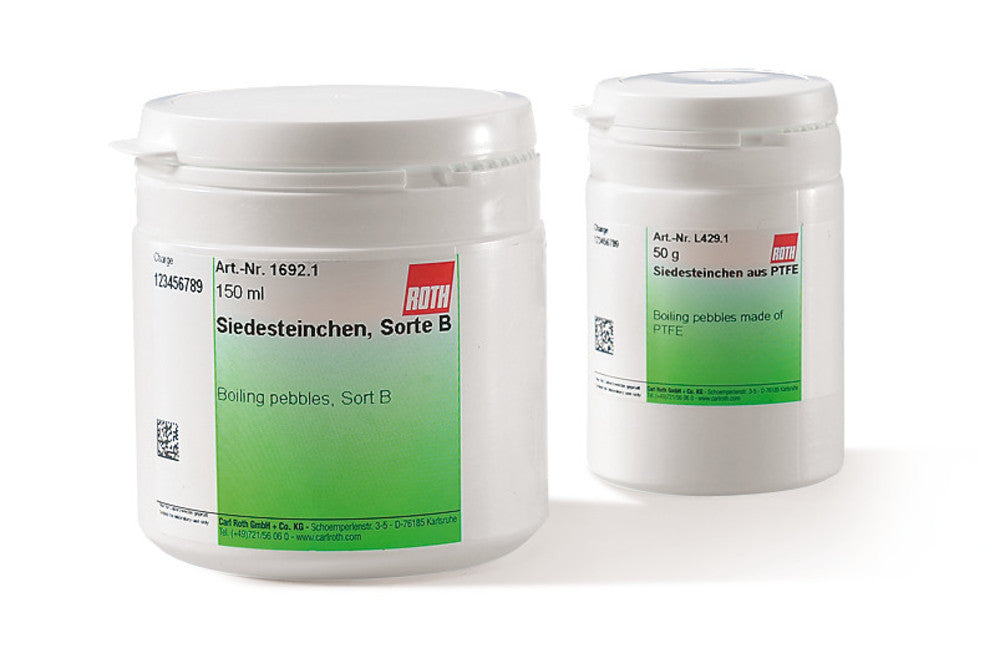
Boiling pebbles, resistant are laboratory boiling aids supplied as a resistant granulate with an approximate granulation of 3–4 mm. They help promote even boiling behaviour in heated laboratory vessels and belong to the labware group covering boiling pebbles, glass beads and floating pellets used in cleaning, care and general laboratory aids. The pack contains 50 g, with a listed density (D) of 3,17 g/cm³, giving a practical quantity for routine bench work. These resistant boiling pebbles are suitable for standard heating and distillation setups where anti-bumping media are required to support controlled boiling. Available from manufacturer Carl ROTH, the product is presented for everyday laboratory use rather than specialised analytical chemistry grades beyond the stated physical data. The compact 50 g unit simplifies dispensing into flasks and other heated glassware across teaching, research and quality-control laboratories. Clear granulation and density information support straightforward selection when stocking boiling aids alongside related glass beads and floating pellets in shared laboratory stores.
This article is part of Grease, boiling stones & sealants, in Tools & accessories.
Key features
- Pack size: 50 g
- Density: (D): 3,17 g/cm³
- Product type: Boiling pebbles, resistant
- Granulation: approx. 3–4 mm
- Weight: 0,066 kg
- Technical Information Sheet:

- Safety Data Sheet:
Recently viewed
You may also like
Questions about Boiling pebbles, resistant, granulation approx. 3 - 4 mm, 50 g
What is this article?
Boiling pebbles, resistant, granulation approx. 3 - 4 mm, 50 g is the article on this page. Luminix Health distributes Carl Roth for laboratory use. It sits in Grease, boiling stones & sealants, inside Tools & accessories, in Labware.
Grease seals a ground joint. Boiling stones give a liquid a place to start boiling so it does not bump. A sealant does the same job as grease when grease would contaminate the product. They are small, and they decide whether a joint weeps.
The small tools of the bench are what the hand actually holds: a spatula for a powder, forceps for an object that must stay clean, a brush for a narrow neck, a desiccator when a dried sample must not take up water again. None of these reads a measurement. They keep the measurement possible. The apparatus around them is listed under ISO laboratory apparatus.
Which category should I open next?
The category is Tools & accessories. The sub-category is Grease, boiling stones & sealants. The catalogue is Labware.
Shelves beside this one are Spatulas & spoons, Other lab tools & accessories, Lab furniture, trolleys & storage, Tweezers & forceps, Scissors, scalpels & dissecting instruments, Weighing boats, dishes & paper, Desiccators & desiccant, Timers, stopwatches & calculators, Stationery, books & lab notebooks, Brushes & cleaning tools, Stirring rods, spreaders & glass tools, Cutting & sealing tools and Gas handling & burners accessories.
What should I check before I order?
The technical information on this page is the manufacturer's sheet. Read that, not a rewritten specification.
When this page shows a safety data sheet, use that manufacturer file. Hazard text does not belong in the sales description. For a pack size, a grade or a certificate that is not on the page, send a quote request or contact the team.
How does ordering and shipping work?
Luminix Health distributes this article from the heart of Europe. Articles in stock ship within 2–5 business days. Standard delivery is free from €250 excl. VAT. Cold-chain goods and dangerous goods under ADR are never included in that free delivery. The terms are in the Shipping Policy. The full brand index is on shop by brand. Who we are is on about us.
Which other categories should I open?
The seven catalogues are Labware, Lab chemicals, Lab instruments, Lab consumables, Chromatography equipment, Lab safety equipment and Life Science & Microbiology.