
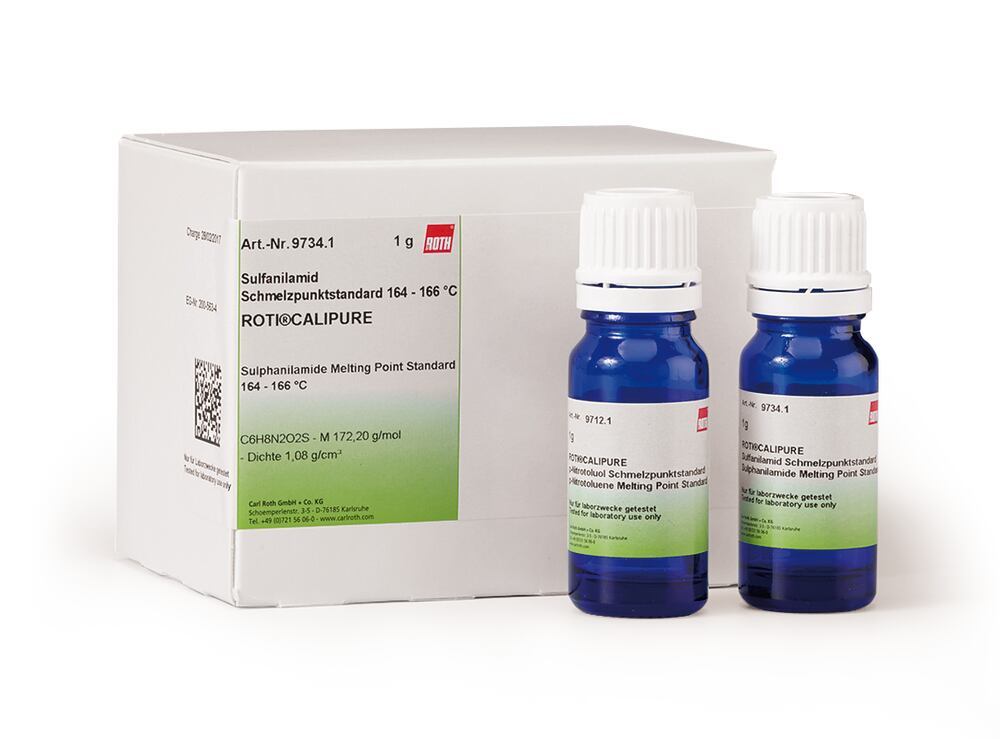


Description
Carbazole, ROTI®Calipure is a melting point standard covering the range 243–247 °C for calibration and verification work in melting point determination. The substance is identified by CAS number 86-74-8, empirical formula C₁₂H₉N and EG nr. 201-696-0, with a molar mass of 167,21 g/mol. Physical data include a density of 1,1 g/cm³, flash point of 188 °C and boiling point of 355 °C, supporting clear material characterisation beside the melting interval. Packed as 1 g in glass, this ROTI®Calipure grade carbazole from manufacturer Carl ROTH is intended for determination of physical properties where a defined melting point reference is required. Laboratories use such standards to check instrument response, compare observed melting behaviour and document calibration points in analytical workflows. The compact glass pack suits controlled dispensing and storage of small reference quantities. Choose Carbazole ROTI®Calipure when a documented melting point standard around 243–247 °C with full identity data is needed for melting point apparatus checks.
This article is part of Spectroscopy & physical property standards, in Analytical standards & reference materials.
Key features
- Meniscus formation: 243-247 °C
- Complete liquefaction: 243-247 °C
- Measurement uncertainty: ±0,3 °C
- CAS number: 86-74-8
- Pack size: 1 g glass
- EG nr.: 201-696-0
- Empirical formula: C₁₂H₉N
- Molar mass: 167,21 g/mol
- Technical Information Sheet:

- Safety Data Sheet:
Compliance & Safety Information
 Warning
Hazard Statements (H-Phrases)
Precautionary Statements (P-Phrases)
Recently viewed
You may also like
Browse related categories
Category
Analytical standards & reference materials
Sub-category
Spectroscopy & physical property standards
Catalogue
Brand
Questions about Carbazole, ROTI®Calipure, Melting point standard 243-247 °C, 1 g, glass
What is this article?
Carbazole, ROTI®Calipure, Melting point standard 243-247 °C, 1 g, glass is the article on this page. Luminix Health distributes Carl Roth for laboratory use. It sits in Spectroscopy & physical property standards, inside Analytical standards & reference materials, in Lab chemicals.
These standards check a physical or optical measurement: a refractive-index liquid, a wavelength standard, a viscosity oil, a melting-point substance. The stated value and its uncertainty are the product. They are not general reagents.
A reference material is the article against which another result is compared. Its value is stated, and the uncertainty of that value is part of the product. An ICP or ion standard is a solution of known concentration. A volumetric standard is for titration. A chromatography standard is the peak you match. The grade names, including pharmacopoeia and ASTM, say which impurities were limited. Identity is checked on PubChem. Names follow IUPAC. Medicinal grades follow the European Pharmacopoeia and USP.
Which category should I open next?
The category is Analytical standards & reference materials. The sub-category is Spectroscopy & physical property standards. The catalogue is Lab chemicals.
Shelves beside this one are ICP, AAS & ion standards, Chromatography standards (GC, HPLC, pesticides), Reference substances & reagents (other), Volumetric standard solutions (titration), Reagents for analysis (Ph. Eur., ASTM, DIN) and Indicators & indicator solutions.
What should I check before I order?
When this page shows a safety data sheet, use that manufacturer file. Hazard text does not belong in the sales description. For a pack size, a grade or a certificate that is not on the page, send a quote request or contact the team.
How does ordering and shipping work?
Luminix Health distributes this article from the heart of Europe. Articles in stock ship within 2–5 business days. Standard delivery is free from €250 excl. VAT. Cold-chain goods and dangerous goods under ADR are never included in that free delivery. The terms are in the Shipping Policy. The full brand index is on shop by brand. Who we are is on about us.
Which other categories should I open?
The seven catalogues are Labware, Lab chemicals, Lab instruments, Lab consumables, Chromatography equipment, Lab safety equipment and Life Science & Microbiology.