


Description
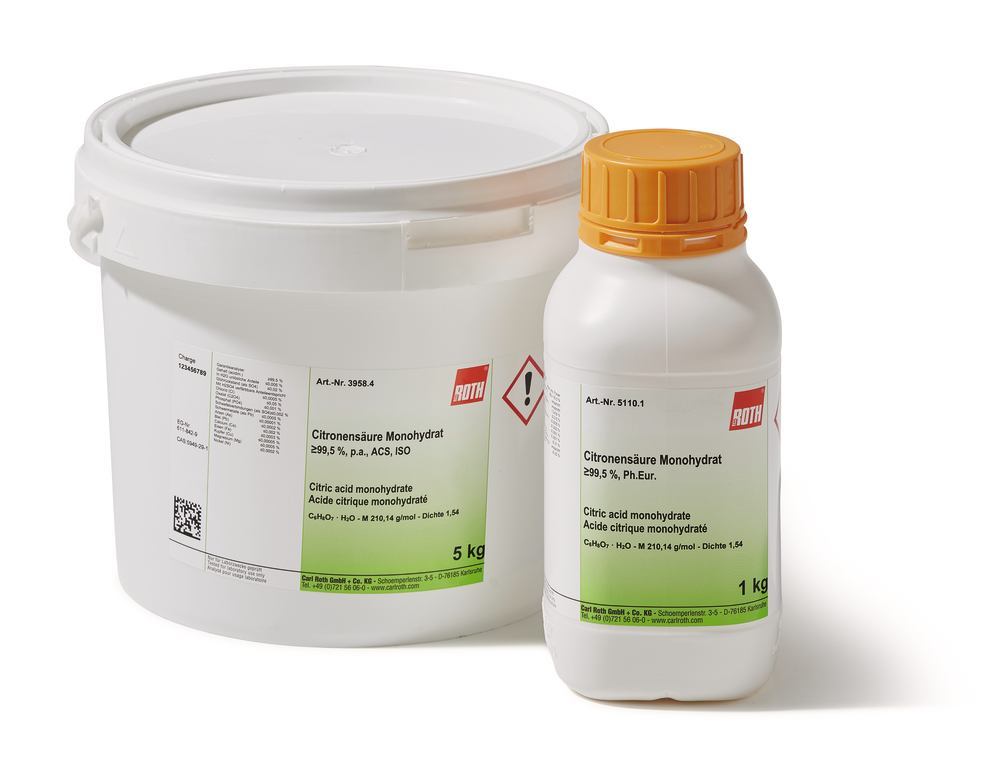
Citric acid monohydrate is a pharmacopoeia-quality excipient with a minimum purity of 99,5 % (Ph.Eur.). Identified by CAS number 5949-29-1 and EG number 611-842-9, it has the empirical formula C₆H₈O₇·H₂O and a molar mass of 210,14 g/mol. Reported physical properties include a density of 1,54 g/cm³ and a boiling point above 170 °C. It suits chemicals in pharmacopoeia quality where reproducible weighing, buffer preparation, pH adjustment and related aqueous systems are required. The monohydrate form provides a defined water of crystallisation content for consistent preparation work. size is convenient for both development trials and routine production or laboratory use. Handle the solid organic acid according to the associated safety information and standard chemical hygiene practices in the laboratory or production environment.
This article belongs on Acids, in Acids & bases.
Key features
- Appearance: white, cryst. powder
- Assay (dry substance): 99.5-100.5 %
- Appearance of solution: complies
- Water (KF): 7.5-8.8 %
- Sulphate (SO4): ≤0.015 %
- Arsenic (As): ≤0.0003 %
- Lead (Pb): ≤0.0001 %
- Mercury (Hg): ≤0.0001 %
- Oxalate (as C2H2O4): ≤0.01 %
- Reaction with H2SO4: complies
- CAS number: 5949-29-1
- Pack sizes: 1 kg, 5 kg, 25 kg
- EG nr.: 611-842-9
- Purity: min. 99,5 %, Ph.Eur.
- Empirical formula: C₆H₈O₇·H₂O
- Molar mass: 210,14 g/mol
- Technical Information Sheet:

- Safety Data Sheet:
Compliance & Safety Information
 Warning
Hazard Statements (H-Phrases)
Precautionary Statements (P-Phrases)
Recently viewed
You may also like
Browse related categories
Category
Sub-category
Catalogue
Brand
Questions about Citric acid monohydrate, ROTI®Pharm Excipient, , 1 kg, plastic
What is this article?
Citric acid monohydrate, ROTI®Pharm Excipient, , 1 kg, plastic is the article on this page. Luminix Health distributes Carl Roth for laboratory use. It sits in Acids, inside Acids & bases, in Lab chemicals.
An acid on this shelf is the substance itself, concentrated or as a stated solution: hydrochloric, sulfuric, nitric, acetic and the rest. Concentration, purity and the trace metals decide the use. A concentrated acid and a volumetric solution of the same name are different products, and both burn.
An acid donates a proton. A base accepts one. In the bottle, the practical differences are the concentration, the purity and the anion or cation that comes along. Concentrated mineral acids are a different article from a dilute volumetric solution. The water in the acid, and the trace metals, decide whether it can be used for analysis. Check the substance on PubChem and the classification on ECHA CLP. Transport is the UNECE dangerous-goods framework. The legal texts are the CLP Regulation and REACH.
Which category should I open next?
The category is Acids & bases. The sub-category is Acids. The catalogue is Lab chemicals.
Shelves beside this one are Bases & alkalis.
What should I check before I order?
When this page shows a safety data sheet, use that manufacturer file. Hazard text does not belong in the sales description. For a pack size, a grade or a certificate that is not on the page, send a quote request or contact the team.
How does ordering and shipping work?
Luminix Health distributes this article from the heart of Europe. Articles in stock ship within 2–5 business days. Standard delivery is free from €250 excl. VAT. Cold-chain goods and dangerous goods under ADR are never included in that free delivery. The terms are in the Shipping Policy. The full brand index is on shop by brand. Who we are is on about us.
Which other categories should I open?
The seven catalogues are Labware, Lab chemicals, Lab instruments, Lab consumables, Chromatography equipment, Lab safety equipment and Life Science & Microbiology.