



Description
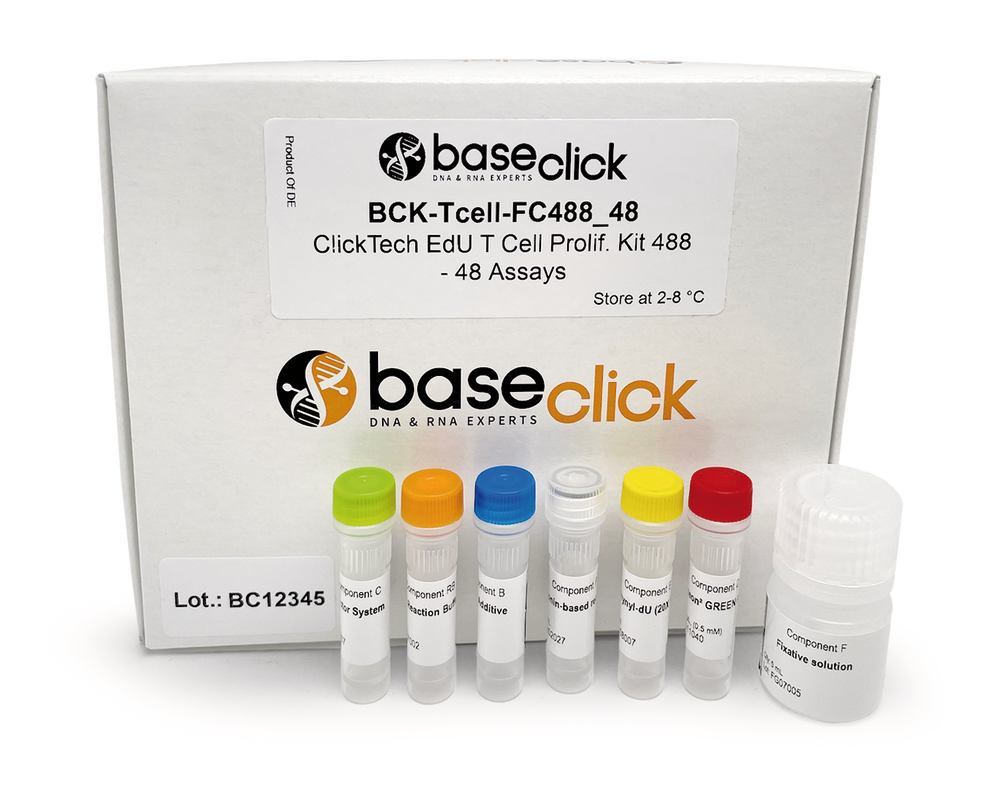
ClickTech EdU T cell Kit 647 is a cell proliferation assay kit configured for flow cytometry, with capacity for 48 assays per unit. It enables EdU-based click-chemistry detection of proliferating T cells in flow-cytometric workflows used in cell biology and immunology research. Supplied as 1 kit, the format is practical for scheduled assay series and controlled reagent handling at the bench. The unit weight is 0,101 kg, supporting convenient storage and transport within the laboratory. Available from manufacturer baseclick, the kit belongs to click chemistry and cell proliferation assay categories aimed at quantitative cellular analysis. Flow cytometry readout allows multiparameter assessment of T cell proliferation alongside other markers when combined with suitable staining panels. Researchers can apply the kit in studies that require sensitive detection of newly synthesised DNA in T cell populations. The 48-assay layout helps plan experimental batches while keeping reagent use consistent across runs in core facilities and project laboratories.
This article is part of Click chemistry, bioconjugation & synthesis reagents, in Organic chemicals & synthesis reagents.
Key features
- Technical Information Sheet:

- Safety Data Sheet:
Compliance & Safety Information
 Warning
Hazard Statements (H-Phrases)
Precautionary Statements (P-Phrases)
Recently viewed
You may also like
Browse related categories
Category
Organic chemicals & synthesis reagents
Sub-category
Click chemistry, bioconjugation & synthesis reagents
Catalogue
Brand
Questions about ClickTech EdU T Cell Proliferation Kit 647, For 192 assays., for Flow Cytometry
What is this article?
ClickTech EdU T Cell Proliferation Kit 647, For 192 assays., for Flow Cytometry is the article on this page. Luminix Health distributes baseclick for laboratory use. It sits in Click chemistry, bioconjugation & synthesis reagents, inside Organic chemicals & synthesis reagents, in Lab chemicals.
Click and bioconjugation reagents join two molecules under mild conditions, often an azide to an alkyne, or an NHS ester to an amine. The linker length and the reactive group are the specification. They are small bottles of a reactive compound, and moisture often ruins them.
An organic chemical is built on carbon. In this category it is a building block or a reagent for making another molecule: a starting material, a coupling agent, a polymer, a PEG. Purity is a specification of which impurities remain. The structure, the CAS number and the grade decide whether two bottles are the same substance. Structures and properties are on PubChem. Nomenclature is IUPAC. Classification follows ECHA and the CLP Regulation.
Which category should I open next?
The category is Organic chemicals & synthesis reagents. The sub-category is Click chemistry, bioconjugation & synthesis reagents. The catalogue is Lab chemicals.
Shelves beside this one are Organic building blocks & synthesis reagents and Polymers, PEGs & silicones.
What should I check before I order?
The technical information on this page is the manufacturer's sheet. Read that, not a rewritten specification.
When this page shows a safety data sheet, use that manufacturer file. Hazard text does not belong in the sales description. For a pack size, a grade or a certificate that is not on the page, send a quote request or contact the team.
How does ordering and shipping work?
Luminix Health distributes this article from the heart of Europe. Articles in stock ship within 2–5 business days. Standard delivery is free from €250 excl. VAT. Cold-chain goods and dangerous goods under ADR are never included in that free delivery. The terms are in the Shipping Policy. The full brand index is on shop by brand. Who we are is on about us.
Which other categories should I open?
The seven catalogues are Labware, Lab chemicals, Lab instruments, Lab consumables, Chromatography equipment, Lab safety equipment and Life Science & Microbiology.