
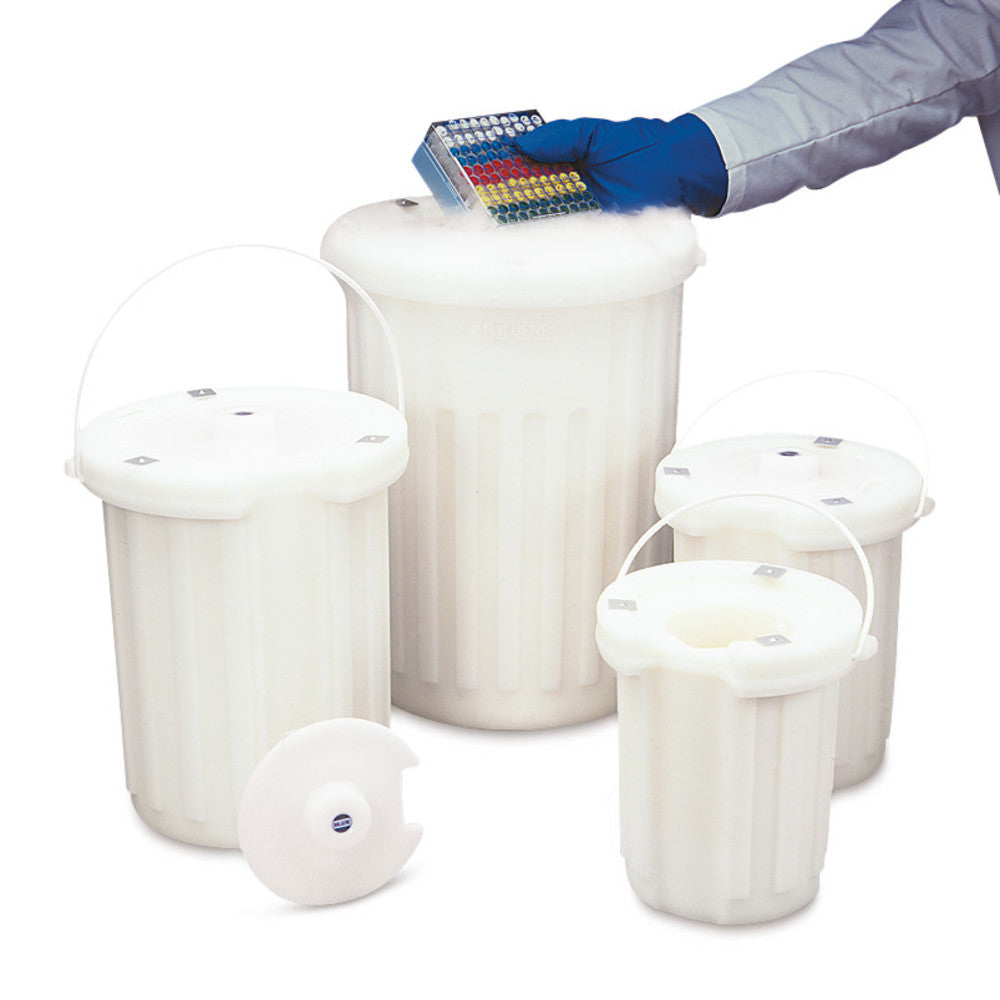


Description
Dewar container 2 litre is a laboratory cooling vessel fabricated from HDPE and delivered with a matching lid for covered temperature-control and cold-holding applications. The two-litre volume supports larger chilled batches, extended cold-sample staging and shared bench cooling duties where a 1 litre vessel is insufficient. HDPE construction provides a durable plastic body suited to routine laboratory handling within the Dewar flasks and temperature-control container class. The included lid assists in keeping contents covered during short transfers and temporary storage. Supplied as 1 pc with a weight of 2,268 kg, the unit is a substantial, freestanding cooling container for organised cold-work zones. This Dewar container from manufacturer Nalgene complements other laboratory glass, vessels and consumables used for cooling workflows. It is aimed at laboratories that specify a 2 litre HDPE Dewar-style container with lid for standardised cold-storage setups. Choose this model when a two-litre capacity, HDPE material and lid-inclusive format are required for everyday Dewar-container use without expanding into unrelated accessory claims.
This article is part of Cryo boxes, racks & freezer storage, in Cryogenics & cold storage.
Key features
- Pack size: 1 pc
- Product type: Dewar container
- Capacity: 2 litre
- Material: HDPE
- Lid: Included
- Weight: 2,268 kg
Recently viewed
You may also like
Questions about Dewar container 2 litre, made of HDPE, incl. lid, 1 unit(s)
What is this article?
Dewar container 2 litre, made of HDPE, incl. lid, 1 unit(s) is the article on this page. Luminix Health distributes Nalgene for laboratory use. It sits in Cryo boxes, racks & freezer storage, inside Cryogenics & cold storage, in Lab consumables.
A cryo box or a freezer rack is how vials are found again at −80 °C or in the vapour phase of nitrogen. The grid, 9×9 or 10×10, has to match the vials. A cardboard box and a polycarbonate box differ in whether they survive liquid nitrogen. The map of the box is part of the sample.
Cold storage slows chemistry and keeps cells, proteins and nucleic acids from falling apart. A cryogenic vial is made to survive liquid-nitrogen temperatures and to be sealed against the liquid. A box and a rack are how those vials are found again. The article is not part of free standard delivery when it must stay cold: cold-chain goods are never included in that free delivery. Biosafety of the material inside is summarised by the WHO laboratory biosafety topic. Reference lines are held by ATCC.
Which category should I open next?
The category is Cryogenics & cold storage. The sub-category is Cryo boxes, racks & freezer storage. The catalogue is Lab consumables.
Shelves beside this one are Cryogenic vials & tubes and Cryo labels & markers.
What should I check before I order?
The technical information on this page is the manufacturer's sheet. Read that, not a rewritten specification.
When this page shows a safety data sheet, use that manufacturer file. Hazard text does not belong in the sales description. For a pack size, a grade or a certificate that is not on the page, send a quote request or contact the team.
How does ordering and shipping work?
Luminix Health distributes this article from the heart of Europe. Articles in stock ship within 2–5 business days. Standard delivery is free from €250 excl. VAT. Cold-chain goods and dangerous goods under ADR are never included in that free delivery. The terms are in the Shipping Policy. The full brand index is on shop by brand. Who we are is on about us.
Which other categories should I open?
The seven catalogues are Labware, Lab chemicals, Lab instruments, Lab consumables, Chromatography equipment, Lab safety equipment and Life Science & Microbiology.