
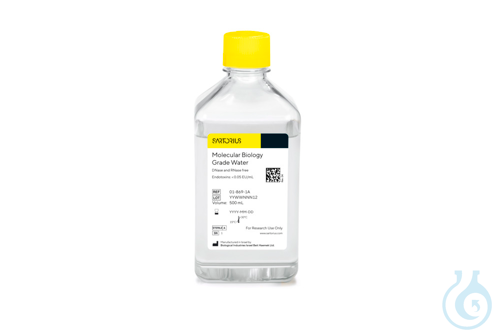



Description
Molecular Biology Grade Water (DNase and RNase-free) is a specialised reagent water designed for cell-culture and molecular biology applications. It undergoes reverse osmosis purification and meets USP and EP testing specifications, ensuring consistent quality for sensitive laboratory work. The solution is free from detectable DNase and RNase activity, with endotoxin levels tested at 0,05 EU/ml, and presents as a clear liquid with a pH between 5,0 and 7,0. Packaged as a single unit with a net weight of 0,500 kg, this water from manufacturer Sartorius supports preparation of buffers, reaction mixes and culture media where nuclease contamination must be avoided. It is well suited to PCR, RT-PCR, cloning, sequencing sample preparation and related nucleic-acid techniques, as well as general cell-culture use. Proper handling under defined conditions enables extended usability in the laboratory environment. The controlled purity profile helps minimise background interference and protects enzyme activity across critical molecular biology workflows that demand reliable nuclease-free water.
This article belongs on Enzymes & substrates, in Biochemicals & reagents.
Key features
- Pack size: 1 pc(s), 0,500 kg net
- Storage temperature: Room Temperature
- Grade: Molecular Biology (DNase and RNase-free)
- Purification: Reverse osmosis
- Testing: Meets USP and EP specifications
- pH range: 5,0 – 7,0
Recently viewed
You may also like
Browse related categories
Category
Sub-category
Catalogue
Brand
Questions about MB Grade Water (DNase RNase-free)
What is this article?
MB Grade Water (DNase RNase-free) is the article on this page. Luminix Health distributes Sartorius for laboratory use. It sits in Enzymes & substrates, inside Biochemicals & reagents, in Life Science & Microbiology.
An enzyme is sold by activity, in units defined by a stated reaction, not only by milligrams. Source and specific activity are the specification. A substrate is the molecule that enzyme converts, often a chromogenic one so the reaction can be seen. Units from two suppliers are comparable only when the definition matches.
A biochemical is a molecule of life, sold as a reagent: an amino acid, a sugar, a nucleotide, a lipid, an enzyme, an antibiotic. The difference from a bulk chemical is that the use is a biological one, and the impurities that matter are the ones that change that use. An enzyme is specified by activity, not only by mass. An antibiotic is specified by potency. Papers are on PubMed. Structures are on PubChem. Strains and lines that consume these reagents are at ATCC.
Which category should I open next?
The category is Biochemicals & reagents. The sub-category is Enzymes & substrates. The catalogue is Life Science & Microbiology.
Shelves beside this one are Amino acids & peptides, Carbohydrates & sugars, Coenzymes, nucleotides & vitamins, Biochemicals (other), Antibiotics & antimycotics, Lipids, steroids & fatty acids and Detergents & surfactants.
What should I check before I order?
When this page shows a safety data sheet, use that manufacturer file. Hazard text does not belong in the sales description. For a pack size, a grade or a certificate that is not on the page, send a quote request or contact the team.
How does ordering and shipping work?
Luminix Health distributes this article from the heart of Europe. Articles in stock ship within 2–5 business days. Standard delivery is free from €250 excl. VAT. Cold-chain goods and dangerous goods under ADR are never included in that free delivery. The terms are in the Shipping Policy. The full brand index is on shop by brand. Who we are is on about us.
Which other categories should I open?
The seven catalogues are Labware, Lab chemicals, Lab instruments, Lab consumables, Chromatography equipment, Lab safety equipment and Life Science & Microbiology.