


Description
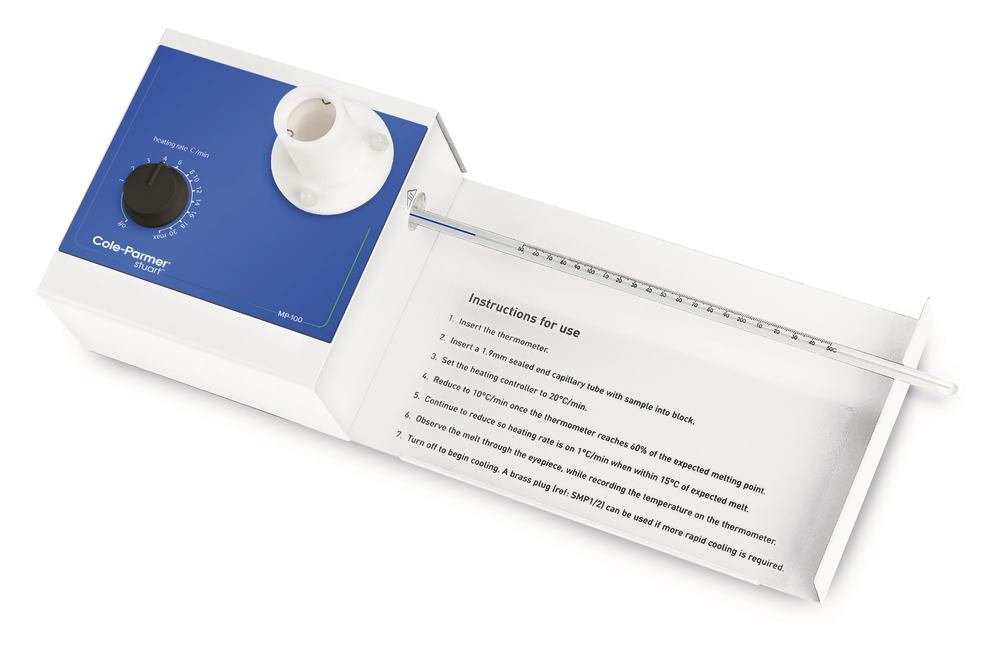
Melting point determination measuring device MP-100 is an analogue instrument for observing and testing up to three samples in parallel during classical melting-point analysis. The three-sample viewing arrangement allows side-by-side comparison of unknowns and references under the same heating conditions, which is useful in organic chemistry, pharmaceutical identity checks and teaching laboratories. Delivery includes 100 melting point tubes that are open at one side, so the workstation can be put into service without a separate capillary order for initial runs. The complete unit weighs 3,000 kg and is supplied as one piece within the melting point measuring devices category of laboratory appliances. Analogue operation keeps the workflow straightforward: load capillaries, heat, and visually record the melt behaviour of each sample. The MP-100 melting point determination measuring device from manufacturer Stuart/Cole-Parmer supports routine solid characterisation where multi-sample observation is preferred. Laboratories specifying an analogue three-sample melting-point station with starter tubes will find this configuration aligned with standard capillary-based melting-point practice.
This article is part of Photometers & spectrophotometers, in Spectroscopy & photometry.
Key features
- Pack size: 1 pc
- Product type: Melting point measuring device
- Model: MP-100
- Operation: Analogue
- Sample capacity: Observe and test 3 samples
- Included: 100 melting point tubes, open at one side
- Technical Information Sheet:

Recently viewed
You may also like
Questions about Melting point determ meas device MP-100, Analogue, observe and test 3 samples,
What is this article?
Melting point determ meas device MP-100, Analogue, observe and test 3 samples, is the article on this page. Luminix Health distributes Stuart/Cole-Parmer for laboratory use. It sits in Photometers & spectrophotometers, inside Spectroscopy & photometry, in Lab instruments.
A photometer reads absorbance at one or a few wavelengths. A spectrophotometer scans or selects many. Both send light through a cuvette or a well. The wavelength range, UV or visible, and the bandwidth decide what can be measured. A visible-only instrument cannot read a nucleic acid at 260 nm.
A photometer or spectrophotometer sends light through a sample and reads how much was absorbed. In the range where the Beer–Lambert relation holds, absorbance tracks concentration. A refractometer reads how a liquid bends light, which tracks dissolved solids. A polarimeter reads the rotation of polarised light, the classical measurement for sugars. The lamp, the wavelength and the cuvette path length are the three things that have to be right before the number means anything. The optical quantities trace to NIST and the BIPM.
Which category should I open next?
The category is Spectroscopy & photometry. The sub-category is Photometers & spectrophotometers. The catalogue is Lab instruments.
Shelves beside this one are Refractometers & polarimeters and Lamps, cuvette holders & accessories.
What should I check before I order?
The technical information on this page is the manufacturer's sheet. Read that, not a rewritten specification.
When this page shows a safety data sheet, use that manufacturer file. Hazard text does not belong in the sales description. For a pack size, a grade or a certificate that is not on the page, send a quote request or contact the team.
How does ordering and shipping work?
Luminix Health distributes this article from the heart of Europe. Articles in stock ship within 2–5 business days. Standard delivery is free from €250 excl. VAT. Cold-chain goods and dangerous goods under ADR are never included in that free delivery. The terms are in the Shipping Policy. The full brand index is on shop by brand. Who we are is on about us.
Which other categories should I open?
The seven catalogues are Labware, Lab chemicals, Lab instruments, Lab consumables, Chromatography equipment, Lab safety equipment and Life Science & Microbiology.