
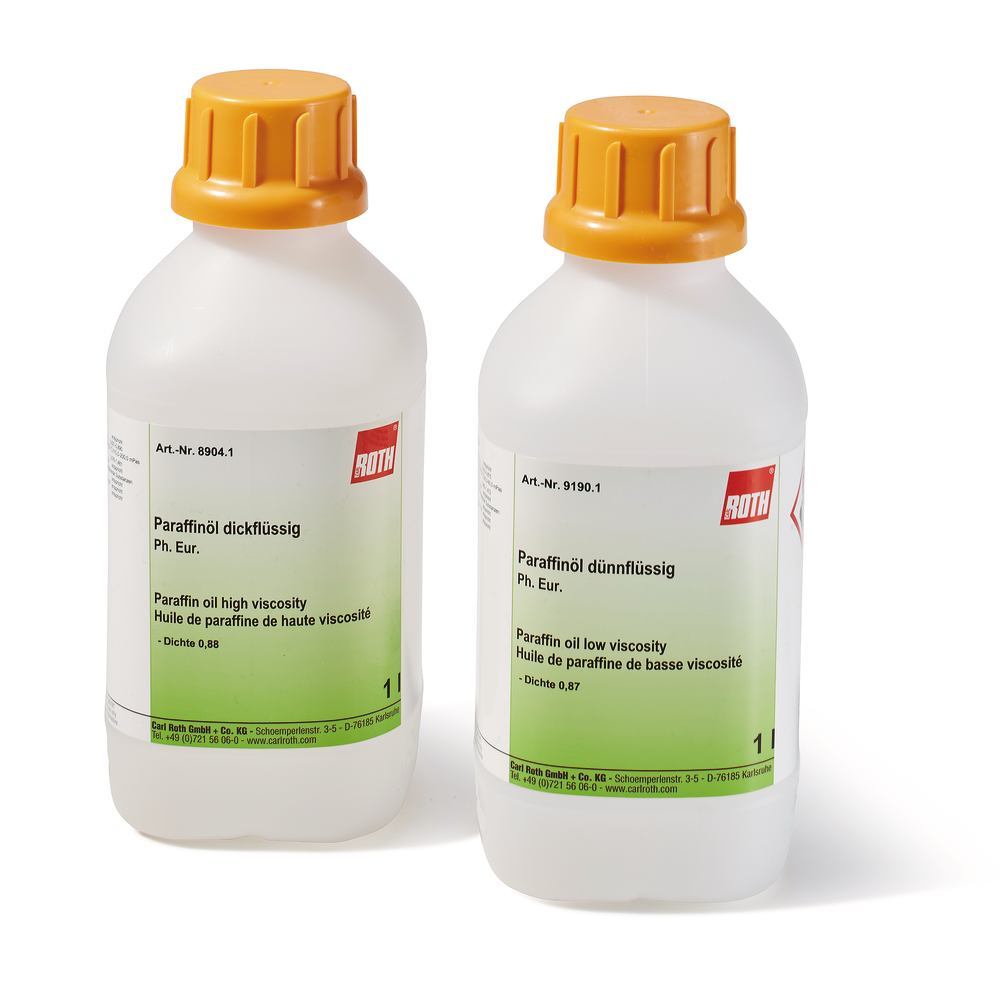


Description
Paraffin oil low viscosity is a ROTI®Pharm Excipient grade mineral oil meeting Ph.Eur. requirements, offered for pharmaceutical and laboratory excipient applications. Identified by CAS number 8042-47-5 and EG nr. 232-455-8, this low-viscosity paraffin oil shows a density range of 0,81 to 0,875 g/cm³, a flash point above 112 °C, and a boiling range from 218 to 800 °C. The product is Typical use includes excipient roles in preparations that call for paraffin oil with controlled physical properties. Clear density, flash-point, and boiling-point data help laboratories select the correct viscosity grade alongside related high-viscosity variants. Packaged for straightforward handling on the bench or in production support areas, this ROTI®Pharm quality oil provides a consistent Ph.Eur. excipient option for regulated and research settings that require documented mineral oil characteristics.
This article is part of Viscometers, in Density & viscosity measurement.
Key features
- Relative density (20 °C): 0.81-0.875
- Dynamic viscosity (20 °C): 25-80 mPas
- Refractive index: 1.462-1.472
- Reaction with H2SO4: complies
- Acid or alkaline react. substances: complies
- Aromatic polycyclic hydrocarbons: complies
- Solid paraffins: complies
- Date of Manufacture: see certificate of analysis
- CAS number: 8042-47-5
- Pack sizes: 1 l, 5 l, 25 l
- EG nr.: 232-455-8
- Density: 0,81 to 0,875 g/cm³
- Flash point: >112 °C
- Technical Information Sheet:

- Safety Data Sheet:
Compliance & Safety Information
 Danger
Hazard Statements (H-Phrases)
Precautionary Statements (P-Phrases)
Recently viewed
You may also like
Questions about Paraffin oil low viscosity, ROTI®Pharm Excipient, 1 l, plastic
What is this article?
Paraffin oil low viscosity, ROTI®Pharm Excipient, 1 l, plastic is the article on this page. Luminix Health distributes Carl Roth for laboratory use. It sits in Viscometers, inside Density & viscosity measurement, in Lab instruments.
A capillary viscometer times the flow of a liquid through a tube. A rotational viscometer twists a spindle in the liquid. Both need a stated temperature. Kinematic and dynamic viscosity are different numbers. The capillary size has to put the flow time in the range the method allows.
Density is mass divided by volume. A hydrometer floats at a depth that depends on the density of the liquid. A pycnometer is a vessel of known volume that is weighed full. Viscosity is the resistance to flow. A capillary viscometer times how long a volume takes to fall through a tube. Both measurements need a stated temperature, because liquids change density and viscosity as they warm. The units trace to the BIPM and to NIST.
Which category should I open next?
The category is Density & viscosity measurement. The sub-category is Viscometers. The catalogue is Lab instruments.
Shelves beside this one are Hydrometers and Density meters & pycnometers.
What should I check before I order?
The technical information on this page is the manufacturer's sheet. Read that, not a rewritten specification.
When this page shows a safety data sheet, use that manufacturer file. Hazard text does not belong in the sales description. For a pack size, a grade or a certificate that is not on the page, send a quote request or contact the team.
How does ordering and shipping work?
Luminix Health distributes this article from the heart of Europe. Articles in stock ship within 2–5 business days. Standard delivery is free from €250 excl. VAT. Cold-chain goods and dangerous goods under ADR are never included in that free delivery. The terms are in the Shipping Policy. The full brand index is on shop by brand. Who we are is on about us.
Which other categories should I open?
The seven catalogues are Labware, Lab chemicals, Lab instruments, Lab consumables, Chromatography equipment, Lab safety equipment and Life Science & Microbiology.