
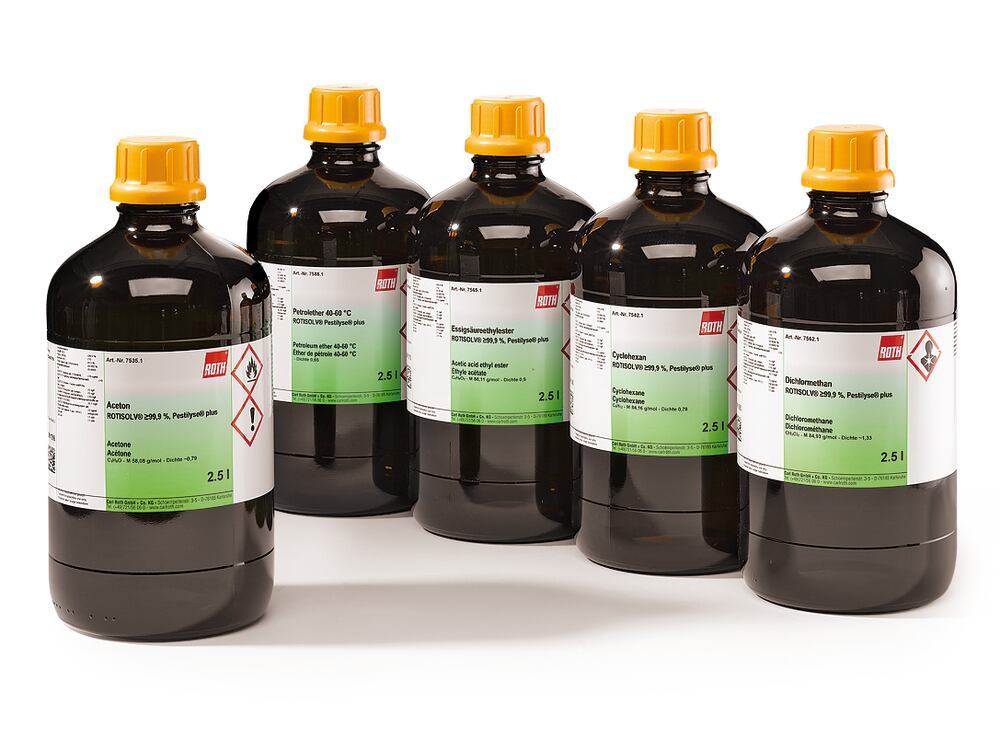


Description
Petroleum ether 40-60 °C is a low-boiling hydrocarbon solvent fraction supplied in ROTISOLV® Pestilyse® plus quality for chromatographic and GC-related laboratory work. The boiling range of 40 to 60 °C defines the cut, while a density of 0,65 g/cm³ and a flash point of −40 °C describe key physical behaviour for process planning and safe handling. The material is packed as 2,5 l in glass, a practical volume for routine extraction, sample preparation and solvent applications in analytical laboratories. Petroleum ether 40-60 °C from manufacturer Carl ROTH under the ROTISOLV® Pestilyse® plus designation suits workflows that need a controlled solvent grade for chromatographic use. UN number 3295 applies for transport classification. Clear boiling-range labelling helps match the solvent to method requirements where a 40–60 °C petroleum ether cut is specified. Handle as a highly flammable liquid in accordance with laboratory safety rules and the product safety data sheet.
This article is part of HPLC & LC-MS grade solvents, in Solvents. See also Analytical grade solvents (p.a.).
Key features
- Boiling range: 40-60 °C
- Colour (APHA): ≤10
- Water (KF): ≤0.005 %
- Free acid (as CH3COOH): ≤0.002 %
- Evaporation residue: ≤0.0003 %
- GC/FID suitability (as 2-octanol): ≤10 ng/ml
- GC/ECD suitability (as heptachloro epoxide): ≤10 ng/l
- GC/ECD dioxins, furans and PCBs (as lindane): ≤5 ng/l
- GC/ECD pesticides (as lindane): ≤5 ng/l
- GC/NPD pesticides (as parathion): ≤10 ng/l
- Pack size: 2,5 l glass
- Density: 0,65 g/cm³
- Flash point: −40 °C
- Boiling point: 40 to 60 °C
- Grade: ROTISOLV® Pestilyse® plus
- Technical Information Sheet:

- Safety Data Sheet:
Compliance & Safety Information
 Danger
Hazard Statements (H-Phrases)
Precautionary Statements (P-Phrases)
Recently viewed
You may also like
Browse related categories
Category
Sub-category
Catalogue
Brand
Questions about Petroleum ether 40-60 °C, ROTISOLV® Pestilyse® plus, 2.5 l, glass
What is this article?
Petroleum ether 40-60 °C, ROTISOLV® Pestilyse® plus, 2.5 l, glass is the article on this page. Luminix Health distributes Carl Roth for laboratory use. It sits in HPLC & LC-MS grade solvents, inside Solvents, in Lab chemicals.
HPLC grade limits the absorbance and the residue that would appear as peaks or baseline drift. LC-MS grade goes further on metal ions and on particles that would suppress a mass spectrum. A solvent that is only analytical grade is a false economy on an LC-MS system.
A solvent dissolves. The grade says which impurities are low enough for the method. Analytical grade is the ordinary pure solvent. HPLC and LC-MS grades limit the absorbance and the ions that would become peaks or background. A dry solvent has had water removed. A deuterated solvent is for NMR, where the hydrogen signal would otherwise drown the sample. Technical grade is for cleaning and for synthesis that does not need a chromatogram. Identity is on PubChem. Names follow IUPAC. Hazards follow ECHA, the CLP Regulation and REACH.
Which category should I open next?
The category is Solvents. The sub-category is HPLC & LC-MS grade solvents. The catalogue is Lab chemicals.
Shelves beside this one are Analytical grade solvents (p.a.), Dry & deuterated solvents (NMR, synthesis), Technical & synthesis grade solvents and Green & alternative solvents.
What should I check before I order?
The technical information on this page is the manufacturer's sheet. Read that, not a rewritten specification.
When this page shows a safety data sheet, use that manufacturer file. Hazard text does not belong in the sales description. For a pack size, a grade or a certificate that is not on the page, send a quote request or contact the team.
How does ordering and shipping work?
Luminix Health distributes this article from the heart of Europe. Articles in stock ship within 2–5 business days. Standard delivery is free from €250 excl. VAT. Cold-chain goods and dangerous goods under ADR are never included in that free delivery. The terms are in the Shipping Policy. The full brand index is on shop by brand. Who we are is on about us.
Which other categories should I open?
The seven catalogues are Labware, Lab chemicals, Lab instruments, Lab consumables, Chromatography equipment, Lab safety equipment and Life Science & Microbiology.