



Description
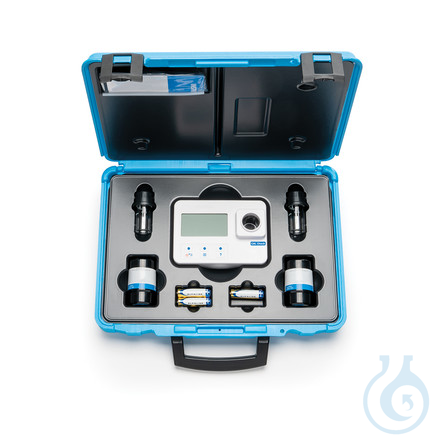
Cyanide photometer HI97714C is a portable, battery-powered instrument for photometric cyanide determination from 0,000 to 0,200 mg/L, with 0,001 mg/L resolution and accuracy of ±0,005 mg/L ±3 % of reading at 25 °C. Measurement uses an LED source at 610 nm (±8 nm) with a silicon photocell detector and a method adapted from the pyridine-pyrazolone procedure. The sealed optical path resists dust, dirt and water and ensures cuvettes return to the same position for repeatable readings. In water, cyanide species that liberate CN⁻ often originate from metallurgical and electroplating operations and are highly toxic to the human nervous system, making reliable low-level monitoring important. CAL CHECK™ with NIST-traceable standards lets users verify performance and recalibrate when needed; an on-board tutorial details sample preparation and reagent quantities. The series offers German menu guidance, automatic storage of the last 50 readings, GLP access to the last calibration date and time, a reaction timer, battery-life display, clear error prompts and auto power-off. The IP67 meter (about 142,5 × 102,5 × 50,5 mm, 380 g) from Hanna Instruments ships in a transport case with two capped cuvettes, plastic inserts, CAL CHECK™ standards, scissors, cleaning cloth, three 1,5 V AA batteries, quality certificate and operating manual; reagents must be ordered separately.
This article is part of Photometers & spectrophotometers, in Spectroscopy & photometry.
Key features
- Pack size: 1 pc
- Measurement range: 0,000–0,200 mg/L
- Resolution: 0,001 mg/L
- Wavelength: 610 nm
- Method: Adapted pyridine-pyrazolone method
- Cuvette type: round, 24,6 mm diameter
Compliance & Safety Information
 Danger
Recently viewed
You may also like
Questions about Portable Photometer for Cyanide with CAL Check standards
What is this article?
Portable Photometer for Cyanide with CAL Check standards is the article on this page. Luminix Health distributes Hanna Instruments for laboratory use. It sits in Photometers & spectrophotometers, inside Spectroscopy & photometry, in Lab instruments.
A photometer reads absorbance at one or a few wavelengths. A spectrophotometer scans or selects many. Both send light through a cuvette or a well. The wavelength range, UV or visible, and the bandwidth decide what can be measured. A visible-only instrument cannot read a nucleic acid at 260 nm.
A photometer or spectrophotometer sends light through a sample and reads how much was absorbed. In the range where the Beer–Lambert relation holds, absorbance tracks concentration. A refractometer reads how a liquid bends light, which tracks dissolved solids. A polarimeter reads the rotation of polarised light, the classical measurement for sugars. The lamp, the wavelength and the cuvette path length are the three things that have to be right before the number means anything. The optical quantities trace to NIST and the BIPM.
Which category should I open next?
The category is Spectroscopy & photometry. The sub-category is Photometers & spectrophotometers. The catalogue is Lab instruments.
Shelves beside this one are Refractometers & polarimeters and Lamps, cuvette holders & accessories.
What should I check before I order?
When this page shows a safety data sheet, use that manufacturer file. Hazard text does not belong in the sales description. For a pack size, a grade or a certificate that is not on the page, send a quote request or contact the team.
How does ordering and shipping work?
Luminix Health distributes this article from the heart of Europe. Articles in stock ship within 2–5 business days. Standard delivery is free from €250 excl. VAT. Cold-chain goods and dangerous goods under ADR are never included in that free delivery. The terms are in the Shipping Policy. The full brand index is on shop by brand. Who we are is on about us.
Which other categories should I open?
The seven catalogues are Labware, Lab chemicals, Lab instruments, Lab consumables, Chromatography equipment, Lab safety equipment and Life Science & Microbiology.