
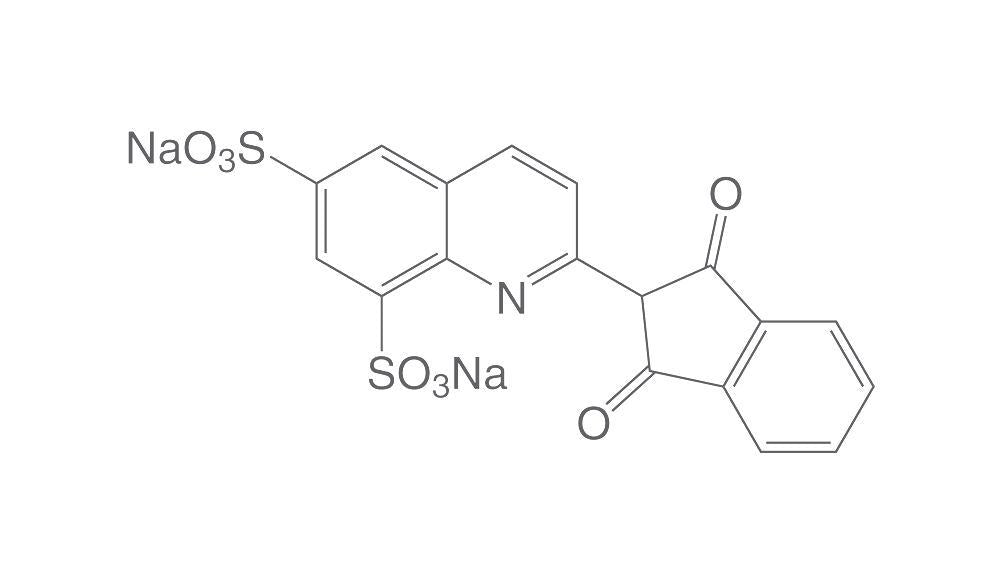


Description
Quinoline yellow (C.I. 47005) is an extra pure dye with CAS number 8004-92-0 and empirical formula C₁₈H₉NO₈S₂Na₂. It has a molar mass of 477,38 g/mol and a density of 0,587 g/cm³, making it suitable for analytical and laboratory colouring applications that require a defined quinoline-based colourant. The material is offered by manufacturer Carl ROTH as a compact laboratory quantity that is convenient for bench-scale use. Its well-characterised physical data and Colour Index designation facilitate identification and method documentation. Laboratories handling food-colour or indicator-related studies can rely on the stated composition and purity level for consistent preparation of solutions and standards.
This article is part of Organic building blocks & synthesis reagents, in Organic chemicals & synthesis reagents.
Key features
- Appearance: yellow to orange powder
- Loss on drying (135 °C): ≤30 %
- CAS number: 8004-92-0
- Pack sizes: 10 g, 25 g, 100 g
- EG nr.: 305-897-5
- Molar mass: 477,38 g/mol
- Density: 0,587 g/cm³
- Technical Information Sheet:

- Safety Data Sheet:
Recently viewed
You may also like
Browse related categories
Category
Organic chemicals & synthesis reagents
Sub-category
Organic building blocks & synthesis reagents
Catalogue
Brand
Questions about Quinoline yellow (C.I. 47005), extra pure, 10 g, glass
What is this article?
Quinoline yellow (C.I. 47005), extra pure, 10 g, glass is the article on this page. Luminix Health distributes Carl Roth for laboratory use. It sits in Organic building blocks & synthesis reagents, inside Organic chemicals & synthesis reagents, in Lab chemicals.
A building block is an organic molecule bought to become part of a larger one. The structure, the CAS number and the purity decide it. A 95 percent reagent and a 99.9 percent reagent of the same name leave different impurities in the product. The functional groups are the reason it was chosen.
An organic chemical is built on carbon. In this category it is a building block or a reagent for making another molecule: a starting material, a coupling agent, a polymer, a PEG. Purity is a specification of which impurities remain. The structure, the CAS number and the grade decide whether two bottles are the same substance. Structures and properties are on PubChem. Nomenclature is IUPAC. Classification follows ECHA and the CLP Regulation.
Which category should I open next?
The category is Organic chemicals & synthesis reagents. The sub-category is Organic building blocks & synthesis reagents. The catalogue is Lab chemicals.
Shelves beside this one are Polymers, PEGs & silicones and Click chemistry, bioconjugation & synthesis reagents.
What should I check before I order?
The technical information on this page is the manufacturer's sheet. Read that, not a rewritten specification.
When this page shows a safety data sheet, use that manufacturer file. Hazard text does not belong in the sales description. For a pack size, a grade or a certificate that is not on the page, send a quote request or contact the team.
How does ordering and shipping work?
Luminix Health distributes this article from the heart of Europe. Articles in stock ship within 2–5 business days. Standard delivery is free from €250 excl. VAT. Cold-chain goods and dangerous goods under ADR are never included in that free delivery. The terms are in the Shipping Policy. The full brand index is on shop by brand. Who we are is on about us.
Which other categories should I open?
The seven catalogues are Labware, Lab chemicals, Lab instruments, Lab consumables, Chromatography equipment, Lab safety equipment and Life Science & Microbiology.