
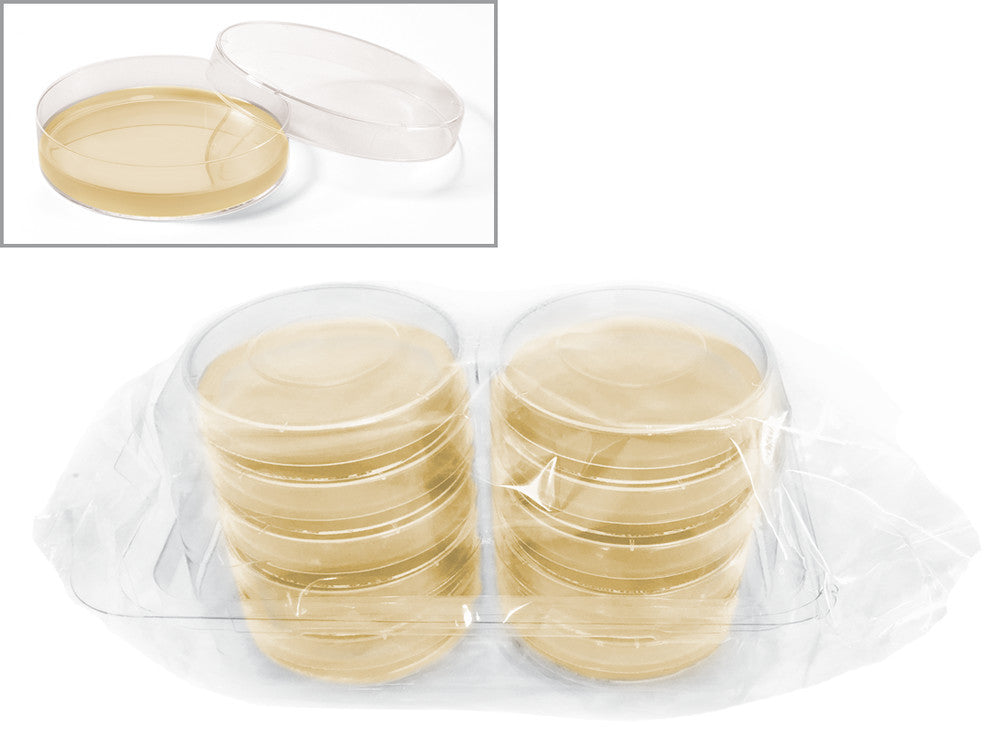


Description
ROTI®Aquatest Plate YE, DEV, ISO 6222, ready-to-use, sterile, for microbiology, Density (D) 1,032 g/cm³, Storage temp. +4 °C
Sterile culture medium plates for the microbiological analysis of liquid samples.
- Diameter 55 mm
- Surface 24 cm2
- Easy to use
- Optimal for the membrane filtration method
- Also well applicable for microbiological analysis of samples in general
- Prepared with our proven dehydrated nutrient media mixtures
- With detailed instructions-for-use
ROTI®Aquatest Plates are prepared culture media plates with a diameter of 55 mm. They are thus adapted to the size of membrane filters for assaying of low-germ fluids by membrane filtration method. They are also applicable for the microbiological analysis of samples in general. The germs of expected low-germ liquid samples are concentrated by membrane filtration. Afterwards, the membrane is placed on top of the medium and incubated. Using a membrane with a grid helps counting the resulting colonies.
Samples which are expected to have a higher microbiological burden are prepared in a serial dilution. Afterwards, every dilution step is plated and incubated. The number of grown colonies is noted as result.
The Yeast Extract Agar (Art. No. CP63) is recommended for enumeration of microorganisms in general.
| Verification of | Yeasts and moulds aerobic microorganisms Bacillus subtilis Escherichia coli |
| Application | General non-selective counting |
| Growth surface | 24 cm² |
| Certified according to | ISO 6222 |
| Ø | 55 mm |
Recently viewed
You may also like
Browse related categories
Category
Sub-category
Catalogue
Brand
Questions about ROTI®Aquatest Plate YE, DEV, ISO 6222, ready-to-use, sterile, for microbiology
What is this article?
ROTI®Aquatest Plate YE, DEV, ISO 6222, ready-to-use, sterile, for microbiology is the article on this page. Luminix Health distributes Carl Roth for laboratory use. It sits in DNA & RNA extraction kits, inside Molecular biology, in Life Science & Microbiology.
An extraction kit lyses the sample and then binds the nucleic acid, usually on a column or on a bead, and washes the rest away. Kits for blood, tissue, soil or a PCR cleanup are different chemistries. Yield and the size of fragments they keep are in the protocol. An RNA kit has to protect against RNase.
Molecular biology here is the handling of DNA and RNA. Extraction kits break the cell and then separate the nucleic acid from protein and from the other nucleic acid. PCR and qPCR reagents copy a chosen sequence so it can be seen. The enzymes and the nucleotides are what the copy depends on. Nuclease contamination destroys the sample before the kit can save it. Sequences are on NCBI Nucleotide. Papers are on PubMed.
Which category should I open next?
The category is Molecular biology. The sub-category is DNA & RNA extraction kits. The catalogue is Life Science & Microbiology.
Shelves beside this one are Molecular biology reagents (other) and PCR, qPCR & nucleic acid analysis reagents.
What should I check before I order?
The technical information on this page is the manufacturer's sheet. Read that, not a rewritten specification.
When this page shows a safety data sheet, use that manufacturer file. Hazard text does not belong in the sales description. For a pack size, a grade or a certificate that is not on the page, send a quote request or contact the team.
How does ordering and shipping work?
Luminix Health distributes this article from the heart of Europe. Articles in stock ship within 2–5 business days. Standard delivery is free from €250 excl. VAT. Cold-chain goods and dangerous goods under ADR are never included in that free delivery. The terms are in the Shipping Policy. The full brand index is on shop by brand. Who we are is on about us.
Which other categories should I open?
The seven catalogues are Labware, Lab chemicals, Lab instruments, Lab consumables, Chromatography equipment, Lab safety equipment and Life Science & Microbiology.