


Description
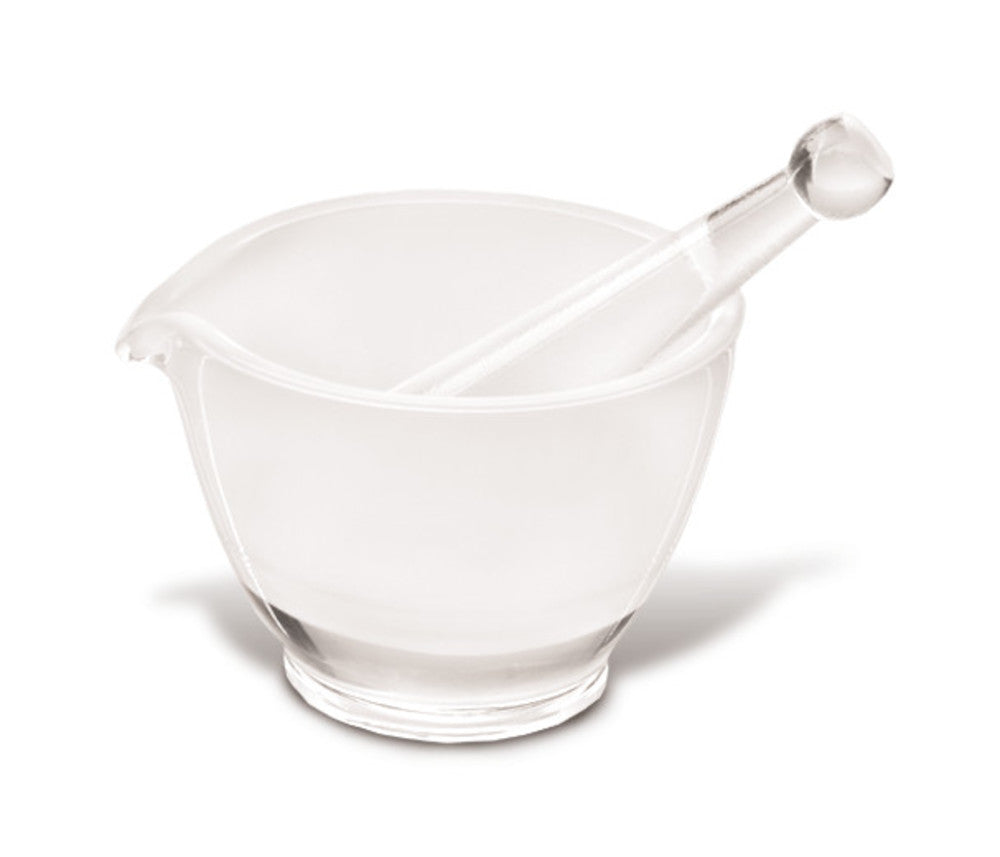
Rotilabo® mortar with pestle is a laboratory grinding set manufactured from borosilicate glass 3.3 with an approximate capacity of 200 ml. Mortar and pestle together support controlled manual crushing, blending and homogenisation of solid materials in analytical, quality-control and research workflows. Borosilicate glass 3.3 delivers the chemical resistance and thermal behaviour required for regular laboratory use with a broad range of sample types and reagents. The article is supplied as one complete unit for convenient bench-top sample preparation before dissolution, weighing or instrumental analysis. With a unit weight of 0,600 kg the vessel provides a solid working base while remaining manageable for daily handling and cleaning. Transparent glass allows continuous visual assessment of grinding progress and particle fineness. This Rotilabo® mortar with pestle from manufacturer ROTH SELECTION is well suited to chemistry, pharmaceutical, materials science and educational laboratories seeking a robust glass mortar-and-pestle set for medium small-volume work among standard mortars and grinding dishes.
This article belongs on Mortars & pestles, in Dishes, crucibles & porcelain.
Key features
- Pack size: 1 pc
- Product type: Mortar with pestle
- Material: Borosilicate glass 3.3
- Capacity: approx. 200 ml
- Weight: 0,600 kg
- Includes: Matching pestle
Recently viewed
You may also like
Browse related categories
Category
Sub-category
Catalogue
Brand
Questions about Rotilabo®-mortar with pestle, borosilicate glass 3.3, approx. 200 ml, 1 unit(s)
What is this article?
Rotilabo®-mortar with pestle, borosilicate glass 3.3, approx. 200 ml, 1 unit(s) is the article on this page. Luminix Health distributes Carl Roth for laboratory use. It sits in Mortars & pestles, inside Dishes, crucibles & porcelain, in Labware.
A mortar and pestle grind a solid by hand. Porcelain is the ordinary laboratory set. Agate and glass are chosen when the sample must not pick up porcelain dust. The unglazed grinding surface, not the glossy outside, does the work.
A dish is an open vessel for drying, evaporating or holding a solid. Porcelain and glazed ceramic take a higher temperature than borosilicate glass, which is why a crucible, not a beaker, goes into a furnace. A watch glass covers, or holds a small amount for drying. A mortar is for grinding. The temperature and the chemical, not the shape alone, choose the material. Laboratory ware of this family is listed under ISO laboratory ware.
Which category should I open next?
The category is Dishes, crucibles & porcelain. The sub-category is Mortars & pestles. The catalogue is Labware.
Shelves beside this one are Crucibles, Trays, bowls & tubs, Watch glasses & crystallising dishes, Evaporating dishes and Dishes (other).
What should I check before I order?
The technical information on this page is the manufacturer's sheet. Read that, not a rewritten specification.
When this page shows a safety data sheet, use that manufacturer file. Hazard text does not belong in the sales description. For a pack size, a grade or a certificate that is not on the page, send a quote request or contact the team.
How does ordering and shipping work?
Luminix Health distributes this article from the heart of Europe. Articles in stock ship within 2–5 business days. Standard delivery is free from €250 excl. VAT. Cold-chain goods and dangerous goods under ADR are never included in that free delivery. The terms are in the Shipping Policy. The full brand index is on shop by brand. Who we are is on about us.
Which other categories should I open?
The seven catalogues are Labware, Lab chemicals, Lab instruments, Lab consumables, Chromatography equipment, Lab safety equipment and Life Science & Microbiology.