


Description
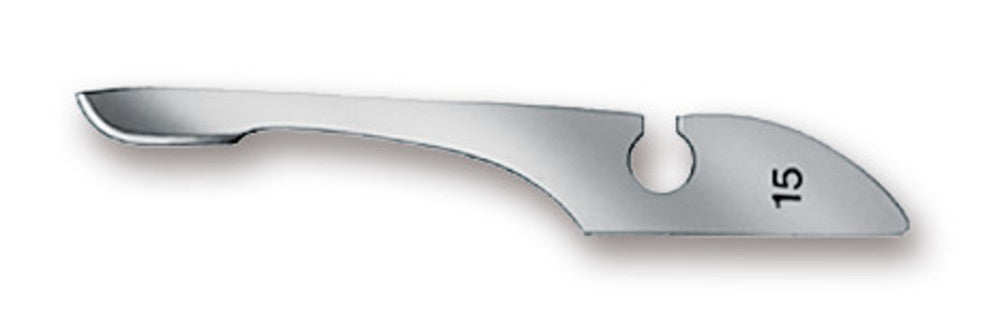
Scalpel blades, type 15, sterile are laboratory blades for use with Bayha-type scalpel handles in microscopy, histology and related instrument applications requiring sterile presentation. Supplied in a pack of 144 pc(s) weighing 0,300 kg, they provide a practical bulk quantity for regular cutting and sample-preparation duties. Type 15 geometry is intended for controlled laboratory sectioning and pairs with matching Bayha handles already common in many research and diagnostic environments. The blades are from manufacturer Bayha, enabling continuity for sites standardised on that handle platform. Sterile packaging suits workflows in which contamination control is part of the protocol. Distinct type labelling aids correct selection, stock organisation and replacement ordering within a mixed blade inventory. As part of the scalpels and blades range for microscopy, histology and instruments, these type 15 sterile blades fit established laboratory cutting routines. The 144-piece pack supports shared benches and higher sample volumes where a reliable reserve of sterile blades is needed.
This article is part of Scissors, scalpels & dissecting instruments, in Tools & accessories.
Key features
- Pack size: 144 pc(s)
- Blade type: 15
- Sterility: Sterile
- Weight: 0,300 kg
- Product group: Scalpels and blades
- Application area: Microscopy, histology, instruments
Recently viewed
You may also like
Browse related categories
Category
Sub-category
Scissors, scalpels & dissecting instruments
Catalogue
Brand
Questions about Scalpel blades, type 15, sterile, 144 unit(s)
What is this article?
Scalpel blades, type 15, sterile, 144 unit(s) is the article on this page. Luminix Health distributes Bayha for laboratory use. It sits in Scissors, scalpels & dissecting instruments, inside Tools & accessories, in Labware.
Scissors, scalpels and dissecting instruments cut or hold tissue and tough samples. The edge and the shape, blunt or sharp, straight or curved, are the specification. A dissecting set is not a surgical implant set.
The small tools of the bench are what the hand actually holds: a spatula for a powder, forceps for an object that must stay clean, a brush for a narrow neck, a desiccator when a dried sample must not take up water again. None of these reads a measurement. They keep the measurement possible. The apparatus around them is listed under ISO laboratory apparatus.
Which category should I open next?
The category is Tools & accessories. The sub-category is Scissors, scalpels & dissecting instruments. The catalogue is Labware.
Shelves beside this one are Spatulas & spoons, Other lab tools & accessories, Lab furniture, trolleys & storage, Tweezers & forceps, Weighing boats, dishes & paper, Desiccators & desiccant, Grease, boiling stones & sealants, Timers, stopwatches & calculators, Stationery, books & lab notebooks, Brushes & cleaning tools, Stirring rods, spreaders & glass tools, Cutting & sealing tools and Gas handling & burners accessories.
What should I check before I order?
The technical information on this page is the manufacturer's sheet. Read that, not a rewritten specification.
When this page shows a safety data sheet, use that manufacturer file. Hazard text does not belong in the sales description. For a pack size, a grade or a certificate that is not on the page, send a quote request or contact the team.
How does ordering and shipping work?
Luminix Health distributes this article from the heart of Europe. Articles in stock ship within 2–5 business days. Standard delivery is free from €250 excl. VAT. Cold-chain goods and dangerous goods under ADR are never included in that free delivery. The terms are in the Shipping Policy. The full brand index is on shop by brand. Who we are is on about us.
Which other categories should I open?
The seven catalogues are Labware, Lab chemicals, Lab instruments, Lab consumables, Chromatography equipment, Lab safety equipment and Life Science & Microbiology.