


Description
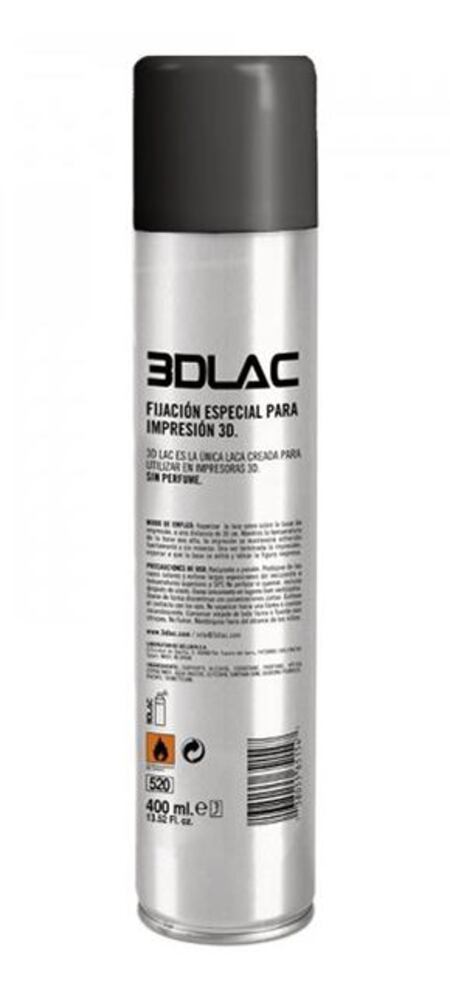
3DLac spray adhesive is a build-surface adhesive supplied as a 400 ml spray can for conventional 3D printing. It is used to promote adhesion between printed parts and the build plate, helping reduce unwanted detachment during printing. The formulation is characterised by a flash point of 12 °C and is classified under UN number 1950, which is relevant for safe storage, transport, and laboratory handling. Presented in an easy-to-apply aerosol format, the adhesive supports quick, even coverage of print beds in workshop and research settings. 3DLac spray adhesive from manufacturer 3DLac fits accessory workflows where repeatable first-layer grip is required across common filament materials. The 400 ml pack size is practical for frequent use on multiple printers or larger build surfaces. Apply a thin, uniform film as part of standard bed preparation, then clean the plate according to your process requirements after printing. This product is positioned among adhesives for 3D printing and complements other bed-preparation tools used in additive manufacturing laboratories and production cells.
This article belongs on Shakers, rockers & rotators, in Stirring, shaking & mixing.
Key features
- Pack size: 400 ml spray can
- Flash point: 12 °C
- Product type: Spray adhesive for 3D printing
- UN nr.: 1950
- EAN: 8411322235803
- Technical Information Sheet:

- Safety Data Sheet:
Compliance & Safety Information
 Danger
Hazard Statements (H-Phrases)
Precautionary Statements (P-Phrases)
Recently viewed
You may also like
Browse related categories
Category
Sub-category
Catalogue
Brand
Questions about 3DLac spray adhesive, 400 ml
What is this article?
3DLac spray adhesive, 400 ml is the article on this page. Luminix Health distributes 3DLac for laboratory use. It sits in Shakers, rockers & rotators, inside Stirring, shaking & mixing, in Lab instruments.
A shaker, rocker or rotator moves a rack, a plate or a bottle so the contents keep moving without a stirrer bar. Orbital, reciprocating and rocking motions are different. The platform, the load and the speed range are the specification.
Stirring keeps a mixture uniform or helps a solid dissolve. A magnetic stirrer spins a bar inside a closed vessel. An overhead stirrer drives a shaft when the liquid is viscous or the volume is large. A vortex mixer agitates a tube. A shaker moves a whole rack or a plate. The shape of the impeller and the speed decide whether the liquid turns over or merely spins. The vessels being stirred are indexed under ISO laboratory glassware.
Which category should I open next?
The category is Stirring, shaking & mixing. The sub-category is Shakers, rockers & rotators. The catalogue is Lab instruments.
Shelves beside this one are Magnetic stirring bars, Stirring shafts, propellers & impellers, Magnetic stirrers, Stirring & mixing accessories, Homogenisers & dispersers, Overhead stirrers and Vortex mixers.
What should I check before I order?
The technical information on this page is the manufacturer's sheet. Read that, not a rewritten specification.
When this page shows a safety data sheet, use that manufacturer file. Hazard text does not belong in the sales description. For a pack size, a grade or a certificate that is not on the page, send a quote request or contact the team.
How does ordering and shipping work?
Luminix Health distributes this article from the heart of Europe. Articles in stock ship within 2–5 business days. Standard delivery is free from €250 excl. VAT. Cold-chain goods and dangerous goods under ADR are never included in that free delivery. The terms are in the Shipping Policy. The full brand index is on shop by brand. Who we are is on about us.
Which other categories should I open?
The seven catalogues are Labware, Lab chemicals, Lab instruments, Lab consumables, Chromatography equipment, Lab safety equipment and Life Science & Microbiology.