
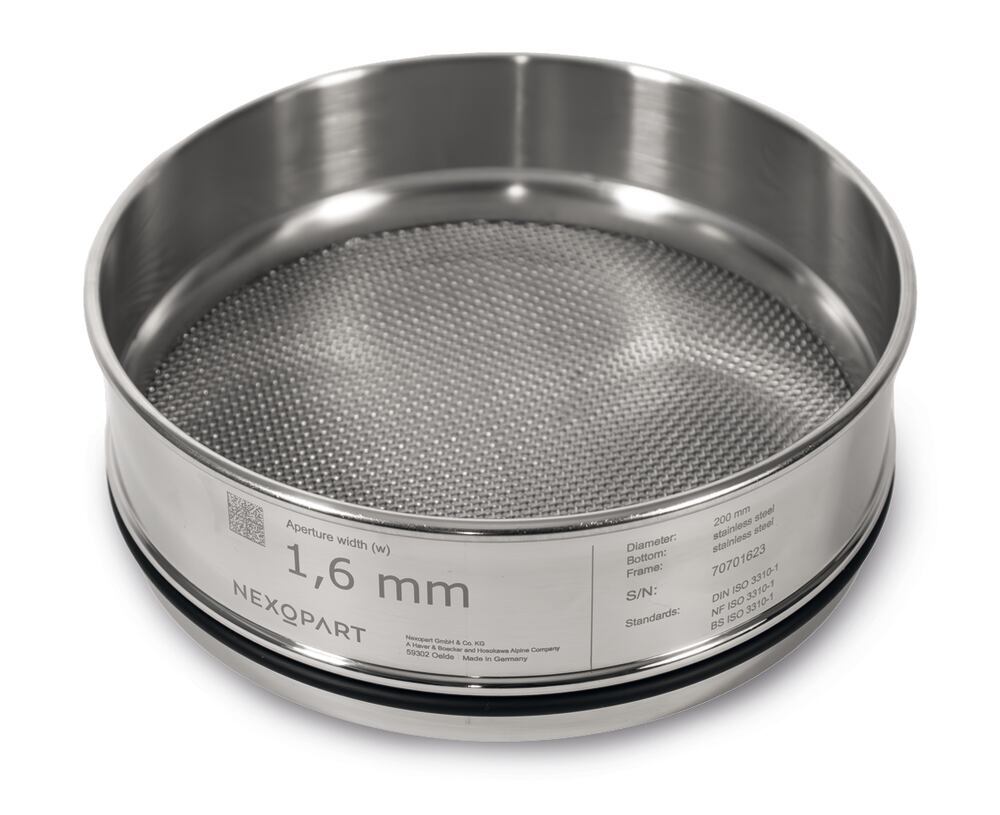



Description
Analytical sieve with a diameter of 200 mm and a mesh size of 0,02 mm is intended for particle-size separation and analysis in laboratory filtration and sieving workflows. The fine 0,02 mm mesh supports classification of finely divided solids where controlled fractionation is required for quality control, research or process monitoring. The 200 mm diameter matches common analytical sieve formats used with compatible sieving equipment and stack arrangements. Supplied as 1 pc, the sieve is a single analytical unit with a pack weight of 0,460 kg, suitable for dedicated bench or instrument use. This analytical sieve from manufacturer NEXOPART belongs to the labware category for filtration, separation and analysis sieves, making it appropriate for laboratories that standardise on 200 mm frames. The defined mesh opening of 0,02 mm enables reproducible separation steps when characterising powders, granules or other particulate samples. Integrate it into existing sieving protocols alongside matching lids, receivers or mechanical sieve shakers where a fine mesh analytical sieve of this diameter is specified.
This article is part of Test sieves (wire mesh), in Test sieves & mills.
Key features
- Pack size: 1 pc
- Diameter: 200 mm
- Mesh size: 0,02 mm
- Weight: 0,460 kg
- Product type: Analytical sieve
Recently viewed
You may also like
Browse related categories
Category
Sub-category
Catalogue
Brand
Questions about Analytical sieve Ø 200 mm, 0,02 mm mesh size, 1 unit(s)
What is this article?
Analytical sieve Ø 200 mm, 0,02 mm mesh size, 1 unit(s) is the article on this page. Luminix Health distributes NEXOPART for laboratory use. It sits in Test sieves (wire mesh), inside Test sieves & mills, in Lab instruments.
A wire-mesh test sieve sorts particles through a woven opening of a stated nominal size. The frame diameter and the mesh are the specification. A sieve without a certificate is a screen, not a measurement.
A test sieve sorts particles by whether they pass an opening. Wire mesh and perforated plate are two ways of making that opening, and the nominal size is not a suggestion. A sieve shaker repeats the motion so the result does not depend on how hard someone shook by hand. A mill or grinder makes the particles smaller before they are sieved. The certificate of the sieve, and the opening size, are what an audit asks for. Measurement practice around mass and dimension sits with the BIPM, EURAMET and BELAC.
Which category should I open next?
The category is Test sieves & mills. The sub-category is Test sieves (wire mesh). The catalogue is Lab instruments.
Shelves beside this one are Test sieves (perforated plate), Mills, grinders & homogenisers, Sieve shakers and Sieve accessories (lids, pans, rings).
What should I check before I order?
The technical information on this page is the manufacturer's sheet. Read that, not a rewritten specification.
When this page shows a safety data sheet, use that manufacturer file. Hazard text does not belong in the sales description. For a pack size, a grade or a certificate that is not on the page, send a quote request or contact the team.
How does ordering and shipping work?
Luminix Health distributes this article from the heart of Europe. Articles in stock ship within 2–5 business days. Standard delivery is free from €250 excl. VAT. Cold-chain goods and dangerous goods under ADR are never included in that free delivery. The terms are in the Shipping Policy. The full brand index is on shop by brand. Who we are is on about us.
Which other categories should I open?
The seven catalogues are Labware, Lab chemicals, Lab instruments, Lab consumables, Chromatography equipment, Lab safety equipment and Life Science & Microbiology.