



Description
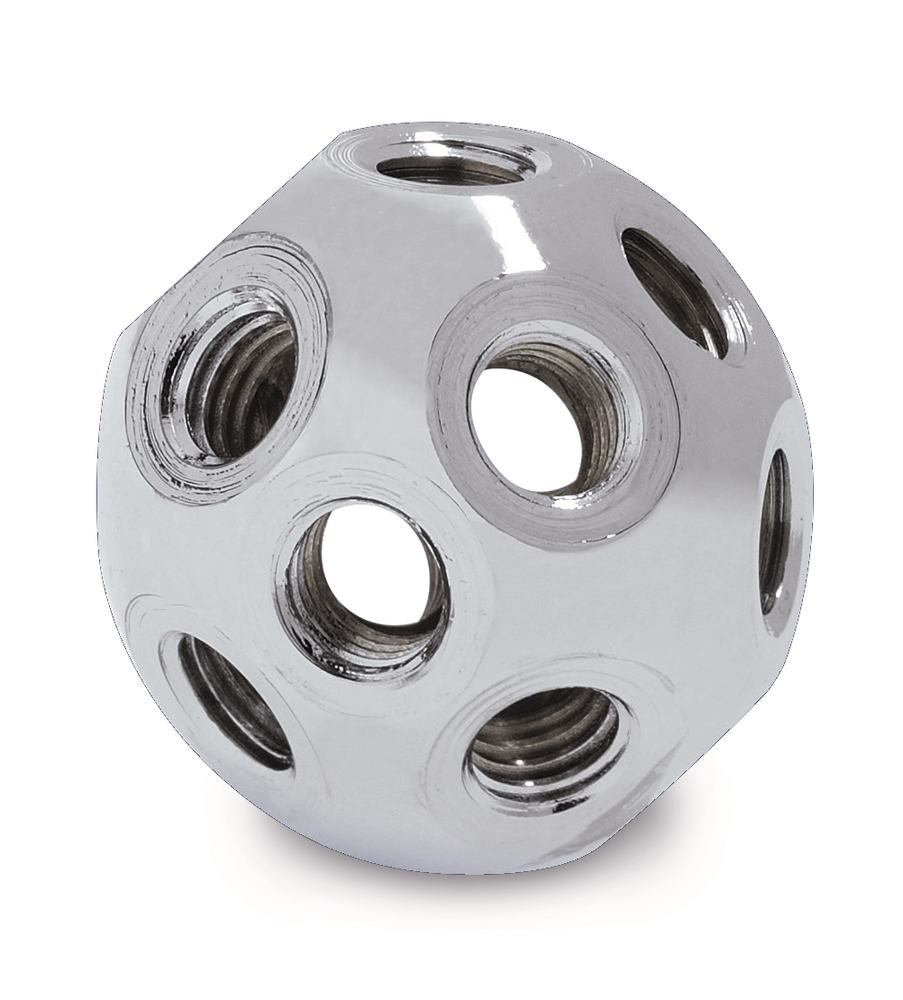
Ball joints for grid stands provide multi-axis connection points within modular laboratory frame systems. Each unit is manufactured from chromed steel and features eighteen tapped M12 holes, enabling secure attachment of rods, clamps and accessory plates at adjustable angles. The chrome-plated surface offers corrosion resistance suitable for typical laboratory environments while maintaining a clean, professional appearance. Weighing 0,230 kg and supplied as one piece, the joint integrates with standard grid-stand tubing and fasteners used to build custom apparatus supports, instrument platforms and teaching setups. From manufacturer Lenz, these ball joints allow technicians to create articulated nodes that accommodate non-orthogonal geometries without compromising mechanical stability. They are particularly useful when routing utility lines, positioning sensors or mounting glassware at precise orientations. The dense pattern of M12 threads supports multiple simultaneous connections, reducing the need for additional adapters. As part of a modular grid stand system, the component contributes to flexible, reconfigurable laboratory infrastructure that can be expanded or rearranged as experimental requirements change.
This article belongs on Ground-joint glassware (other), in Distillation & extraction glassware.
Key features
- Pack size: 1 pc
- Product type: Ball joints for grid stands
- Tapped holes: 18 x M12
- Material: Chromed steel
- Finish: Chrome-plated
- Weight: 0,230 kg
Recently viewed
You may also like
Browse related categories
Category
Distillation & extraction glassware
Sub-category
Ground-joint glassware (other)
Catalogue
Brand
Questions about Ball joints for grid stands,, with 18 tapped holes M12, chromed steel, 1 unit(s)
What is this article?
Ball joints for grid stands,, with 18 tapped holes M12, chromed steel, 1 unit(s) is the article on this page. Luminix Health distributes Lenz for laboratory use. It sits in Ground-joint glassware (other), inside Distillation & extraction glassware, in Labware.
This is ground-joint glassware that is not a head, a condenser or a Soxhlet: receivers, blank joints, odd adapters. A ground joint is named by the wide end and the length, such as 29/32. Mismatched joints do not seal, even with grease.
Distillation separates liquids by boiling point. A condenser turns the vapour back into liquid: Liebig, coil and cold-finger shapes differ in how much cooling surface they offer. A still head and a column sit between the flask and the condenser. A Soxhlet extractor washes a solid again and again with the same solvent. Ground joints have a standard size, and the joint, not the flask, is what has to match. The pieces are indexed under ISO laboratory glassware.
Which category should I open next?
The category is Distillation & extraction glassware. The sub-category is Ground-joint glassware (other). The catalogue is Labware.
Shelves beside this one are Distillation heads, adapters & columns, Condensers and Soxhlet & extraction apparatus.
What should I check before I order?
The technical information on this page is the manufacturer's sheet. Read that, not a rewritten specification.
When this page shows a safety data sheet, use that manufacturer file. Hazard text does not belong in the sales description. For a pack size, a grade or a certificate that is not on the page, send a quote request or contact the team.
How does ordering and shipping work?
Luminix Health distributes this article from the heart of Europe. Articles in stock ship within 2–5 business days. Standard delivery is free from €250 excl. VAT. Cold-chain goods and dangerous goods under ADR are never included in that free delivery. The terms are in the Shipping Policy. The full brand index is on shop by brand. Who we are is on about us.
Which other categories should I open?
The seven catalogues are Labware, Lab chemicals, Lab instruments, Lab consumables, Chromatography equipment, Lab safety equipment and Life Science & Microbiology.