
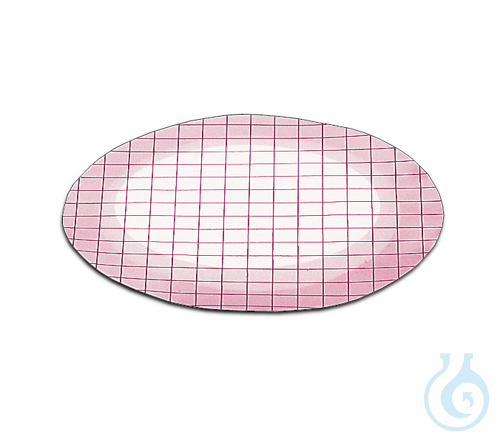



Description
Cellulose nitrate (CN) membrane filters with a pore size of 0,45 µm and a diameter of 50 mm are non-sterile laboratory membranes based on cellulose nitrate, also termed cellulose mixed ester (CN, MCE). They are used for colony count determination, particle testing and microscopy in microbiological and analytical environments. Unsterile membranes may be chosen with or without a grid and with or without a hydrophobic edge, so users can match holder geometry and counting preferences. The 0,45 µm pore size and 50 mm diameter support standard filtration manifolds and funnels when preparing liquid samples for subsequent examination. Each unit is packed as 100 pieces, which is practical for recurring quality-control and research series. Offered by manufacturer Sartorius, these CN/MCE filters deliver the familiar wetting and handling profile associated with classical membrane filtration in microbiology reagent workflows. Defined pore geometry and material composition help laboratories keep filtration steps reproducible across parallel samples while remaining within the stated non-sterile product configuration.
This article is part of Carbohydrates & sugars, in Biochemicals & reagents.
Key features
- Pack size: 100 pc(s)
- Storage temperature: Room temperature
- Pore size: 0,45 µm
- Diameter: 50 mm
- Material: Cellulose nitrate, cellulose mixed ester (CN, MCE)
- Sterility: Non-sterile
Compliance & Safety Information
Recently viewed
You may also like
Browse related categories
Category
Sub-category
Catalogue
Brand
Questions about CN white -black HE, non-sterile, 0.45
What is this article?
CN white -black HE, non-sterile, 0.45 is the article on this page. Luminix Health distributes Sartorius for laboratory use. It sits in Carbohydrates & sugars, inside Biochemicals & reagents, in Life Science & Microbiology.
A carbohydrate reagent is a sugar or a derivative, specified by identity, anomer where it matters, and purity. Hydrate and anhydrous forms change the mass. A culture-grade sugar and an analytical standard of the same name are different bottles.
A biochemical is a molecule of life, sold as a reagent: an amino acid, a sugar, a nucleotide, a lipid, an enzyme, an antibiotic. The difference from a bulk chemical is that the use is a biological one, and the impurities that matter are the ones that change that use. An enzyme is specified by activity, not only by mass. An antibiotic is specified by potency. Papers are on PubMed. Structures are on PubChem. Strains and lines that consume these reagents are at ATCC.
Which category should I open next?
The category is Biochemicals & reagents. The sub-category is Carbohydrates & sugars. The catalogue is Life Science & Microbiology.
Shelves beside this one are Amino acids & peptides, Coenzymes, nucleotides & vitamins, Biochemicals (other), Enzymes & substrates, Antibiotics & antimycotics, Lipids, steroids & fatty acids and Detergents & surfactants.
What should I check before I order?
When this page shows a safety data sheet, use that manufacturer file. Hazard text does not belong in the sales description. For a pack size, a grade or a certificate that is not on the page, send a quote request or contact the team.
How does ordering and shipping work?
Luminix Health distributes this article from the heart of Europe. Articles in stock ship within 2–5 business days. Standard delivery is free from €250 excl. VAT. Cold-chain goods and dangerous goods under ADR are never included in that free delivery. The terms are in the Shipping Policy. The full brand index is on shop by brand. Who we are is on about us.
Which other categories should I open?
The seven catalogues are Labware, Lab chemicals, Lab instruments, Lab consumables, Chromatography equipment, Lab safety equipment and Life Science & Microbiology.