
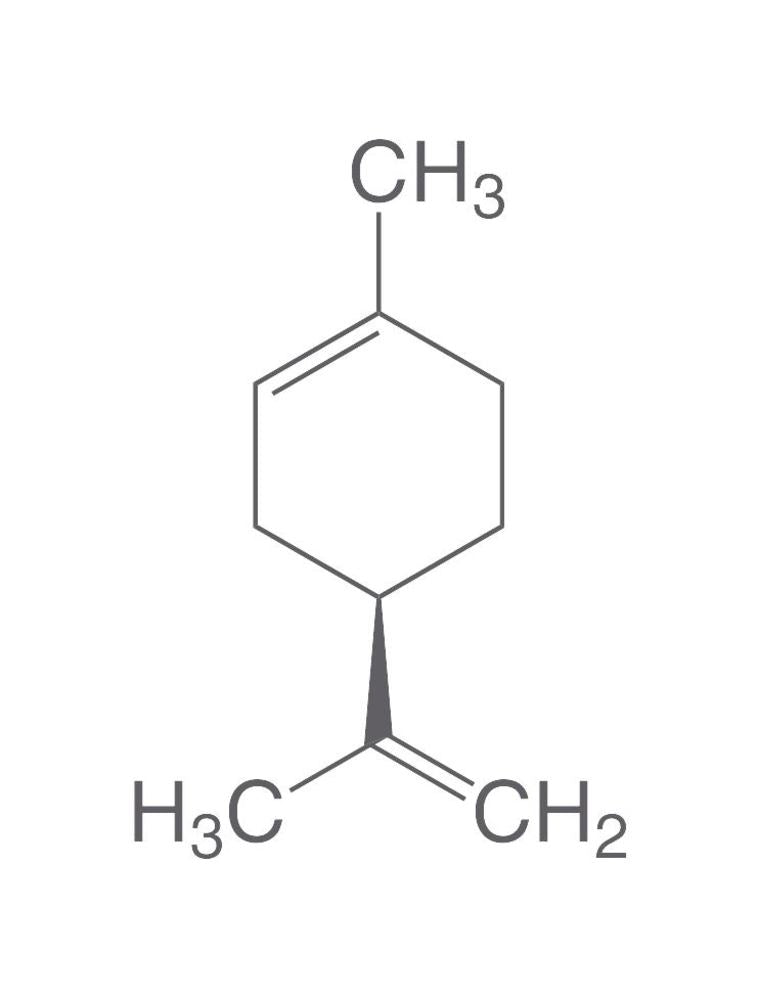


Description
D-(+)-Limonene is a cyclic monoterpene with empirical formula C₁₀H₁₆, molar mass 136,24 g/mol and CAS number 5989-27-5 (EG nr. 227-813-5). The liquid shows a density of 0,84 g/cm³, a flash point of 51 °C and a boiling range of 175 to 178 °C, giving a well-defined profile for organic synthesis, solvent applications and natural-product research. Offered as 500 ml in glass, this grade from manufacturer Carl ROTH supports laboratory work requiring a chiral limonene building block, citrus-related reference standard or non-polar process solvent. Physical data assist in reaction planning, distillation set-up and compatibility assessment with common laboratory glassware and equipment. The compound is widely used in fragrance-related studies, polymer and resin investigations, and as a renewable-chemistry feedstock in academic and industrial R&D settings. Clear identity data and pack format simplify cataloguing and dispensing. UN number 2052 applies for transport classification. The 500 ml glass presentation balances convenient bench-scale volume with secure containment for routine chemical handling.
This article is part of Essential oils & fragrances, in Natural products & essential oils.
Key features
- Appearance: clear, colourless to yellow oil
- Density (20 °C): 0.830-0.860
- Refractive index n a: 1.465-1.490
- CAS number: 5989-27-5
- Pack size: 500 ml glass
- EG nr.: 227-813-5
- Empirical formula: C₁₀H₁₆
- Molar mass: 136,24 g/mol
- Density: 0,84 g/cm³
- Technical Information Sheet:

- Safety Data Sheet:
Compliance & Safety Information
 Danger
Hazard Statements (H-Phrases)
Precautionary Statements (P-Phrases)
Recently viewed
You may also like
Questions about D-(+)-Limonene, 500 ml, glass
What is this article?
D-(+)-Limonene, 500 ml, glass is the article on this page. Luminix Health distributes Carl Roth for laboratory use. It sits in Essential oils & fragrances, inside Natural products & essential oils, in Lab chemicals.
An essential oil is the volatile fraction distilled or pressed from a named plant part. The species, the chemotype and a stated component, when the seller gives one, are the specification. A fragrance compound is a formulated mixture. The two should not be treated as the same bottle.
A natural product is a molecule extracted from a plant, an animal or a microorganism, or a mixture of those molecules. An essential oil is the volatile fraction. The useful specification is the source species, the plant part and, where it exists, the stated content of a marker compound. Two oils with the same common name are not the same article. Marker compounds are identified on PubChem and named by IUPAC.
Which category should I open next?
The category is Natural products & essential oils. The sub-category is Essential oils & fragrances. The catalogue is Lab chemicals.
Shelves beside this one are Natural products & phytochemicals.
What should I check before I order?
When this page shows a safety data sheet, use that manufacturer file. Hazard text does not belong in the sales description. For a pack size, a grade or a certificate that is not on the page, send a quote request or contact the team.
How does ordering and shipping work?
Luminix Health distributes this article from the heart of Europe. Articles in stock ship within 2–5 business days. Standard delivery is free from €250 excl. VAT. Cold-chain goods and dangerous goods under ADR are never included in that free delivery. The terms are in the Shipping Policy. The full brand index is on shop by brand. Who we are is on about us.
Which other categories should I open?
The seven catalogues are Labware, Lab chemicals, Lab instruments, Lab consumables, Chromatography equipment, Lab safety equipment and Life Science & Microbiology.