


Description
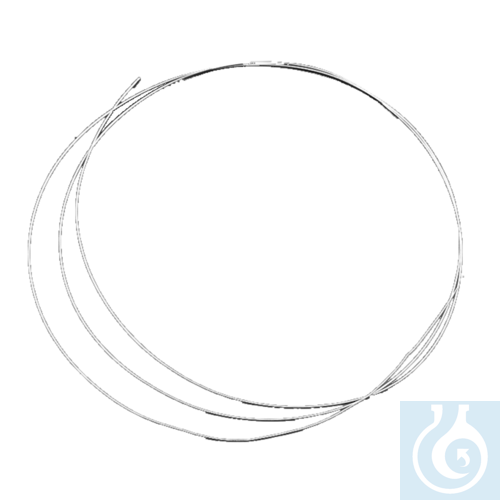
neoChoice Platinum-Iridium Wire, 0,3 mm Ø is a fine laboratory wire of 90/10 platinum-iridium alloy supplied by the centimetre. The alloy is firm yet springy, combining the chemical inertness of platinum with the mechanical strength and elasticity contributed by iridium. With a diameter of 0,3 mm, the wire is suited to electrodes, contacts, thermocouples, micro-heating elements and other specialised apparatus used in electrochemistry, catalysis and high-temperature sensing. When ordering, the required length in centimetres must be specified so that exact quantities can be cut for each application. This neoChoice wire from manufacturer neolab - Labor resists oxidation and corrosion under typical laboratory conditions and retains its dimensional integrity during repeated thermal or mechanical stress. The per-centimetre unit allows economical procurement for both small-scale research and larger fabrication needs. Professional laboratories rely on such noble-metal conductors wherever reliable electrical performance and chemical stability are essential.
This article is part of Metals, elements & oxides, in Inorganic chemicals.
Key features
- Pack size: 1 cm
- Alloy: Platinum-Iridium 90/10
- Diameter: 0,3 mm
- Character: Firm and springy
- Brand: neoChoice
- EAN: 4058072001315
- Technical Information Sheet:

Recently viewed
You may also like
Browse related categories
Category
Sub-category
Catalogue
Brand
Questions about neoChoice Platin-Iridiumdraht, 0,3 mm Ø, je cm
What is this article?
neoChoice Platin-Iridiumdraht, 0,3 mm Ø, je cm is the article on this page. Luminix Health distributes neolab for laboratory use. It sits in Metals, elements & oxides, inside Inorganic chemicals, in Lab chemicals.
Metals, elements and oxides are the element itself or its oxide, sold as powder, shot, foil or wire. Purity and particle size are both the specification. A 99 percent powder and a 99.999 percent shot of the same element are different articles. Many are reactive to air or to water.
An inorganic chemical is a salt, an acid or base in solid form, a metal, an oxide, or an element. The waters of hydration are part of the formula: a hydrate and an anhydrous salt are different masses for the same ion. Trace metals matter when the salt will be used in analysis. Nanomaterials add particle size to the specification. Look the substance up on PubChem. Hazard classes are on ECHA, under the CLP Regulation and REACH. Transport of the dangerous ones is explained by the UNECE.
Which category should I open next?
The category is Inorganic chemicals. The sub-category is Metals, elements & oxides. The catalogue is Lab chemicals.
Shelves beside this one are Inorganic salts and Nanomaterials & quantum dots.
What should I check before I order?
When this page shows a safety data sheet, use that manufacturer file. Hazard text does not belong in the sales description. For a pack size, a grade or a certificate that is not on the page, send a quote request or contact the team.
How does ordering and shipping work?
Luminix Health distributes this article from the heart of Europe. Articles in stock ship within 2–5 business days. Standard delivery is free from €250 excl. VAT. Cold-chain goods and dangerous goods under ADR are never included in that free delivery. The terms are in the Shipping Policy. The full brand index is on shop by brand. Who we are is on about us.
Which other categories should I open?
The seven catalogues are Labware, Lab chemicals, Lab instruments, Lab consumables, Chromatography equipment, Lab safety equipment and Life Science & Microbiology.