
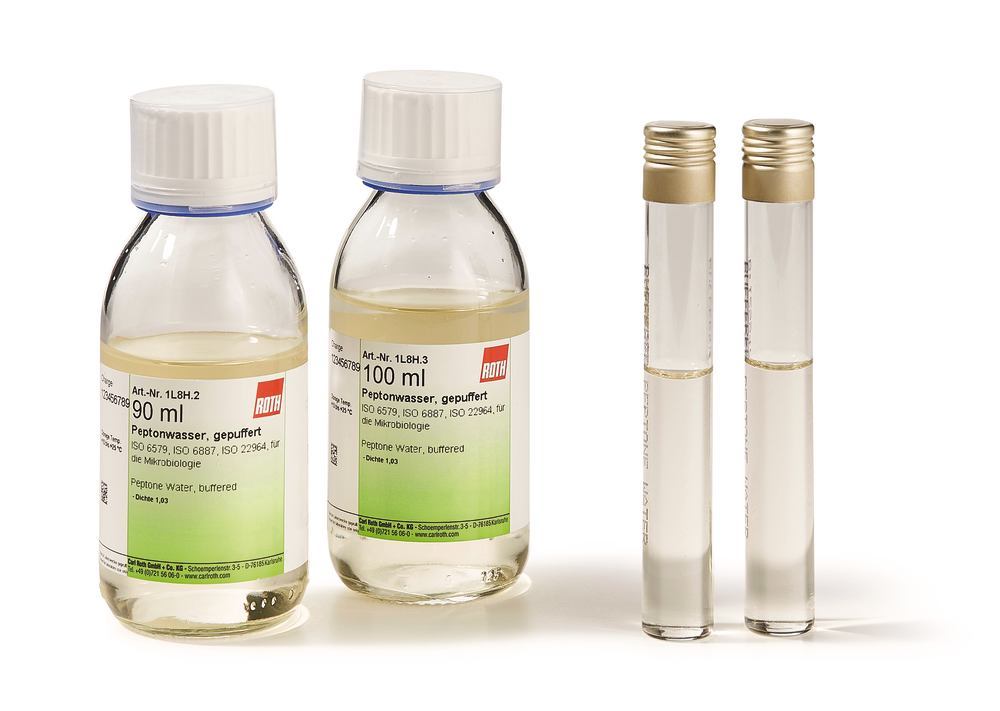


Description
Peptone Water, buffered is a ready-to-use medium for microbiology, It supports standardised sample handling and enrichment steps in hygiene monitoring and routine culture workflows where pre-prepared media are preferred. Physical data include a density of 1,037 g/cm³ and a boiling point of 100 °C, consistent with an aqueous laboratory medium. The ready-to-use format reduces preparation effort and helps maintain method consistency across serial tests. Offered from manufacturer Carl ROTH in the ready-made media range, this buffered peptone water fits food, environmental and general microbiology laboratories that follow the cited ISO procedures. The glass presentation is practical for bench use during inoculation and transfer steps. As a defined ready-made medium it integrates cleanly into existing SOPs without reconstitution, supporting reliable day-to-day microbial recovery work under controlled laboratory conditions.
This article is part of Dehydrated culture media (agar & broth bases), in Culture media & microbiology. See also Petri dishes.
Key features
- Casein peptone: 10 g/l
- Sodium chloride (NaCl): 5 g/l
- Disodium phosphate dodecahydrate: 9 g/l
- Dipotassium hydrogen phosphate: 1.5 g/l
- pH value (25 °C): 6.8-7.2
- Pack sizes: 180 ml, 900 ml, 1 l
- Density: 1,037 g/cm³
- Boiling point: 100 °C
- Form: Ready-to-use
- Technical Information Sheet:

- Safety Data Sheet:
Recently viewed
You may also like
Browse related categories
Category
Sub-category
Dehydrated culture media (agar & broth bases)
Catalogue
Brand
Questions about Peptone Water, buffered, ISO 6579, ISO 6887, ISO 22964, 180 ml, glass
What is this article?
Peptone Water, buffered, ISO 6579, ISO 6887, ISO 22964, 180 ml, glass is the article on this page. Luminix Health distributes Carl Roth for laboratory use. It sits in Dehydrated culture media (agar & broth bases), inside Culture media & microbiology, in Life Science & Microbiology.
A dehydrated medium is a powder the laboratory dissolves, sterilises and pours. The formulation name, the supplements it still needs, and the grams per litre are the specification. Two powders with similar names, one selective and one not, grow different organisms.
A culture medium is the food and the solid or liquid home of a microorganism. Dehydrated media are powders the laboratory dissolves and sterilises. Ready-to-use plates and tubes are already that. A Petri dish is the plate. Selective media let one kind of organism grow and hold another back. The formulation and the supplements, not the colour of the agar, are the specification. Reference strains are at ATCC. Methods are on PubMed. Biosafety practice is the WHO laboratory biosafety topic.
Which category should I open next?
The category is Culture media & microbiology. The sub-category is Dehydrated culture media (agar & broth bases). The catalogue is Life Science & Microbiology.
Shelves beside this one are Petri dishes, Ready-to-use culture media (plates, tubes, bottles), Microbiology (other), Inoculation loops, spreaders & needles and Microbial identification, hygiene monitoring & rapid tests.
What should I check before I order?
The technical information on this page is the manufacturer's sheet. Read that, not a rewritten specification.
When this page shows a safety data sheet, use that manufacturer file. Hazard text does not belong in the sales description. For a pack size, a grade or a certificate that is not on the page, send a quote request or contact the team.
How does ordering and shipping work?
Luminix Health distributes this article from the heart of Europe. Articles in stock ship within 2–5 business days. Standard delivery is free from €250 excl. VAT. Cold-chain goods and dangerous goods under ADR are never included in that free delivery. The terms are in the Shipping Policy. The full brand index is on shop by brand. Who we are is on about us.
Which other categories should I open?
The seven catalogues are Labware, Lab chemicals, Lab instruments, Lab consumables, Chromatography equipment, Lab safety equipment and Life Science & Microbiology.