
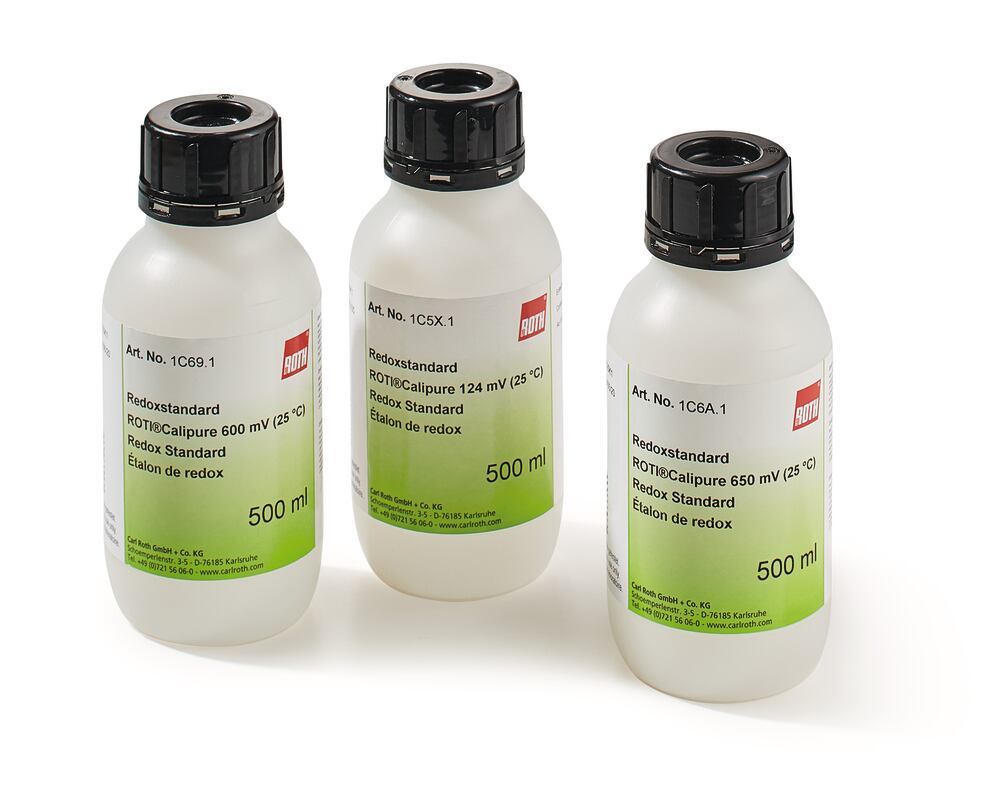


Description
Redox Standard ROTI®Calipure 468 mV (25 °C) is a ready-to-use calibration solution for redox electrode verification and redox titration in analytical laboratories. Defined at a potential of 468 mV at 25 °C, this standard supports accurate ORP sensor checks and helps maintain consistent performance in oxidation–reduction measurement workflows. Physical characteristics include a density of 1,134 g/cm³ together with a boiling point of 100 °C. The product is filled as a 500 ml plastic bottle that is convenient for bench-top handling during everyday calibration and control measurements. This redox standard from manufacturer Carl ROTH belongs to the ROTI®Calipure range and is intended for laboratory applications in titration and electrode maintenance. With a pack weight of 0,620 kg, the unit quantity offers a practical volume for repeated verification of redox electrodes and related quality-control tasks. Analytical teams performing redox titration can integrate the solution into instrument check schedules to support reliable potential readings. Transport classification of the material is indicated by UN number 1760.
This article is part of pH buffers & conductivity standards, in Buffers & pH solutions.
Key features
- Redox potential (25 °C): 463-473 mV
- Pack size: 500 ml plastic
- Density: 1,134 g/cm³
- Boiling point: 100 °C
- Storage temperature: +15 to +25 °C
- Range: ROTI®Calipure
- Technical Information Sheet:

- Safety Data Sheet:
Compliance & Safety Information
 Danger
Hazard Statements (H-Phrases)
Precautionary Statements (P-Phrases)
Recently viewed
You may also like
Questions about Redox Standard, ROTI®Calipure 468 mV (25 °C), 500 ml, plastic
What is this article?
Redox Standard, ROTI®Calipure 468 mV (25 °C), 500 ml, plastic is the article on this page. Luminix Health distributes Carl Roth for laboratory use. It sits in pH buffers & conductivity standards, inside Buffers & pH solutions, in Lab chemicals.
A pH buffer for calibration has a stated pH at a stated temperature, often traceable. A conductivity standard has a stated conductivity. They are not general reagents and they should not be poured back into the bottle. The temperature of the measurement has to be the temperature on the label, or the meter has to compensate.
A buffer resists a change in pH when a little acid or base is added. It does that because a weak acid and its conjugate base are both present. A pH buffer used to calibrate a meter has a stated value at a stated temperature. A biological buffer such as Tris or HEPES is chosen because it holds the pH of a living system and does not poison it. Conductivity standards are the sister articles for a conductivity meter. The ions are on PubChem. Electrode calibration practice sits with EURAMET and BELAC.
Which category should I open next?
The category is Buffers & pH solutions. The sub-category is pH buffers & conductivity standards. The catalogue is Lab chemicals.
Shelves beside this one are Biological buffers (Tris, HEPES, MOPS) and Buffers (other).
What should I check before I order?
When this page shows a safety data sheet, use that manufacturer file. Hazard text does not belong in the sales description. For a pack size, a grade or a certificate that is not on the page, send a quote request or contact the team.
How does ordering and shipping work?
Luminix Health distributes this article from the heart of Europe. Articles in stock ship within 2–5 business days. Standard delivery is free from €250 excl. VAT. Cold-chain goods and dangerous goods under ADR are never included in that free delivery. The terms are in the Shipping Policy. The full brand index is on shop by brand. Who we are is on about us.
Which other categories should I open?
The seven catalogues are Labware, Lab chemicals, Lab instruments, Lab consumables, Chromatography equipment, Lab safety equipment and Life Science & Microbiology.