
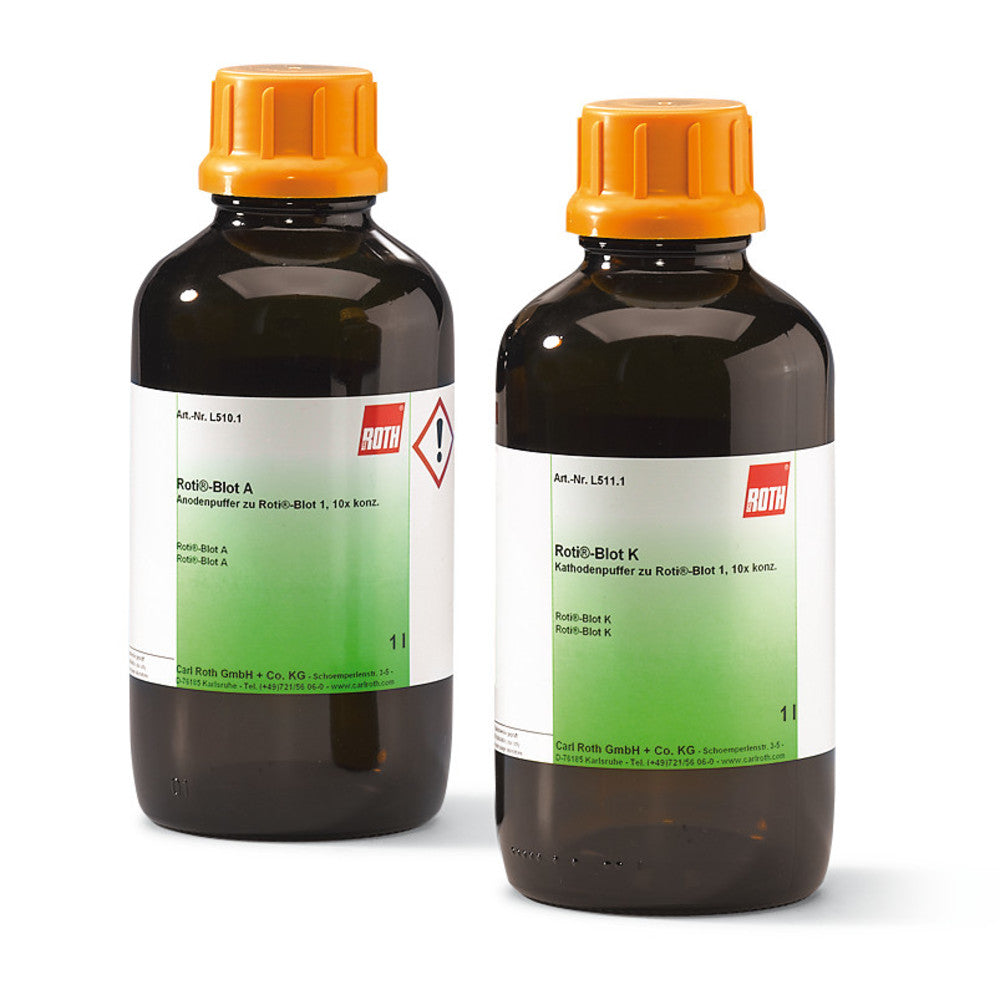


Description
ROTI®Blot K is a cathode buffer prepared for use with the ROTI®-Blot 1 system in electrophoretic protein transfer and Western blotting. Delivered as a 10× concentrate for electrophoresis, it establishes the cathodic buffer environment required for efficient migration of proteins from polyacrylamide gels onto membranes. Density is specified as 1,035 g/cm³. The product is supplied in a 1 l glass pack, suited to laboratories running regular blotting series that need a stable stock concentrate. Typical applications cover blotting workflows, Western blot and ELISA-related membrane work, and transfer of proteins to membranes. Offered by manufacturer Carl ROTH, ROTI®Blot K is designed to complement the corresponding anode buffer in the ROTI®-Blot 1 configuration, supporting balanced ionic strength during transfer. The concentrated format simplifies inventory and allows working dilutions to be prepared shortly before use. Ideal for protein biochemistry and molecular diagnostics labs seeking consistent cathode buffer performance in membrane-transfer protocols.
This article belongs on Blotting membranes & papers, in Protein biology & Western blot.
Key features
- Pack size: 1 l glass
- Density: 1,035 g/cm³
- Storage temperature: +15 to +25 °C
- Product type: Cathode buffer for ROTI®-Blot 1
- Concentration: 10× concentrate for electrophoresis
- Technical Information Sheet:

- Safety Data Sheet:
Recently viewed
You may also like
Questions about ROTI®Blot K, cathode buffer to ROTI®-Blot 1,, 1 l, glass
What is this article?
ROTI®Blot K, cathode buffer to ROTI®-Blot 1,, 1 l, glass is the article on this page. Luminix Health distributes Carl Roth for laboratory use. It sits in Blotting membranes & papers, inside Protein biology & Western blot, in Life Science & Microbiology.
A blotting membrane, nitrocellulose or PVDF, binds proteins transferred out of a gel. Pore size, 0.2 µm or 0.45 µm, and the format, roll or pre-cut, are the choices. PVDF is activated in methanol. The papers and the sponges around it in the cassette are part of the same stack.
Protein work separates a mixture, then asks which protein is which. Extraction and purification take the protein out of the cell. A marker shows the masses. A Western blot moves the separated proteins onto a membrane and probes them with an antibody. The membrane, nitrocellulose or PVDF, has to bind the protein and survive the washes. Antibodies and methods are in PubMed. Reference material is at ATCC.
Which category should I open next?
The category is Protein biology & Western blot. The sub-category is Blotting membranes & papers. The catalogue is Life Science & Microbiology.
Shelves beside this one are Protein biology (other) and Protein extraction, purification & markers.
What should I check before I order?
When this page shows a safety data sheet, use that manufacturer file. Hazard text does not belong in the sales description. For a pack size, a grade or a certificate that is not on the page, send a quote request or contact the team.
How does ordering and shipping work?
Luminix Health distributes this article from the heart of Europe. Articles in stock ship within 2–5 business days. Standard delivery is free from €250 excl. VAT. Cold-chain goods and dangerous goods under ADR are never included in that free delivery. The terms are in the Shipping Policy. The full brand index is on shop by brand. Who we are is on about us.
Which other categories should I open?
The seven catalogues are Labware, Lab chemicals, Lab instruments, Lab consumables, Chromatography equipment, Lab safety equipment and Life Science & Microbiology.