
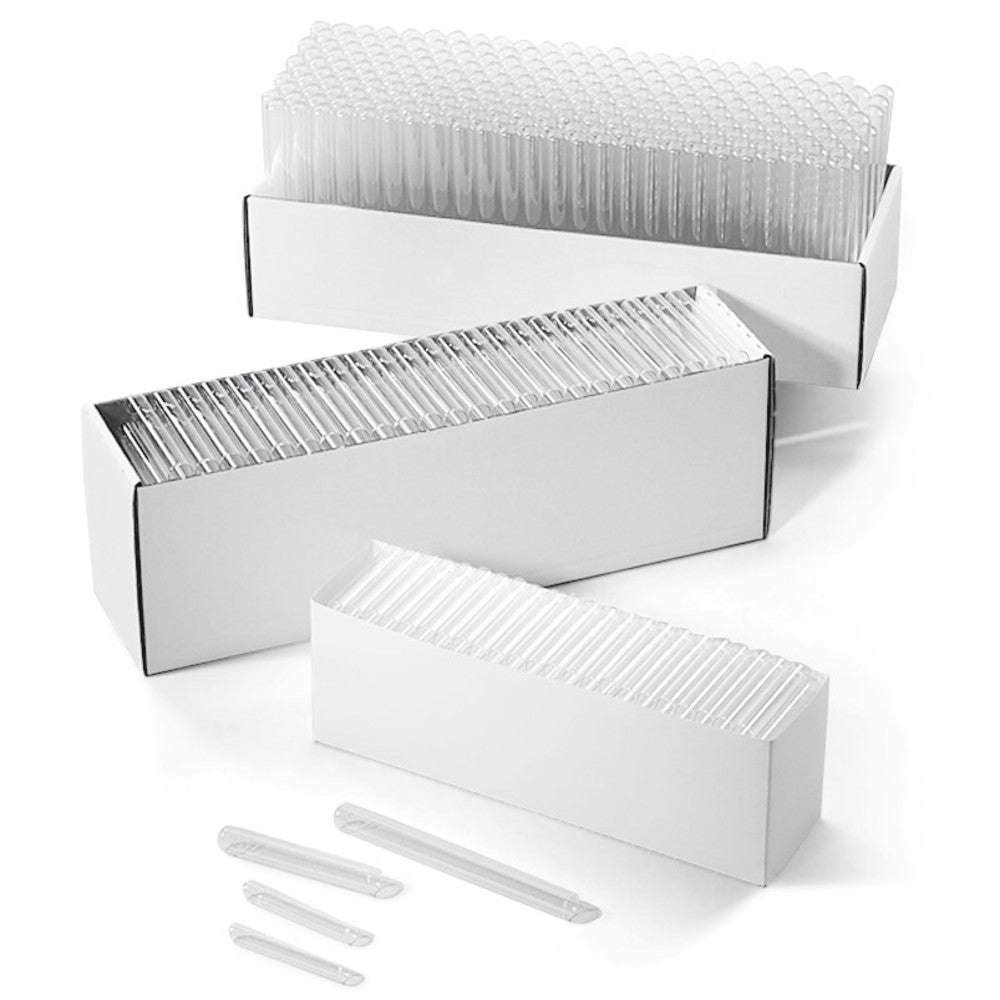


Description
Rotilabo® test tubes with straight rim are thick-walled laboratory tubes made from borosilicate glass 3.3 and offered with a nominal capacity of 70 ml. The straight rim geometry supports easy filling, pouring, and access with pipettes or simple closures during routine sample work. Borosilicate glass 3.3 is widely used in laboratory glassware for its chemical resistance and suitability for thermal stress in everyday heating and cooling steps. The thick-walled build adds mechanical robustness for repeated handling on the bench. These tubes are intended for general laboratory use with samples, reagents, and intermediate preparations where clear glass vessels are required. Pack size is 50 pc(s), giving a practical stock quantity for teaching, quality control, and research workflows that process multiple tubes in parallel. The pack weight is 2,000 kg. Rotilabo® test tubes from manufacturer ROTH SELECTION fit standard racks and common wet-chemistry procedures involving aqueous media and many solvents compatible with borosilicate glass 3.3. Transparent walls allow direct visual checks of colour, turbidity, and phase behaviour without transferring the contents. The combination of straight rim, thick wall, and 70 ml capacity makes this variant a straightforward choice for preparatory chemistry, observation, and short-term holding of laboratory samples.
This article is part of Test tubes, in Tubes & vials.
Key features
- Pack size: 50 pc(s)
- Brand: Rotilabo®
- Rim type: Straight rim
- Material: Borosilicate glass 3.3
- Construction: Thick-walled
- Capacity: 70 ml
Recently viewed
You may also like
Browse related categories
Category
Sub-category
Catalogue
Brand
Questions about Rotilabo®-test tubes, straight rim, borosilic. glass 3.3, thick walled, 70ml
What is this article?
Rotilabo®-test tubes, straight rim, borosilic. glass 3.3, thick walled, 70ml is the article on this page. Luminix Health distributes Carl Roth for laboratory use. It sits in Test tubes, inside Tubes & vials, in Labware.
A test tube is the open cylindrical vessel for a small liquid, in borosilicate glass or in plastic. Rimmed and rimless mouths differ. The size is diameter by length. It is not graduated for a result, and a glass tube that will be centrifuged has a force limit.
A tube holds a small sample upright. A test tube is the open glass or plastic cylinder. A centrifuge tube is conical so a pellet forms at the tip, and it is rated for a centrifugal force the rotor will actually reach. A vial is a small closed bottle, often for a sample that will sit in an instrument. NMR tubes are a special case: the glass has to be uniform or the spectrum is the tube, not the sample. Laboratory ware is listed under ISO laboratory glassware.
Which category should I open next?
The category is Tubes & vials. The sub-category is Test tubes. The catalogue is Labware.
Shelves beside this one are Centrifuge tubes (conical), Sample vials & NMR tubes and Tube & vial accessories.
What should I check before I order?
The technical information on this page is the manufacturer's sheet. Read that, not a rewritten specification.
When this page shows a safety data sheet, use that manufacturer file. Hazard text does not belong in the sales description. For a pack size, a grade or a certificate that is not on the page, send a quote request or contact the team.
How does ordering and shipping work?
Luminix Health distributes this article from the heart of Europe. Articles in stock ship within 2–5 business days. Standard delivery is free from €250 excl. VAT. Cold-chain goods and dangerous goods under ADR are never included in that free delivery. The terms are in the Shipping Policy. The full brand index is on shop by brand. Who we are is on about us.
Which other categories should I open?
The seven catalogues are Labware, Lab chemicals, Lab instruments, Lab consumables, Chromatography equipment, Lab safety equipment and Life Science & Microbiology.