
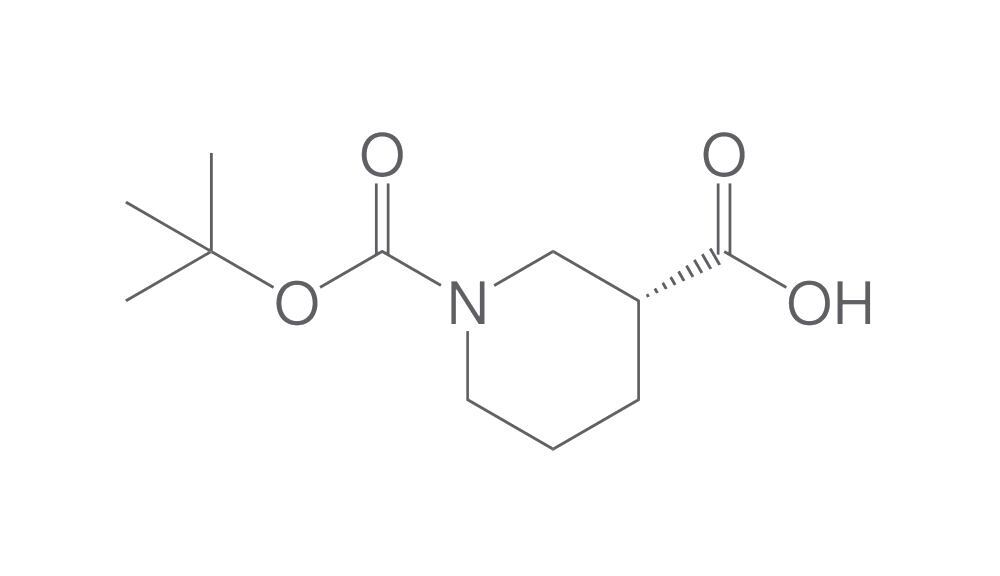


Description
N-Boc-(R)-Nipecotic acid est un acide carboxylique pipéridinique chiral protégé proposé à une pureté min. 95 % pour la synthèse peptidique, médicinale et de chimie fine. Identifié par le numéro CAS 163438-09-3, il a la formule empirique C₁₁H₁₉NO₄ et une masse molaire de 229.27 g/mol. L'azote protégé par Boc et la fonctionnalité acide carboxylique libre font de la molécule un intermédiaire polyvalent pour le couplage amide, l'élaboration de scaffolds et les voies stéréosélectives vers des dérivés de nipecotic acid. Fourni en conditionnement de 100 g, le matériau prend en charge aussi bien la recherche exploratoire que les campagnes multi-étapes qui exigent un synthon de configuration (R) fiable. Disponible du fabricant Carl ROTH, ce réactif s'intègre aisément à la chimie Boc standard et aux protocoles en phase solide ou en solution. Sa stéréochimie définie et sa stratégie de groupe protecteur aident à rationaliser la purification et les étapes de déprotection en aval. Les groupes de recherche axés sur les scaffolds liés au CNS, les analogues d'acides aminés contraints ou les bibliothèques hétérocycliques peuvent employer cette qualité comme intermédiaire chiral prêt à l'emploi dans des conditions de laboratoire conventionnelles.
Cet article fait partie de Chimie click, bioconjugaison & réactifs de synthèse, dans Produits biochimiques & réactifs.
Caractéristiques
- Dosage: ≥ 95 %
- Couleur: rapporté
- Forme: rapporté
- Numéro CAS: 163438-09-3
- Pack sizes: 100 g, 250 g
- Pureté: min. 95 %
- Formule brute: C₁₁H₁₉NO₄
- Masse molaire: 229.27 g/mol
- Poids: 0.013 kg
- UNSPSC: 12352200
- Fiche technique:

- Fiche de données de sécurité:
Compliance & Safety Information
 Warning
Hazard Statements (H-Phrases)
Récemment consulté
Vous aimerez peut-être aussi
Questions about N-Boc-(R)-Nipecotic acid
What is this article?
N-Boc-(R)-Nipecotic acid is the article on this page. Luminix Health distributes Carl Roth for laboratory use. It sits in Acides aminés & peptides, inside Produits biochimiques & réactifs, in Milieux microbiologiques.
An amino acid or a peptide is specified by the sequence or the residue, the chirality, and for a peptide the purity and the salt form. L and D forms are different compounds. A trifluoroacetate salt and a hydrochloride salt weigh differently per mole of peptide.
A biochemical is a molecule of life, sold as a reagent: an amino acid, a sugar, a nucleotide, a lipid, an enzyme, an antibiotic. The difference from a bulk chemical is that the use is a biological one, and the impurities that matter are the ones that change that use. An enzyme is specified by activity, not only by mass. An antibiotic is specified by potency. Papers are on PubMed. Structures are on PubChem. Strains and lines that consume these reagents are at ATCC.
Which category should I open next?
The category is Produits biochimiques & réactifs. The sub-category is Acides aminés & peptides. The catalogue is Milieux microbiologiques.
Shelves beside this one are Glucides & sucres, Coenzymes, nucléotides & vitamines, Produits biochimiques (autres), Enzymes & substrats, Antibiotiques & antimycotiques, Lipides, stéroïdes & acides gras and Détergents & tensioactifs.
What should I check before I order?
When this page shows a safety data sheet, use that manufacturer file. Hazard text does not belong in the sales description. For a pack size, a grade or a certificate that is not on the page, send a quote request or contact the team.
How does ordering and shipping work?
Luminix Health distributes this article from the heart of Europe. Articles in stock ship within 2–5 business days. Standard delivery is free from €250 excl. VAT. Cold-chain goods and dangerous goods under ADR are never included in that free delivery. The terms are in the Shipping Policy. The full brand index is on shop by brand. Who we are is on about us.
Which other categories should I open?
The seven catalogues are Labware, Lab chemicals, Lab instruments, Lab consumables, Chromatography equipment, Lab safety equipment and Life Science & Microbiology.