


Description
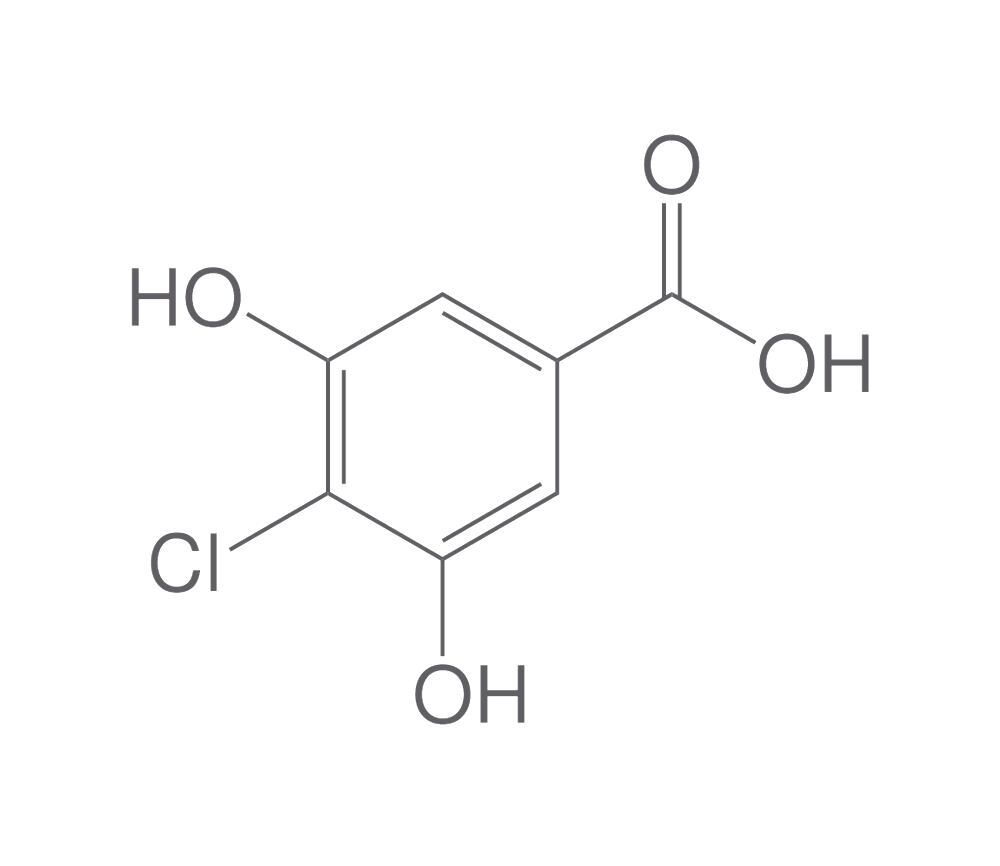
L'acide 4-chloro-3,5-dihydroxybenzoïque est un dérivé d'acide carboxylique aromatique proposé avec une pureté minimale de 98 % pour la recherche en laboratoire et en biochimie. Identifié par le numéro CAS 102338-87-4, il possède la formule empirique C₇H₅ClO₄ et une masse molaire de 188,56 g/mol, offrant un squelette d'acide dihydroxybenzoïque chloré bien défini pour les travaux de synthèse. Le composé présente un point d'ébullition de 415,7 °C. Fourni en conditionnement de 10 g par le fabricant Carl ROTH, ce matériau est adapté à la synthèse organique, à la préparation d'intermédiaires et aux études structure-activité nécessitant un noyau d'acide phénolique portant à la fois des substituants chloro et hydroxy. Il est couramment utilisé dans les voies de la chimie médicinale, les programmes d'analogues de produits naturels et le développement de produits chimiques fins où une substitution contrôlée sur le cycle aromatique est essentielle. Le réactif soutient les flux de travail professionnels en laboratoire qui exigent un bloc de construction cohérent et de haute pureté pour une fonctionnalisation ultérieure ou une chimie de couplage dans des conditions de recherche standard.
Cet article appartient à Acides, dans Acides et bases.
Caractéristiques principales
- Conditionnements : 500 mg, 1 g, 2 g, 5 g
- Masse molaire : 188,56 g/mol
- Fiche technique :

- Fiche de données de sécurité :
Compliance & Safety Information
 Avertissement
Hazard Statements (H-Phrases)
Récemment consulté
Vous aimerez peut-être aussi
Browse related categories
Category
Sub-category
Catalogue
Brand
Questions about Acide 4-chloro-3,5-dihydroxybenzoïque, min. 98 %, 500 mg
What is this article?
Acide 4-chloro-3,5-dihydroxybenzoïque, min. 98 %, 500 mg is the article on this page. Luminix Health distributes Carl Roth for laboratory use. It sits in Acides, inside Acides & bases, in Produits chimiques.
An acid on this shelf is the substance itself, concentrated or as a stated solution: hydrochloric, sulfuric, nitric, acetic and the rest. Concentration, purity and the trace metals decide the use. A concentrated acid and a volumetric solution of the same name are different products, and both burn.
An acid donates a proton. A base accepts one. In the bottle, the practical differences are the concentration, the purity and the anion or cation that comes along. Concentrated mineral acids are a different article from a dilute volumetric solution. The water in the acid, and the trace metals, decide whether it can be used for analysis. Check the substance on PubChem and the classification on ECHA CLP. Transport is the UNECE dangerous-goods framework. The legal texts are the CLP Regulation and REACH.
Which category should I open next?
The category is Acides & bases. The sub-category is Acides. The catalogue is Produits chimiques.
Shelves beside this one are Bases & alcalis.
What should I check before I order?
When this page shows a safety data sheet, use that manufacturer file. Hazard text does not belong in the sales description. For a pack size, a grade or a certificate that is not on the page, send a quote request or contact the team.
How does ordering and shipping work?
Luminix Health distributes this article from the heart of Europe. Articles in stock ship within 2–5 business days. Standard delivery is free from €250 excl. VAT. Cold-chain goods and dangerous goods under ADR are never included in that free delivery. The terms are in the Shipping Policy. The full brand index is on shop by brand. Who we are is on about us.
Which other categories should I open?
The seven catalogues are Labware, Lab chemicals, Lab instruments, Lab consumables, Chromatography equipment, Lab safety equipment and Life Science & Microbiology.