



Description
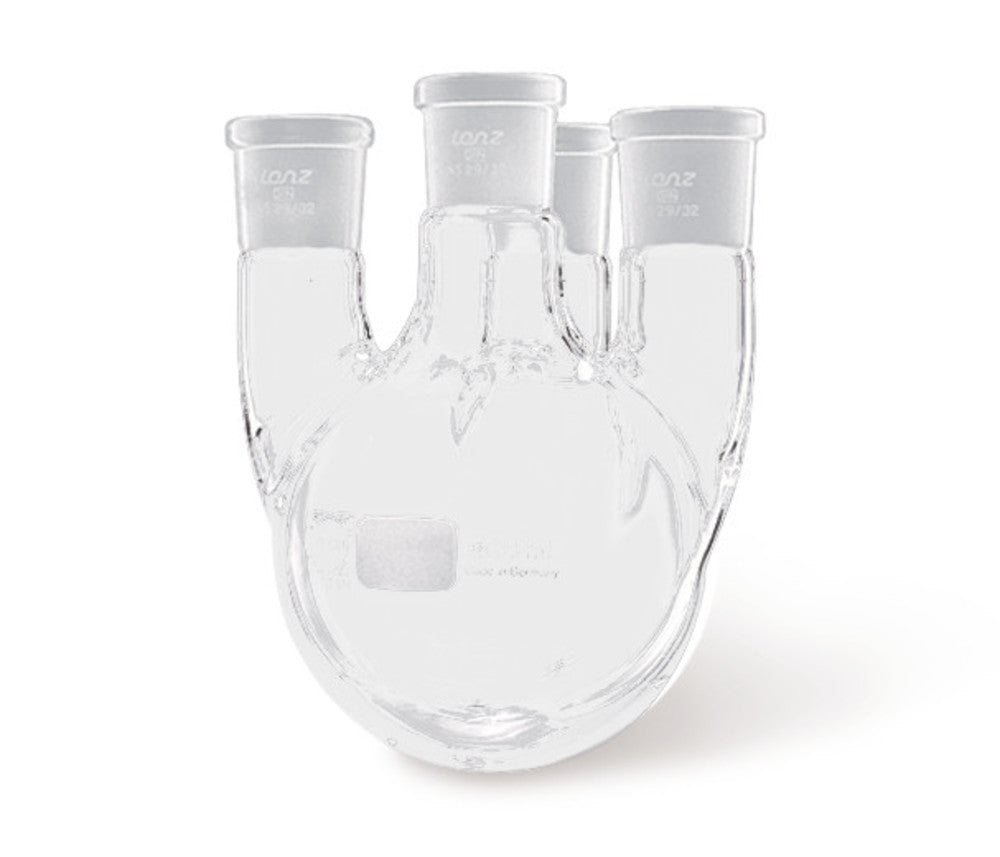
Ballon à fond rond à quatre cols, 3000 ml est un ballon de laboratoire en DURAN® avec un col central NS 29/32 et un col latéral NS 29/32 disposés en cols latéraux parallèles pour un travail multiports à une capacité de trois litres. La conception à fond rond favorise un chauffage uniforme et un mélange efficace dans des manteaux chauffants ou des bains pendant des réactions préparatives plus importantes, le reflux et des montages de procédé à entrées multiples. Les cols latéraux parallèles permettent de monter ensemble des réfrigérants, des ampoules d'addition, des capteurs de température et des assemblages d'agitateurs sur des rodages en verre standard NS 29/32. Fourni en une seule pièce d'un poids de 0.88 kg, le ballon du fabricant Lenz correspond à la verrerie rodée interchangeable courante utilisée dans les laboratoires de synthèse. Il est destiné aux applications de chimie organique et générale où quatre points d'accès sur un seul récipient simplifient la disposition de l'appareil et aident à maintenir un système fermé. Le volume de trois litres convient aux expériences de montée en échelle, aux démonstrations d'enseignement et au travail préparatif courant qui repose encore sur des composants standard à rodage. Il appartient à la catégorie des ballons ronds à rodages en verre pour la recherche et la pratique de laboratoire.
Cet article fait partie de Ballons à fond rond, dans Béchers & fioles. Voir aussi Fioles à fond plat.
Caractéristiques
- Conditionnement: 1 pièce
- Type de produit: Ballon à fond rond à quatre cols
- Capacité: 3000 ml
- Col central: NS 29/32
- Cols latéraux: NS 29/32, parallèle
- Type de verre: DURAN®
Récemment consulté
Vous aimerez peut-être aussi
Browse related categories
Category
Sub-category
Catalogue
Brand
Questions about Ballon à fond rond à quatre cols, 3000 ml, col central NS 29/32
What is this article?
Ballon à fond rond à quatre cols, 3000 ml, col central NS 29/32 is the article on this page. Luminix Health distributes Lenz for laboratory use. It sits in Ballons à fond rond, inside Béchers & fioles, in Matériel de laboratoire.
A round-bottom flask is the heating flask of a distillation or a reflux. The curved wall takes the heat, and the ground neck connects to a still head or a condenser. The joint size, not only the volume, has to match the rest of the set.
A beaker is an open working vessel: easy to pour, poor as a measure. An Erlenmeyer flask has a flat base and a conical wall so a liquid can be swirled without climbing out. A round-bottom flask is for heating under a condenser, because the heat meets a curved wall and the joint at the neck connects to the rest of the glassware. Borosilicate is the glass that survives the temperature change. These forms are listed under ISO laboratory glassware.
Which category should I open next?
The category is Béchers & fioles. The sub-category is Ballons à fond rond. The catalogue is Matériel de laboratoire.
Shelves beside this one are Béchers, Fioles Erlenmeyer, Récipients de réaction & récipients à double enveloppe, Fioles à fond plat, Fioles (autres) and Accessoires pour béchers & fioles.
What should I check before I order?
The technical information on this page is the manufacturer's sheet. Read that, not a rewritten specification.
When this page shows a safety data sheet, use that manufacturer file. Hazard text does not belong in the sales description. For a pack size, a grade or a certificate that is not on the page, send a quote request or contact the team.
How does ordering and shipping work?
Luminix Health distributes this article from the heart of Europe. Articles in stock ship within 2–5 business days. Standard delivery is free from €250 excl. VAT. Cold-chain goods and dangerous goods under ADR are never included in that free delivery. The terms are in the Shipping Policy. The full brand index is on shop by brand. Who we are is on about us.
Which other categories should I open?
The seven catalogues are Labware, Lab chemicals, Lab instruments, Lab consumables, Chromatography equipment, Lab safety equipment and Life Science & Microbiology.