
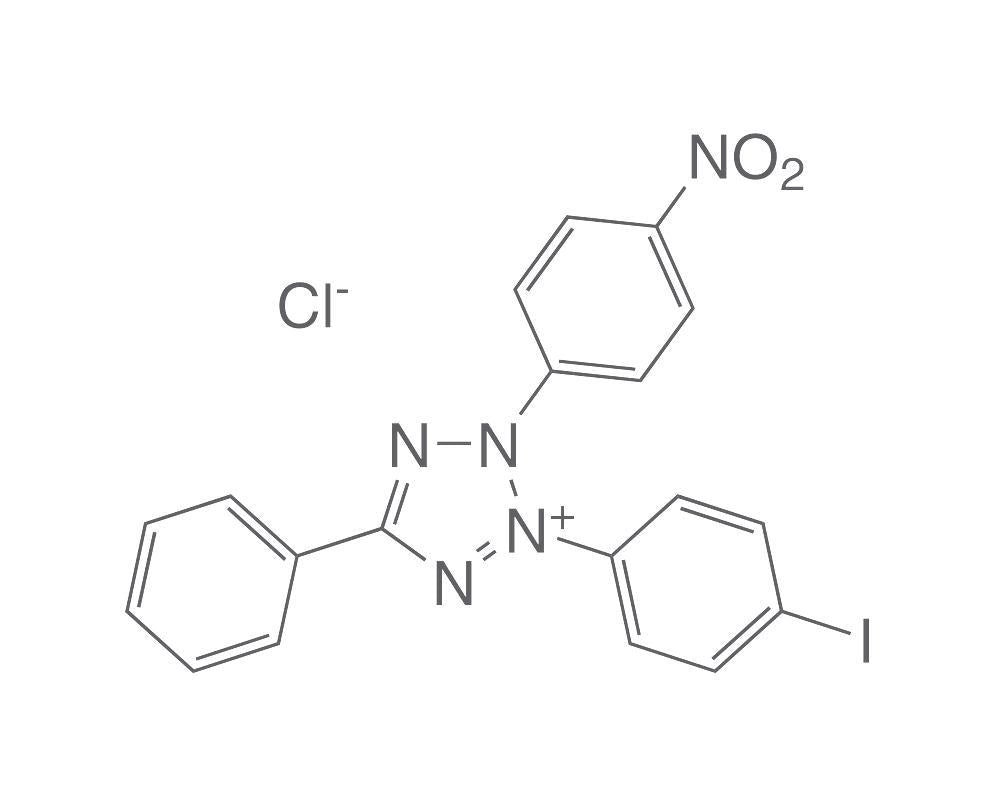


Description
Iodonitrotetrazolium chloride est un réactif biochimique proposé à une pureté minimale de 97 % pour la biochimie. Il est identifié par le numéro CAS 146-68-9 et EG nr. 205-676-2, a la formule empirique C₁₉H₁₃ClN₅O₂I et une masse molaire de 505.7 g/mol. Ce solide défini soutient le travail de laboratoire qui spécifie iodonitrotetrazolium chloride à l'essai indiqué pour la préparation de solutions et les procédures biochimiques. Le matériau est conditionné en 1 g dans du verre, ce qui convient à un dosage précis et à une manipulation protégée de petites quantités. Disponible du fabricant Carl ROTH, la qualité est destinée aux environnements de recherche et d'analyse qui exigent un réactif tetrazolium cohérent pour la biochimie. Les données de masse moléculaire et de formule permettent un calcul stœchiométrique correct lors de la préparation de solutions de travail ou de mélanges réactionnels. Les laboratoires peuvent intégrer ce conditionnement en verre de 1 g dans les stocks courants de réactifs pour les applications biochimiques qui requièrent un matériau à min. 97 %. Consultez la fiche de données de sécurité avant utilisation et suivez les règles institutionnelles de manipulation des produits chimiques pour les réactifs solides.
Cet article fait partie de Produits biochimiques (autres), dans Produits biochimiques & réactifs.
Caractéristiques
- Aspect: poudre jaune pâle à orange pâle
- Dosage: ≥97 %
- Numéro CAS: 146-68-9
- Conditionnement: 1 g verre
- N° CE: 205-676-2
- Pureté: min. 97 %
- Formule brute: C₁₉H₁₃ClN₅O₂I
- Masse molaire: 505.7 g/mol
- Fiche technique:

- Fiche de données de sécurité:
Compliance & Safety Information
 Attention
Hazard Statements (H-Phrases)
Precautionary Statements (P-Phrases)
Récemment consulté
Vous aimerez peut-être aussi
Browse related categories
Category
Produits biochimiques & réactifs
Sub-category
Produits biochimiques (autres)
Catalogue
Brand
Questions about Iodonitrotetrazolium chloride, min. 97 %, pour la biochimie, 1 g, verre
What is this article?
Iodonitrotetrazolium chloride, min. 97 %, pour la biochimie, 1 g, verre is the article on this page. Luminix Health distributes Carl Roth for laboratory use. It sits in Produits biochimiques (autres), inside Produits biochimiques & réactifs, in Milieux microbiologiques.
These are the biochemical reagents that are not an amino acid, a sugar, a lipid, an enzyme or an antibiotic. Identity and purity still decide the bottle. If the compound is light-sensitive or hygroscopic, the handling on the label is part of the specification.
A biochemical is a molecule of life, sold as a reagent: an amino acid, a sugar, a nucleotide, a lipid, an enzyme, an antibiotic. The difference from a bulk chemical is that the use is a biological one, and the impurities that matter are the ones that change that use. An enzyme is specified by activity, not only by mass. An antibiotic is specified by potency. Papers are on PubMed. Structures are on PubChem. Strains and lines that consume these reagents are at ATCC.
Which category should I open next?
The category is Produits biochimiques & réactifs. The sub-category is Produits biochimiques (autres). The catalogue is Milieux microbiologiques.
Shelves beside this one are Acides aminés & peptides, Glucides & sucres, Coenzymes, nucléotides & vitamines, Enzymes & substrats, Antibiotiques & antimycotiques, Lipides, stéroïdes & acides gras and Détergents & tensioactifs.
What should I check before I order?
When this page shows a safety data sheet, use that manufacturer file. Hazard text does not belong in the sales description. For a pack size, a grade or a certificate that is not on the page, send a quote request or contact the team.
How does ordering and shipping work?
Luminix Health distributes this article from the heart of Europe. Articles in stock ship within 2–5 business days. Standard delivery is free from €250 excl. VAT. Cold-chain goods and dangerous goods under ADR are never included in that free delivery. The terms are in the Shipping Policy. The full brand index is on shop by brand. Who we are is on about us.
Which other categories should I open?
The seven catalogues are Labware, Lab chemicals, Lab instruments, Lab consumables, Chromatography equipment, Lab safety equipment and Life Science & Microbiology.