
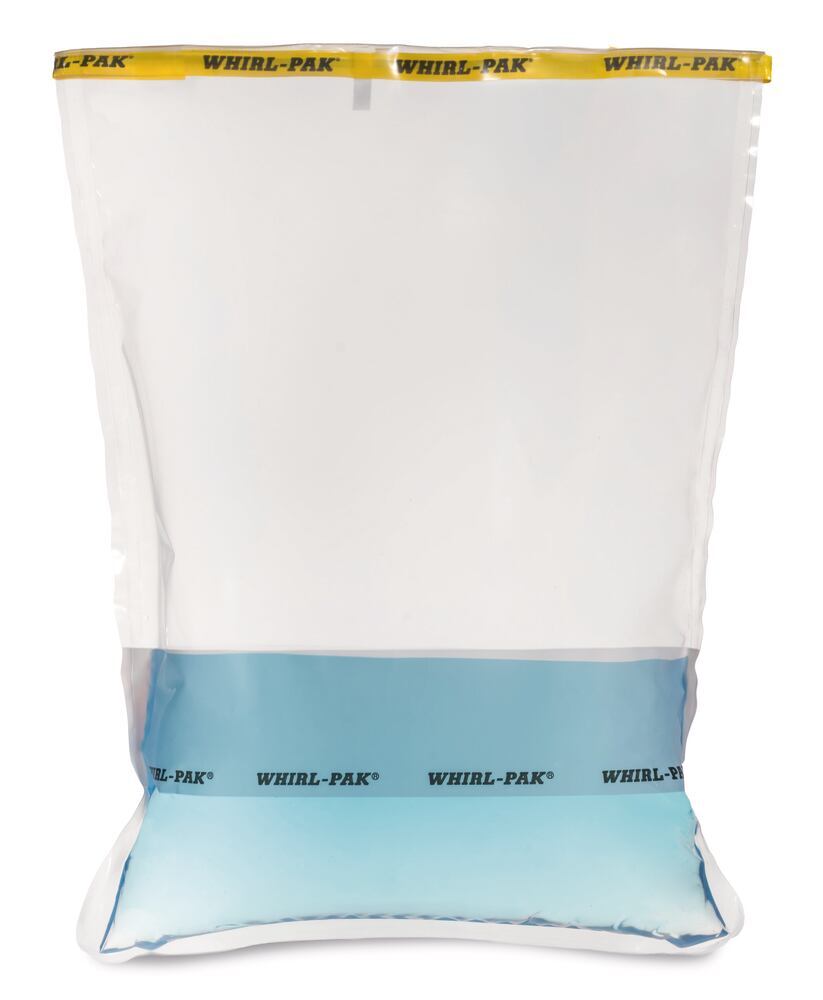



Description
Les sacs pour échantillons liquides avec espace d'étiquetage sont des contenants de plus grande capacité pour collecter et conserver des échantillons liquides en contextes de laboratoire et d'environnement. Chaque sac offre une capacité de 2720 ml et comprend un espace d'étiquetage dédié pour favoriser une identification claire des échantillons pendant la manipulation et la préparation. Ils conviennent à l'analyse environnementale ainsi qu'aux flux de travail d'échantillonnage et de préparation d'échantillons qui reposent sur des bouteilles, des contenants et des pochettes pour les spécimens liquides. Le paquet comprend 250 pièces et a un poids total de 5.578 kg, offrant aux laboratoires un approvisionnement en vrac pratique de sacs de plus grand volume. Ces sacs du fabricant Nasco Sampling s'intègrent dans les procédures de collecte établies lorsqu'un plus grand volume de remplissage est requis. La capacité de 2720 ml accueille des échantillons liquides plus grands couramment rencontrés en surveillance environnementale et dans le travail analytique connexe, tandis que l'espace d'étiquetage aide à maintenir l'organisation de la collecte jusqu'au traitement ultérieur. La conception se concentre sur le volume, l'identification et un confinement fiable pour les tâches d'échantillonnage courantes sans complexité ajoutée.
Cet article fait partie de Étiquettes de laboratoire, dans Étiquettes, panneaux & marquage.
Caractéristiques
- Conditionnement: 250 pièces
- Type de produit: Sacs pour échantillons liquides
- Capacité: 2720 ml
- Espace d'étiquetage: Avec espace d'étiquetage
- Poids: 5.578 kg
- Technical Information Sheet:

Récemment consulté
Vous aimerez peut-être aussi
Questions about Sacs pour échantillons liquides, avec espace d'étiquetage, 2720 ml, 250 pièces
What is this article?
Sacs pour échantillons liquides, avec espace d'étiquetage, 2720 ml, 250 pièces is the article on this page. Luminix Health distributes Nasco Sampling for laboratory use. It sits in Étiquettes de laboratoire, inside Étiquettes, panneaux & marquage, in Sécurité.
A laboratory label has to stick to a cold, a wet or a curved surface and stay legible. Cryo labels, autoclave labels and ordinary bench labels are different adhesives. The size and whether it takes pencil, print or a thermal transfer are the choices.
A label is how the next person knows what is in the bottle. A GHS label carries the pictogram, the signal word and the hazard statements the classification requires. A tape or a marker is only as useful as its survival in the freezer, the autoclave or the solvent it will meet. A safety sign is the instruction that stays on the door. The pictograms come from the CLP Regulation and are explained by ECHA CLP. Workplace signs sit with EU-OSHA.
Which category should I open next?
The category is Étiquettes, panneaux & marquage. The sub-category is Étiquettes de laboratoire. The catalogue is Sécurité.
Shelves beside this one are Ruban d'étiquetage & de marquage, Étiquettes GHS & de danger, Marqueurs & stylos, Panneaux de sécurité & pictogrammes and Étiquettes & marquage (autres).
What should I check before I order?
The technical information on this page is the manufacturer's sheet. Read that, not a rewritten specification.
When this page shows a safety data sheet, use that manufacturer file. Hazard text does not belong in the sales description. For a pack size, a grade or a certificate that is not on the page, send a quote request or contact the team.
How does ordering and shipping work?
Luminix Health distributes this article from the heart of Europe. Articles in stock ship within 2–5 business days. Standard delivery is free from €250 excl. VAT. Cold-chain goods and dangerous goods under ADR are never included in that free delivery. The terms are in the Shipping Policy. The full brand index is on shop by brand. Who we are is on about us.
Which other categories should I open?
The seven catalogues are Labware, Lab chemicals, Lab instruments, Lab consumables, Chromatography equipment, Lab safety equipment and Life Science & Microbiology.