



Description
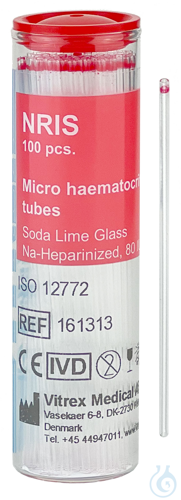
Les capillaires à microhématocrite, CE non héparinisés, sont des consommables de laboratoire de précision destinés à la détermination de l'hématocrite et aux procédures d'analyse sanguine associées. Ces capillaires sont fournis sans revêtement d'héparine, ce qui permet aux laboratoires de contrôler l'anticoagulation selon leurs propres protocoles. L'emballage contient 100 pièces et prend en charge des flux de travail à haut débit en diagnostic clinique, en hématologie de recherche et pour les mesures de routine du volume globulaire. Le marquage CE indique la conformité aux exigences européennes applicables pour l'usage en laboratoire. Produits par le fabricant Hecht, les capillaires offrent une géométrie constante adaptée aux centrifugeuses et lecteurs de microhématocrite standard. Leur conception non héparinisée est particulièrement utile lorsque la préparation de l'échantillon comprend déjà des anticoagulants ou lorsque des conditions sans héparine sont spécifiées. Le faible volume interne minimise la quantité de sang total requise tout en permettant une séparation nette des fractions cellulaires et plasmatiques après centrifugation. Ces capillaires à microhématocrite constituent un composant pratique de tout inventaire de matériel de laboratoire axé sur des tests d'hématocrite fiables et reproductibles.
Cet article fait partie de Microcentrifugeuses & mini-centrifugeuses, dans Centrifugeuses.
Caractéristiques
- Conditionnement: 100 pièces
- Type de produit: Capillaires à microhématocrite
- Héparination: Non hépariné
- Marquage CE: Oui
Récemment consulté
Vous aimerez peut-être aussi
Browse related categories
Category
Sub-category
Microcentrifugeuses & mini-centrifugeuses
Catalogue
Brand
Questions about Capillaires à microhématocrite, CE non héparinisés
What is this article?
Capillaires à microhématocrite, CE non héparinisés is the article on this page. Luminix Health distributes Hecht for laboratory use. It sits in Microcentrifugeuses & mini-centrifugeuses, inside Centrifugeuses, in Instruments de laboratoire.
A microcentrifuge spins 0.2 mL to 2 mL tubes at high force. A mini centrifuge is the small quick-spin for bringing a droplet down from a lid. They are not interchangeable with a 50 mL rotor. The lid lock is part of the safety of the instrument.
A centrifuge separates by density. The rotor spins the sample and the force is reported as a multiple of gravity, not as a raw speed, because the same revolutions per minute are a different force at a different radius. A microcentrifuge takes small tubes. A benchtop or floor model takes larger rotors. The tube, the adapter and the rotor have to be the combination the manufacturer rated. An unbalanced load is how centrifuges fail. Measurement of the related quantities sits with the BIPM.
Which category should I open next?
The category is Centrifugeuses. The sub-category is Microcentrifugeuses & mini-centrifugeuses. The catalogue is Instruments de laboratoire.
Shelves beside this one are Rotors, Adaptateurs de rotor & accessoires, Centrifugeuses de paillasse & au sol and Accessoires de centrifugeuse.
What should I check before I order?
When this page shows a safety data sheet, use that manufacturer file. Hazard text does not belong in the sales description. For a pack size, a grade or a certificate that is not on the page, send a quote request or contact the team.
How does ordering and shipping work?
Luminix Health distributes this article from the heart of Europe. Articles in stock ship within 2–5 business days. Standard delivery is free from €250 excl. VAT. Cold-chain goods and dangerous goods under ADR are never included in that free delivery. The terms are in the Shipping Policy. The full brand index is on shop by brand. Who we are is on about us.
Which other categories should I open?
The seven catalogues are Labware, Lab chemicals, Lab instruments, Lab consumables, Chromatography equipment, Lab safety equipment and Life Science & Microbiology.