
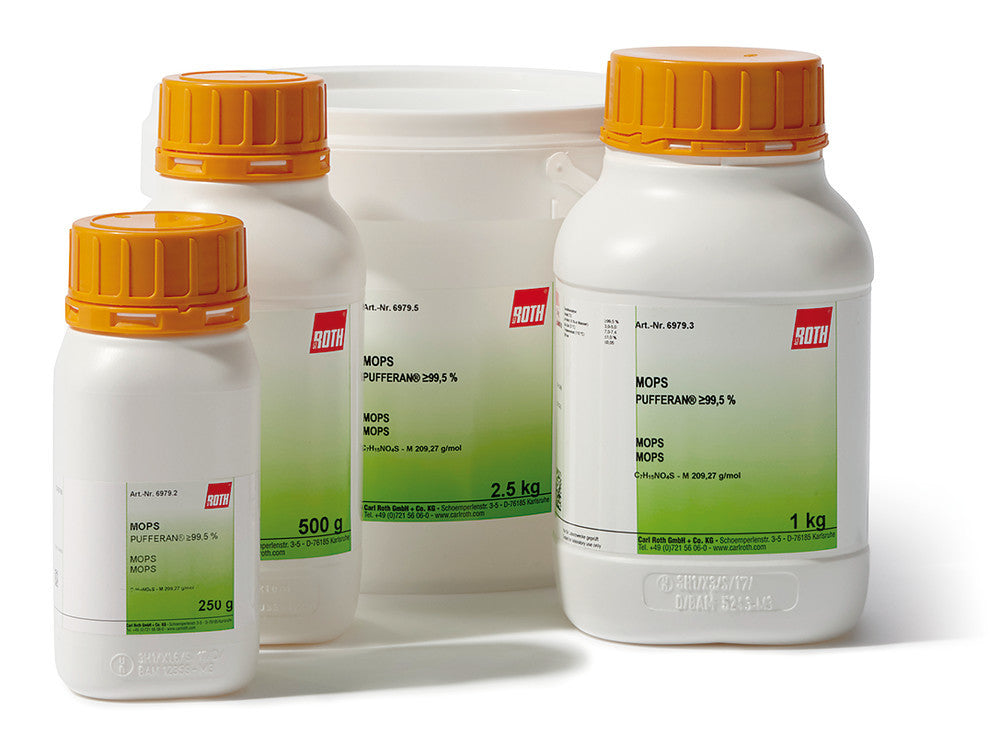


Description
MOPS, PUFFERAN®, is a molecular biological buffer reagent supplied at a minimum purity of 99,5 %. The substance is identified by CAS number 1132-61-2 and empirical formula C₇H₁₅NO₄S, with a molar mass of 209,27 g/mol. Documented physical properties include a flash point of 116 °C and a boiling point of 354,6 °C; the European inventory reference is EG nr. 214-478-5. The material is available from manufacturer Carl ROTH within the PUFFERAN® buffer range. Its clearly stated assay and physicochemical data support preparation of aqueous buffer systems under controlled laboratory conditions. offers a practical quantity for routine molecular biology reagent handling while retaining the specified minimum content of 99,5 %. Laboratories working with molecular biological buffers benefit from the combination of high stated purity, full CAS and EG identification, and the convenient pack size for everyday buffer formulation tasks.
This article belongs on Biological buffers (Tris, HEPES, MOPS), in Buffers & pH solutions.
Key features
- Assay (dry substance): ≥99,5 %
- pH value (10 % in water): 3,0-5,0
- pKa (at 25 °C): 7,0-7,4
- Loss of drying (140 °C, 30 min): ≤1.0 %
- 260 nm: ≤0,05
- CAS number: 1132-61-2
- Pack sizes: 250 g, 1 kg, 500 g, 2.5 kg
- EG nr.: 214-478-5
- Purity: min. 99,5 %
- Empirical formula: C₇H₁₅NO₄S
- Molar mass: 209,27 g/mol
- Technical Information Sheet:

- Safety Data Sheet:
Recently viewed
You may also like
Browse related categories
Category
Sub-category
Biological buffers (Tris, HEPES, MOPS)
Catalogue
Produits chimiques de laboratoire et industriels
Brand
Questions about MOPS, PUFFERAN®, min. 99,5 %, 250 g, plastic
What is this article?
MOPS, PUFFERAN®, min. 99,5 %, 250 g, plastic is the article on this page. Luminix Health distributes Carl Roth for laboratory use. It sits in Biological buffers (Tris, HEPES, MOPS), inside Buffers & pH solutions, in Produits chimiques de laboratoire et industriels.
Tris, HEPES, MOPS and their relatives hold pH in a range that cells and proteins tolerate, with a pKa near the working pH. The useful range is roughly one unit either side of the pKa. A phosphate buffer and Tris are not interchangeable in a method that names one of them, because the ion itself has effects.
A buffer resists a change in pH when a little acid or base is added. It does that because a weak acid and its conjugate base are both present. A pH buffer used to calibrate a meter has a stated value at a stated temperature. A biological buffer such as Tris or HEPES is chosen because it holds the pH of a living system and does not poison it. Conductivity standards are the sister articles for a conductivity meter. The ions are on PubChem. Electrode calibration practice sits with EURAMET and BELAC.
Which category should I open next?
The category is Buffers & pH solutions. The sub-category is Biological buffers (Tris, HEPES, MOPS). The catalogue is Produits chimiques de laboratoire et industriels.
Shelves beside this one are pH buffers & conductivity standards and Buffers (other).
What should I check before I order?
The technical information on this page is the manufacturer's sheet. Read that, not a rewritten specification.
When this page shows a safety data sheet, use that manufacturer file. Hazard text does not belong in the sales description. For a pack size, a grade or a certificate that is not on the page, send a quote request or contact the team.
How does ordering and shipping work?
Luminix Health distributes this article from the heart of Europe. Articles in stock ship within 2–5 business days. Standard delivery is free from €250 excl. VAT. Cold-chain goods and dangerous goods under ADR are never included in that free delivery. The terms are in the Shipping Policy. The full brand index is on shop by brand. Who we are is on about us.
Which other categories should I open?
The seven catalogues are Labware, Lab chemicals, Lab instruments, Lab consumables, Chromatography equipment, Lab safety equipment and Life Science & Microbiology.