
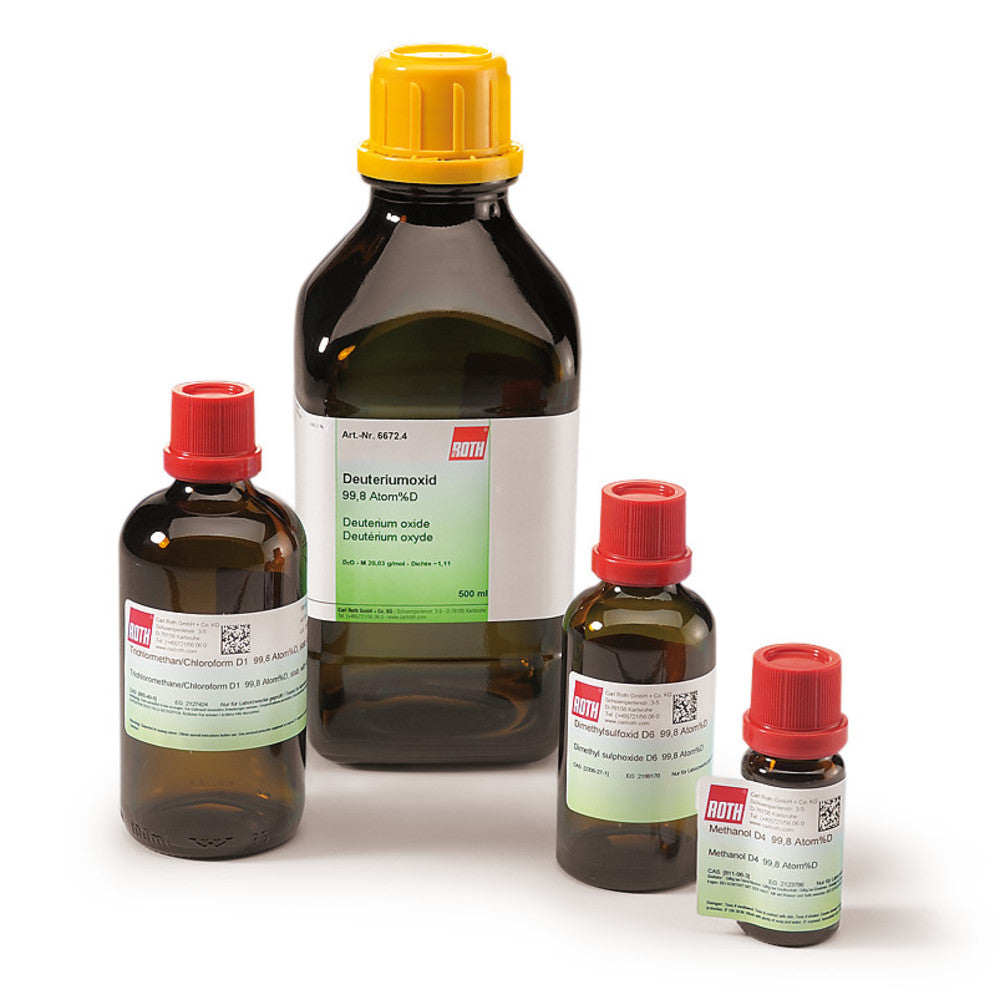


Description
Styrene D₈ est un composé de NMR deutéré, fourni à 98 Atom%D et stabilisé avec 4-tert-butylcatechol, avec le numéro CAS 19361-62-7 et la formule empirique C₈D₈. La masse molaire est de 112.22 g/mol, la densité de 0.98 g/cm³, le point d'ébullition de 145 °C et le point d'éclair de 31 °C, ce qui donne des données physiques claires pour la manipulation et le travail spectroscopique. Conditionné en 1 g dans une ampoule en verre, ce styrene marqué isotopiquement est destiné à la spectroscopie par résonance magnétique nucléaire et aux applications de spectrométrie associées où un enrichissement élevé en deutérium est requis. Disponible du fabricant Carl ROTH, il soutient l'étalonnage, les études de solvants et d'analytes, et le développement de méthodes dans les laboratoires de NMR. Le niveau défini d'Atom%D et le stabilisant aident à maintenir l'intégrité pendant le stockage et l'utilisation dans des conditions contrôlées. Choisissez ce matériau lorsque vous avez besoin d'un étalon aromatique deutéré compact et bien caractérisé pour des flux de travail de NMR de recherche et d'analyse.
Cet article fait partie de Substances de référence & réactifs (autres), dans Étalons analytiques & matériaux de référence.
Caractéristiques
- Degré de deutérisation: ≥98 %
- Water (KF, H2O+D2O): ≤0.05 %
- 4-tert. Butylcatechol (% massique): 0.5 %
- Numéro CAS: 19361-62-7
- Conditionnement: 1 g ampoule en verre
- N° CE: 242-995-6
- Formule brute: C₈D₈
- Masse molaire: 112.22 g/mol
- Fiche technique:

- Fiche de données de sécurité:
Compliance & Safety Information


 Danger
Hazard Statements (H-Phrases)
Precautionary Statements (P-Phrases)
Récemment consulté
Vous aimerez peut-être aussi
Browse related categories
Category
Étalons analytiques & matériaux de référence
Sub-category
Substances de référence & réactifs (autres)
Catalogue
Brand
Questions about Styrene D8, 98 Atom%D,, stab. avec 4-tert-Butylcatechol, 1 g, ampoule en verre
What is this article?
Styrene D8, 98 Atom%D,, stab. avec 4-tert-Butylcatechol, 1 g, ampoule en verre is the article on this page. Luminix Health distributes Carl Roth for laboratory use. It sits in Substances de référence & réactifs (autres), inside Étalons analytiques & matériaux de référence, in Produits chimiques.
A reference substance has a stated identity and a stated content, used to check a method or to standardise a titration. It is a more tightly specified article than a reagent grade bottle of the same name. The lot's certificate is part of the product.
A reference material is the article against which another result is compared. Its value is stated, and the uncertainty of that value is part of the product. An ICP or ion standard is a solution of known concentration. A volumetric standard is for titration. A chromatography standard is the peak you match. The grade names, including pharmacopoeia and ASTM, say which impurities were limited. Identity is checked on PubChem. Names follow IUPAC. Medicinal grades follow the European Pharmacopoeia and USP.
Which category should I open next?
The category is Étalons analytiques & matériaux de référence. The sub-category is Substances de référence & réactifs (autres). The catalogue is Produits chimiques.
Shelves beside this one are Étalons ICP, AAS & ions, Étalons de chromatographie (GC, HPLC, pesticides), Solutions étalons volumétriques (titrage), Réactifs pour analyse (Ph. Eur., ASTM, DIN), Étalons de spectroscopie & de propriétés physiques and Indicateurs & solutions indicatrices.
What should I check before I order?
When this page shows a safety data sheet, use that manufacturer file. Hazard text does not belong in the sales description. For a pack size, a grade or a certificate that is not on the page, send a quote request or contact the team.
How does ordering and shipping work?
Luminix Health distributes this article from the heart of Europe. Articles in stock ship within 2–5 business days. Standard delivery is free from €250 excl. VAT. Cold-chain goods and dangerous goods under ADR are never included in that free delivery. The terms are in the Shipping Policy. The full brand index is on shop by brand. Who we are is on about us.
Which other categories should I open?
The seven catalogues are Labware, Lab chemicals, Lab instruments, Lab consumables, Chromatography equipment, Lab safety equipment and Life Science & Microbiology.