


Description
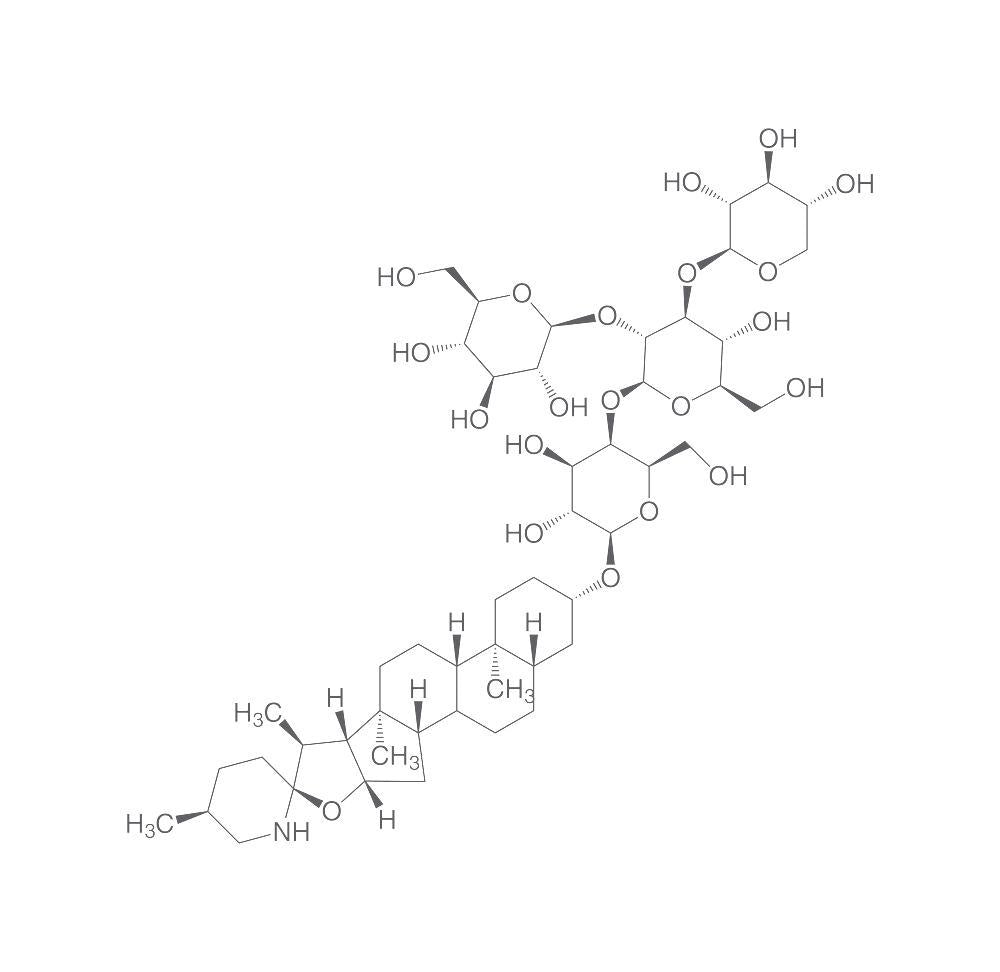
Tomatin est un matériau de référence phytochimique défini, fourni en qualité ROTICHROM® HPLC pour le travail chromatographique et analytique. Il porte le numéro CAS 17406-45-0, la formule empirique C₅₀H₈₃NO₂₁ et une masse molaire de 1034.22 g/mol, ce qui favorise une identification et une quantification exactes dans les méthodes HPLC. Le composé est proposé dans un conditionnement en verre de 25 mg, une quantité pratique pour les solutions d'étalonnage, le développement de méthodes et le contrôle qualité de routine d'analytes d'origine végétale. En tant qu'étalon de chromatographie dans la gamme des composés phytochimiques, Tomatin convient aux laboratoires qui réalisent le profilage de produits naturels, l'évaluation des impuretés et des comparaisons de référence. Le matériau du fabricant Carl ROTH est présenté sous la désignation ROTICHROM® HPLC pour indiquer l'adéquation aux flux de travail de chromatographie liquide à haute performance. Le conditionnement en verre transparent facilite l'inspection visuelle et la manipulation contrôlée de la petite portion solide. Utilisez cet étalon partout où une référence Tomatin bien caractérisée est requise pour la chimie analytique, la recherche phytochimique ou les contrôles d'adéquation du système chromatographique.
Cet article fait partie de Étalons de chromatographie (GC, HPLC, pesticides), dans Étalons analytiques & matériaux de référence.
Caractéristiques
- Numéro CAS: 17406-45-0
- Conditionnement: 25 mg verre
- N° CE: 241-429-5
- Formule brute: C₅₀H₈₃NO₂₁
- Masse molaire: 1034.22 g/mol
- Fiche technique:

- Fiche de données de sécurité:
Compliance & Safety Information
 Avertissement
Hazard Statements (H-Phrases)
Precautionary Statements (P-Phrases)
Récemment consulté
Vous aimerez peut-être aussi
Browse related categories
Category
Étalons analytiques & matériaux de référence
Sub-category
Étalons de chromatographie (GC, HPLC, pesticides)
Catalogue
Brand
Questions about Tomatin, ROTICHROM® HPLC, 25 mg, verre
What is this article?
Tomatin, ROTICHROM® HPLC, 25 mg, verre is the article on this page. Luminix Health distributes Carl Roth for laboratory use. It sits in Étalons de chromatographie (GC, HPLC, pesticides), inside Étalons analytiques & matériaux de référence, in Produits chimiques.
A chromatography standard is the substance, or the mix, injected so a peak can be named and quantified. Pesticide mixes, residual-solvent mixes and single-compound standards are different articles. The concentration and the solvent are the specification. The solvent has to be one the method may contain.
A reference material is the article against which another result is compared. Its value is stated, and the uncertainty of that value is part of the product. An ICP or ion standard is a solution of known concentration. A volumetric standard is for titration. A chromatography standard is the peak you match. The grade names, including pharmacopoeia and ASTM, say which impurities were limited. Identity is checked on PubChem. Names follow IUPAC. Medicinal grades follow the European Pharmacopoeia and USP.
Which category should I open next?
The category is Étalons analytiques & matériaux de référence. The sub-category is Étalons de chromatographie (GC, HPLC, pesticides). The catalogue is Produits chimiques.
Shelves beside this one are Étalons ICP, AAS & ions, Substances de référence & réactifs (autres), Solutions étalons volumétriques (titrage), Réactifs pour analyse (Ph. Eur., ASTM, DIN), Étalons de spectroscopie & de propriétés physiques and Indicateurs & solutions indicatrices.
What should I check before I order?
When this page shows a safety data sheet, use that manufacturer file. Hazard text does not belong in the sales description. For a pack size, a grade or a certificate that is not on the page, send a quote request or contact the team.
How does ordering and shipping work?
Luminix Health distributes this article from the heart of Europe. Articles in stock ship within 2–5 business days. Standard delivery is free from €250 excl. VAT. Cold-chain goods and dangerous goods under ADR are never included in that free delivery. The terms are in the Shipping Policy. The full brand index is on shop by brand. Who we are is on about us.
Which other categories should I open?
The seven catalogues are Labware, Lab chemicals, Lab instruments, Lab consumables, Chromatography equipment, Lab safety equipment and Life Science & Microbiology.