



Description
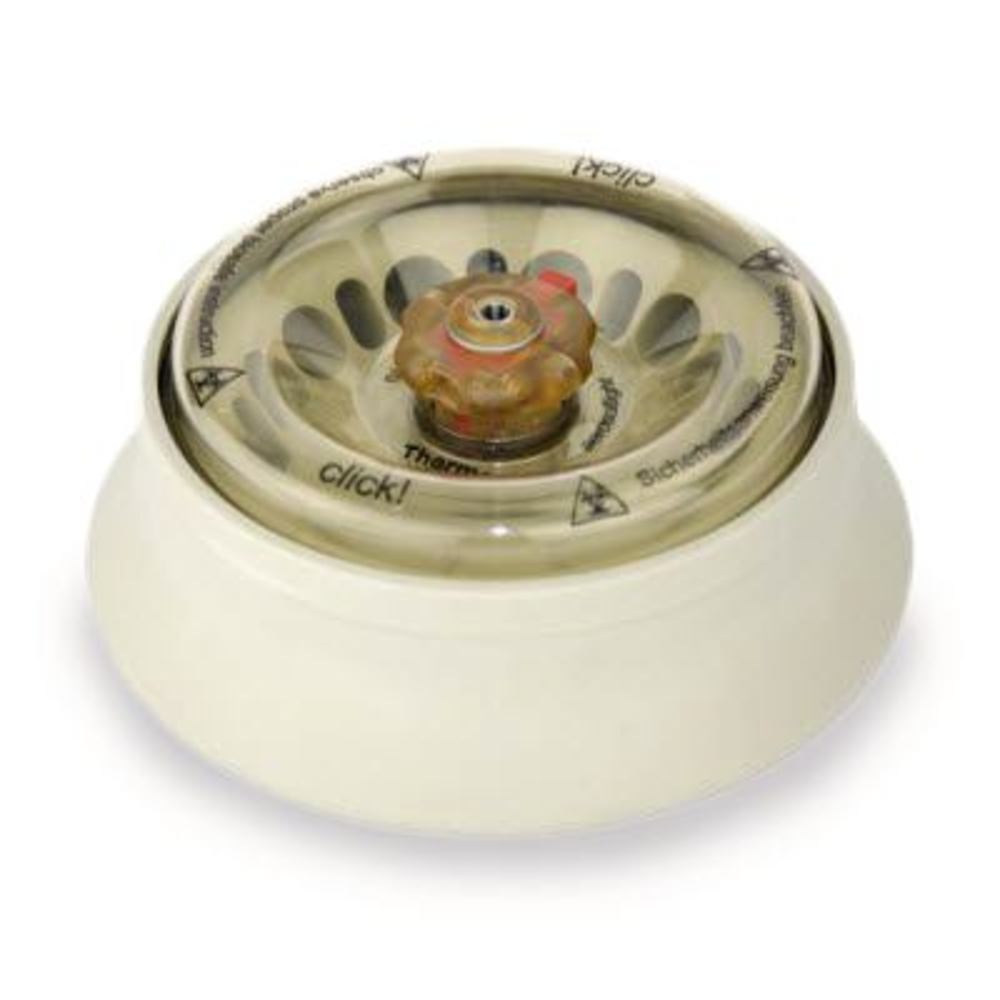
10-place microliter rotor is a laboratory centrifuge rotor configured for 5 ml reaction tubes and supplied as a single unit for microlitre centrifuge workflows. Designed for routine sample processing in molecular biology, biochemistry and clinical research laboratories, it provides dedicated positions for ten tubes so that small-volume preparations can be spun in a compact, organised layout. The rotor is fitted with an aerosol-tight ClickSeal lid that helps contain aerosols during centrifugation and supports safer handling of potentially hazardous samples. With a unit weight of 0,550 kg, the assembly remains practical to mount and exchange on compatible centrifuge systems while remaining stable in daily use. This accessory from manufacturer Thermo Scientific belongs to the microlitre centrifuge segment of laboratory appliances and is intended for labs that regularly process reaction tubes at the 5 ml scale. It integrates into standard labware setups for DNA/RNA work-up, protein assays, cell lysates and other microlitre-scale protocols where controlled spinning of multiple small tubes is required. Pack size is one piece, ready for installation on a matching centrifuge platform.
This article belongs on Rotors, in Centrifuges.
Key features
- Pack size: 1 pc(s)
- Product type: 10-place microliter rotor
- Tube compatibility: 5 ml reaction tubes
- Lid: Aerosol-tight ClickSeal lid
- Weight: 0,550 kg
- Application area: Microlitre centrifuges
Recently viewed
You may also like
Browse related categories
Category
Sub-category
Catalogue
Brand
Questions about 10-place microliter rotor, for 5 ml reaction tubes, 1 unit(s)
What is this article?
10-place microliter rotor, for 5 ml reaction tubes, 1 unit(s) is the article on this page. Luminix Health distributes THERMO SCIENTIFIC for laboratory use. It sits in Rotors, inside Centrifuges, in Lab instruments.
A centrifuge rotor is the rotating part that holds the tubes, and it is rated for a maximum speed and a maximum load. A swing-out rotor and a fixed-angle rotor pellet differently. A rotor from another centrifuge does not belong on this drive, even when it seems to fit.
A centrifuge separates by density. The rotor spins the sample and the force is reported as a multiple of gravity, not as a raw speed, because the same revolutions per minute are a different force at a different radius. A microcentrifuge takes small tubes. A benchtop or floor model takes larger rotors. The tube, the adapter and the rotor have to be the combination the manufacturer rated. An unbalanced load is how centrifuges fail. Measurement of the related quantities sits with the BIPM.
Which category should I open next?
The category is Centrifuges. The sub-category is Rotors. The catalogue is Lab instruments.
Shelves beside this one are Rotor adapters & accessories, Benchtop & floor-standing centrifuges, Microcentrifuges & mini centrifuges and Centrifuge accessories.
What should I check before I order?
The technical information on this page is the manufacturer's sheet. Read that, not a rewritten specification.
When this page shows a safety data sheet, use that manufacturer file. Hazard text does not belong in the sales description. For a pack size, a grade or a certificate that is not on the page, send a quote request or contact the team.
How does ordering and shipping work?
Luminix Health distributes this article from the heart of Europe. Articles in stock ship within 2–5 business days. Standard delivery is free from €250 excl. VAT. Cold-chain goods and dangerous goods under ADR are never included in that free delivery. The terms are in the Shipping Policy. The full brand index is on shop by brand. Who we are is on about us.
Which other categories should I open?
The seven catalogues are Labware, Lab chemicals, Lab instruments, Lab consumables, Chromatography equipment, Lab safety equipment and Life Science & Microbiology.