


Description
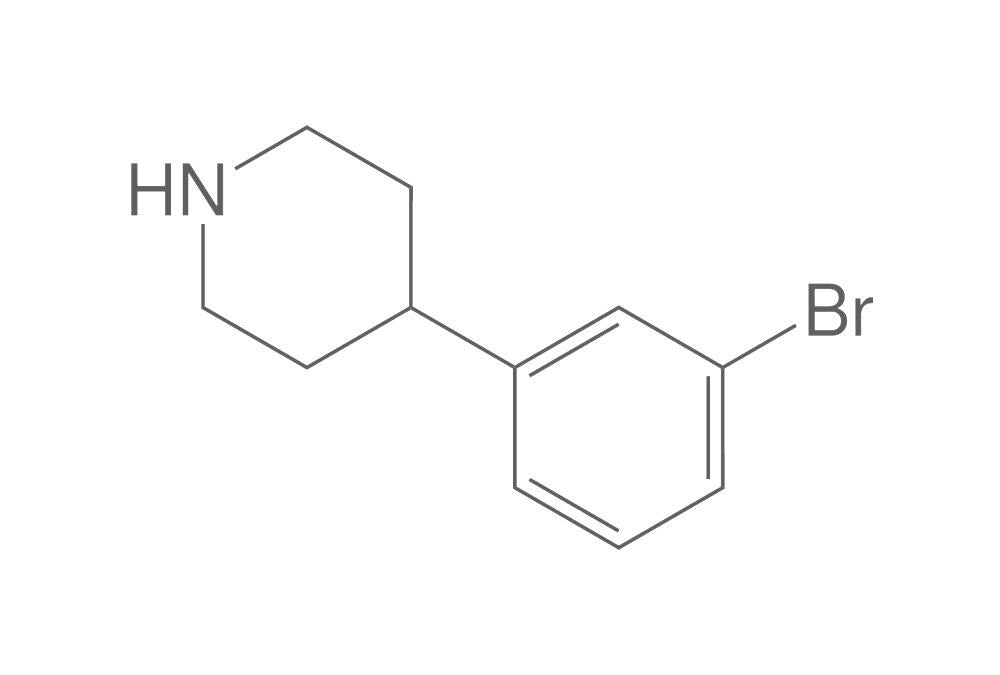
4-(3-Bromo-phenyl)-piperidine is an aryl-substituted piperidine building block offered at a minimum purity of 95 % for chemical and biochemical laboratory use. It is registered under CAS number 351534-36-6 and corresponds to the empirical formula C₁₁H₁₄BrN, with a molar mass of 240,14 g/mol. Physical data include a flash point of 139,3 °C and a boiling point of 306,6 °C, which help laboratories assess thermal behaviour during synthesis, purification, or storage planning. The product is supplied in a 1 g pack, suitable for exploratory reactions, intermediate preparation, and structure–activity studies that require a bromophenyl-piperidine motif. Available from manufacturer Carl ROTH within its chemicals and biochemicals portfolio, the material is presented with transparent identity and property information so users can align the reagent with their experimental design. CAS number, formula, molar mass, flash point, and boiling point are stated exactly as provided, supporting accurate labelling, safety assessment, and reproducible laboratory practice without additional purity or performance assertions beyond the manufacturer’s minimum 95 % specification.
This article is part of Bases & alkalis, in Acids & bases.
Key features
- Pack sizes: 100 mg, 250 mg, 500 mg
- Molar mass: 240,14 g/mol
- Technical Information Sheet:

- Safety Data Sheet:
Compliance & Safety Information
 Warning
Hazard Statements (H-Phrases)
Recently viewed
You may also like
Browse related categories
Category
Sub-category
Catalogue
Brand
Questions about 4-(3-Bromo-phenyl)-piperidine, min. 95 %, 100 mg
What is this article?
4-(3-Bromo-phenyl)-piperidine, min. 95 %, 100 mg is the article on this page. Luminix Health distributes Carl Roth for laboratory use. It sits in Bases & alkalis, inside Acids & bases, in Lab chemicals.
A base or an alkali is sodium hydroxide, potassium hydroxide, ammonia and their relatives, as solid or as solution. The carbonate that a hydroxide picks up from the air changes a titre. Concentration and purity are the specification. Concentrated alkalis attack skin and aluminium.
An acid donates a proton. A base accepts one. In the bottle, the practical differences are the concentration, the purity and the anion or cation that comes along. Concentrated mineral acids are a different article from a dilute volumetric solution. The water in the acid, and the trace metals, decide whether it can be used for analysis. Check the substance on PubChem and the classification on ECHA CLP. Transport is the UNECE dangerous-goods framework. The legal texts are the CLP Regulation and REACH.
Which category should I open next?
The category is Acids & bases. The sub-category is Bases & alkalis. The catalogue is Lab chemicals.
Shelves beside this one are Acids.
What should I check before I order?
When this page shows a safety data sheet, use that manufacturer file. Hazard text does not belong in the sales description. For a pack size, a grade or a certificate that is not on the page, send a quote request or contact the team.
How does ordering and shipping work?
Luminix Health distributes this article from the heart of Europe. Articles in stock ship within 2–5 business days. Standard delivery is free from €250 excl. VAT. Cold-chain goods and dangerous goods under ADR are never included in that free delivery. The terms are in the Shipping Policy. The full brand index is on shop by brand. Who we are is on about us.
Which other categories should I open?
The seven catalogues are Labware, Lab chemicals, Lab instruments, Lab consumables, Chromatography equipment, Lab safety equipment and Life Science & Microbiology.